

On this page
Many hot-water systems are sealed. Cold water comes in from the mains through a non-return or pressure-reducing valve, and nothing can flow back out. That is fine until the heater switches on. Warm water takes up more room than cold water, and in a sealed system the extra volume has nowhere to go. The fix is a small steel tank, an expansion vessel, with a cushion of gas inside it. This post works out how much the water grows, why the pressure would shoot up without the vessel, and how Boyle's law tells you the vessel's size.
How much does water expand when you heat it?
Use densities, not a single expansion coefficient. Water's expansion coefficient changes a lot with temperature (it is even negative below 4 °C), so the clean way is to compare densities from a table. Standard values are about 999.70 kg/m³ at 10 °C and 977.76 kg/m³ at 70 °C.
The mass of water stays the same, so the volume scales as 1/ρ:
ΔV = V(ρ_cold/ρ_hot − 1)
For a 200 L cylinder, ΔV = 200 × (999.70/977.76 − 1) = 4.49 L. That is a 2.2% increase. Maker sizing tables list similar figures: one manufacturer's guide gives about 2% for water heated from 40 °F to 160 °F (about 4 °C to 71 °C) (Amtrol Therm-X-Trol sizing guide).
If real and apparent expansion are new to you, read real and apparent expansion of liquids first. Here we only need the real expansion of the water.
What would the pressure do with no expansion vessel?
Water is hard to squeeze. Its bulk modulus K is about 2.2 × 10⁹ Pa, the value in the NCERT table. Bulk modulus links a fractional volume change to a pressure change:
Δp = K × ΔV/V
Let the water expand freely, then squeeze it back into 200 L. The pressure needed is:
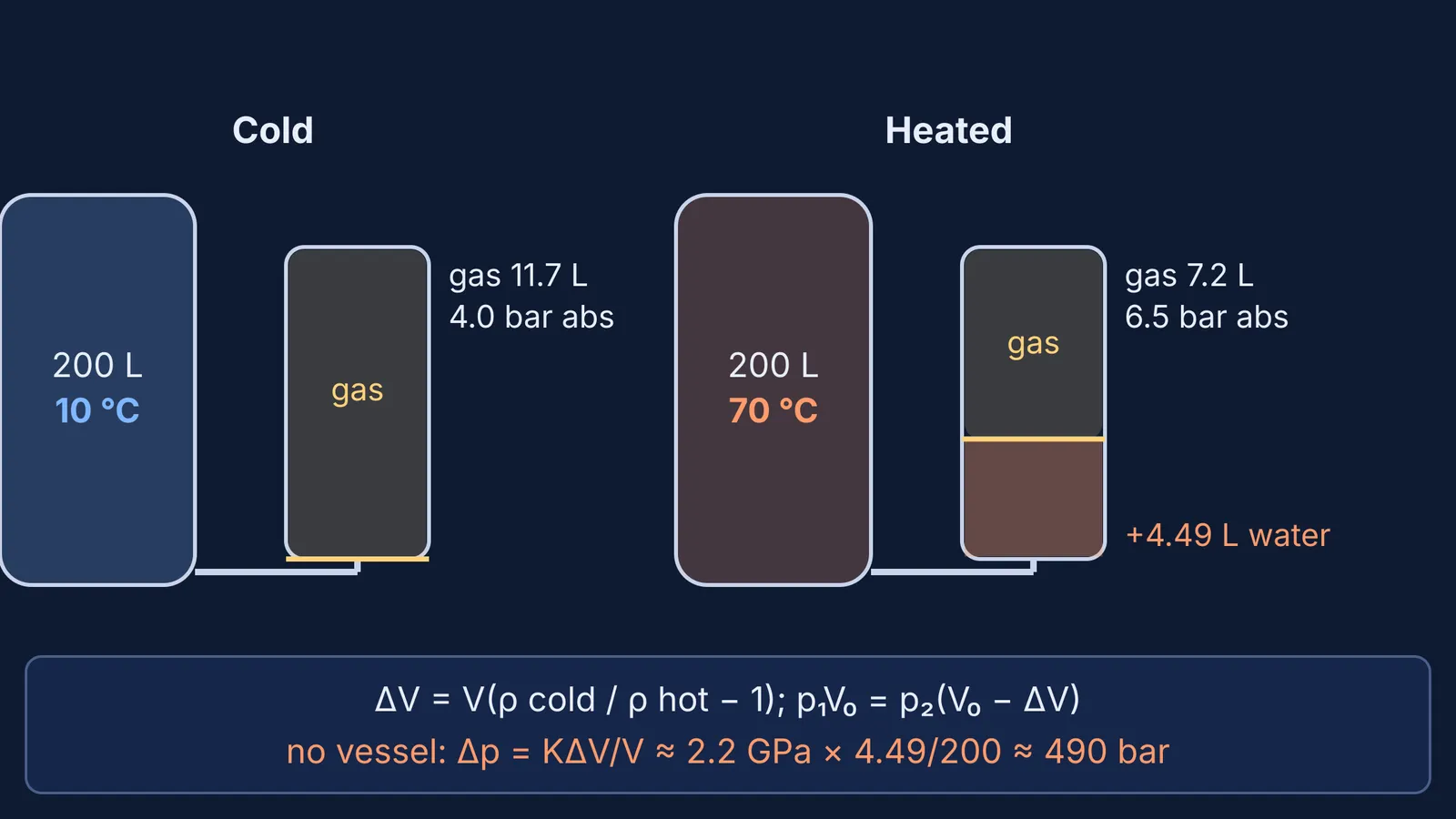
Δp = 2.2 × 10⁹ × 4.49/200 = 4.9 × 10⁷ Pa, about 490 bar.
A domestic system works at a few bar. Long before 490 bar something would give: a joint, the cylinder, or, as designed, the relief valve. The sum also ignores the small stretch of the cylinder and pipes, which takes up a little of the volume, but not enough to change the conclusion.
How does an expansion vessel absorb the extra water?
The vessel is a steel tank split by a rubber diaphragm or bag. One side connects to the water. The other side holds air or nitrogen, filled at the factory to a set pressure called the pre-charge.
When the water warms, the extra 4.49 L flows into the vessel and pushes the diaphragm into the gas. The gas compresses, its pressure rises gently, and the system pressure rises with it. When hot water is used and cold water refills the cylinder, the gas pushes the water back out.
The gas is the spring. Why a gas is so much easier to squeeze than a liquid is covered in the isothermal and adiabatic bulk modulus of a gas: at constant temperature a gas's bulk modulus equals its pressure, a few hundred kPa here, against 2.2 GPa for water.
How do you size an expansion vessel with Boyle's law?
Treat the gas as isothermal. The cylinder takes many minutes to heat, and the vessel sits on the cold feed, so the gas stays near room temperature. Then p₁V₁ = p₂V₂, with pressures in absolute units.
Worked example
Take these illustrative values. Real pre-charge and pressure limits come from the maker and the local code.
Cylinder: 200 L, heated from 10 °C to 70 °C.
Cold system pressure: 3.0 bar gauge, which is about 4.0 bar absolute (adding 1 bar for the atmosphere).
Vessel pre-charge: the same, 4.0 bar absolute, so the vessel holds no water when the system is cold.
Highest pressure you allow when hot: 5.5 bar gauge, about 6.5 bar absolute, kept below the relief valve setting.
Steps:
Expansion volume. ΔV = 200 × (999.70/977.76 − 1) = 4.49 L.
Cold state of the gas. Pressure 4.0 bar, volume V₀ (the whole vessel, since no water has entered).
Hot state of the gas. The water has taken 4.49 L, so the gas has V₀ − 4.49 L at 6.5 bar.
Boyle's law. 4.0 × V₀ = 6.5 × (V₀ − 4.49).
Solve. 2.5 V₀ = 6.5 × 4.49 = 29.2, so V₀ = 11.7 L.
Check. Hot gas volume = 11.7 − 4.49 = 7.2 L. Then 6.5 × 7.2 = 46.7 and 4.0 × 11.7 = 46.7. The two sides match.
So a vessel of about 12 L does the job.
The ratio p₂/(p₂ − p₁) = 6.5/2.5 = 2.6 is the multiplier that turns expansion volume into vessel volume. Amtrol's guide calls the same quantity the design pressure factor, written in psi as (maximum pressure + 14.7)/(maximum pressure − line pressure). The 14.7 psi is atmospheric pressure, which turns gauge into absolute, exactly as in our sum.
Why must the pre-charge match the cold water pressure?
Suppose the pre-charge is only 1.5 bar absolute but the mains pushes at 4.0 bar absolute. Before any heating, water forces its way in until the gas reaches 4.0 bar. By Boyle's law the gas shrinks from 11.7 L to 11.7 × 1.5/4.0 = 4.4 L. Only 4.4 L of gas is left, already at 4.0 bar, so taking 4.49 L of expansion would squash it to nearly nothing and the pressure would climb far past 6.5 bar. Most of the cushion has been used up before the heater even starts.
That is why makers state that the pre-charge should equal the incoming supply pressure. Setting it is a job for the installer, not the householder.
Does every hot-water system need one?
No. An open, vented system has a cold-water tank in the loft and an open vent pipe, so expanded water simply rises up the vent. The pressure stays at the head of the tank. Sealed systems, fed straight from the mains through a valve that stops backflow, are the ones that need a vessel. Closed central-heating loops need one for the same reason. The energy side of heating that water, which decides your electricity bill, is a separate question, worked in which geyser uses less electricity.
To picture how a gas trades volume for pressure, the Simulation Lab has interactive simulations for ideas that are easier to see than read.
Quick checklist
Find the expansion from densities: ΔV = V(ρ_cold/ρ_hot − 1), about 4.49 L for 200 L from 10 to 70 °C.
With no room to expand, Δp = KΔV/V, about 490 bar here, which is why sealed systems need a relief path.
Size the vessel with Boyle's law in absolute pressures: p₁V₀ = p₂(V₀ − ΔV), giving about 11.7 L.
Pre-charge equal to the cold supply pressure keeps the whole gas volume free for expansion.
Vented systems with an open vent do not need a vessel.
Relief valves and pre-charge are fitted and set by qualified plumbers.


