

On this page
Every slip below is checked against NCERT's Class 11 Biology text, Chapter 16, Excretory Products and their Elimination (NCERT chapter kebo116, Reprint 2026-27), which the NMC's NEET (UG) 2026 syllabus lists under Unit 5, Human Physiology. For the whole chapter, start with our excretion for NEET guide to the nephron, GFR and counter-current. This is a study summary, not medical advice.
Where in the nephron does each job happen?
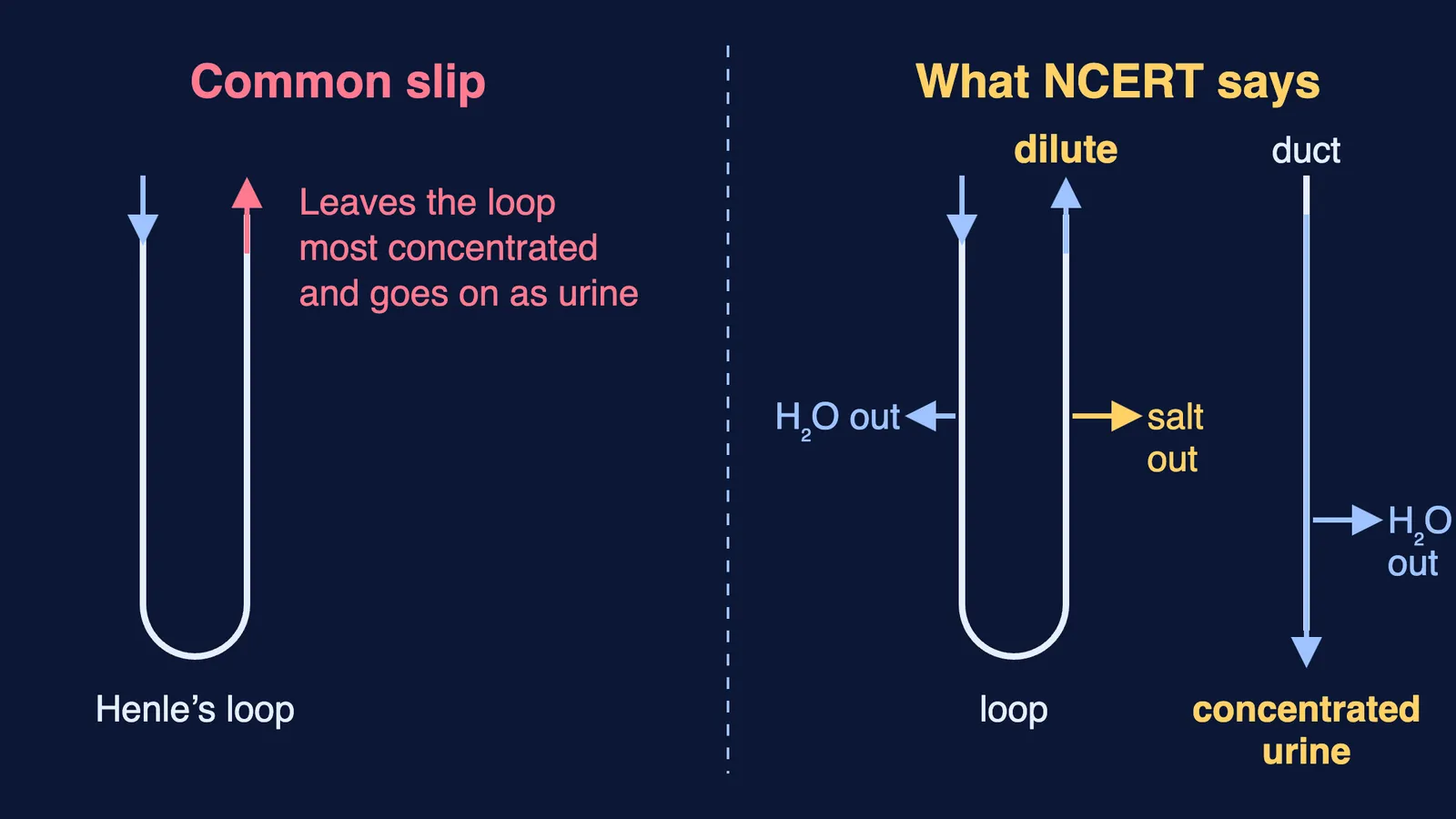
"Filtrate is at its most concentrated as it leaves Henle's loop."
Why it tempts: the loop is famous for concentrating urine, so its exit seems the place for the strongest fluid.
What NCERT says (16.3, 16.4): filtrate concentrates on the way down the descending limb, then gets diluted on the way up, because the ascending limb passes electrolytes out but keeps water in. The loop and vasa recta keep the medulla salty; urine is concentrated when water leaves the collecting tubule into that salty medulla.
Check: using NCERT's Figure 16.6, rank three samples from most to least concentrated: filtrate leaving the PCT, at the bend of the loop, just entering the DCT. (Bend, about 1200; PCT, about 300; DCT entry, about 200 mOsmol/L.)
Habit: give the loop the job of building the gradient, and the collecting duct the job of using it.
"Only the DCT secretes ions into the filtrate."
Why it tempts: secretion is often taught only with the DCT's sodium-potassium balance.
What NCERT says (16.3): its text gives secretion to the PCT (hydrogen ions and ammonia), the DCT (H+, K+ and NH3) and the collecting duct (H+ and K+). Section 16.2 ties secretion to keeping body-fluid ions and pH steady.
Check: a stem says "H+ enters the filtrate in one segment only." How many segments does NCERT's 16.3 text name for it? (Three: PCT, DCT and collecting duct.)
Habit: for each segment, keep two columns, "takes back" and "adds", and fill both.
"Most of the water the kidney reclaims is taken back under ADH."
Why it tempts: ADH is the hormone everyone links with saving water, so it gets all the credit.
What NCERT says (16.2, 16.3, 16.5): the PCT alone takes back 70-80 per cent of the filtrate's water and electrolytes, and water moves back passively in the early segments. ADH acts on the latter parts of the tubule, on what the PCT has left.
Check: at NCERT's 125 mL a minute, about how many litres of filtrate form in one hour, and how much of that has the PCT reclaimed before ADH's segments? (7.5 litres; about 5.25 to 6 litres.)
Habit: when a hormone appears in an option, ask which segment it acts on first.
Which look-alike ideas get swapped?
"The counter current runs in Henle's loop alone; the vasa recta only supplies blood."
Why it tempts: the loop gets the famous diagram; the vessel beside it looks like plumbing.
What NCERT says (16.4): blood runs opposite ways in the down and up limbs of the vasa recta too, and NaCl released by the ascending limb is exchanged with the vasa recta and handed back to the interstitium. Together these keep osmolarity climbing from 300 mOsmol/L at the cortex to roughly 1200 mOsmol/L deep in the medulla.
Check: name the two U-shaped structures in which NCERT describes opposite flows. (Henle's loop and the vasa recta.)
Habit: whenever you write "counter current", name both U-shapes.
"Renin is the hormone that narrows blood vessels."
Why it tempts: renin starts the chain that raises blood pressure, so it gets the final effect too.
What NCERT says (16.5): when glomerular blood flow, pressure or GFR falls, JG cells release renin, which converts angiotensinogen to angiotensin I and then to angiotensin II. Angiotensin II is the powerful vasoconstrictor, and it also makes the adrenal cortex release aldosterone.
Check: a line reads "JG cells release renin, a powerful vasoconstrictor that converts angiotensinogen." Which phrase is misplaced, and which molecule owns it? ("A powerful vasoconstrictor"; angiotensin II.)
Habit: give each molecule in the chain one verb: renin converts, angiotensin II constricts, aldosterone drives Na+ and water reabsorption.
"Urea in the kidney is only waste on its way out."
Why it tempts: urea is the chapter's headline waste.
What NCERT says (16.3, 16.4): NaCl and urea are the main causes of the medullary gradient. A little urea slips into the thin part of the ascending limb, and the collecting tubule returns urea to the interstitium, so urea cycles to keep the osmolarity up.
Check: apart from NaCl, which solute does NCERT name as a main builder of the medullary gradient, and which segment lets it into the medulla? (Urea; the collecting duct.)
Habit: when an option says urea is "only" excreted, look for the word medulla in the stem.
Which numbers get swapped?
"A GFR of 125 mL a minute is how much urine you make."
Why it tempts: both are volumes per unit time, and 125 is the number that sticks.
What NCERT says (16.2, 16.6): GFR, about 125 mL per minute (180 litres daily), is the filtrate the kidneys form. An adult's daily urine averages 1 to 1.5 litres, so close to 99 per cent of the filtrate goes back into the blood.
Check: at 125 mL a minute, how many minutes of filtration add up to a full day's urine of 1.5 litres? (12 minutes, since 1500 ÷ 125 = 12.)
Habit: tag every volume as blood, filtrate or urine before you use it.
"NCERT's one-fifth means one-fifth of all the blood in the body."
Why it tempts: "1/5th" and "blood" share a sentence, so the yardstick gets dropped.
What NCERT says (16.2): the kidneys filter on average 1100-1200 mL of blood per minute, which NCERT puts at roughly one-fifth of each ventricle's output per minute. The yardstick is one ventricle's output, not the body's total blood.
Check: if 1100-1200 mL a minute is one-fifth of one ventricle's output, roughly what does that ventricle pump each minute? (About 5.5 to 6 litres; NCERT implies this but never prints it.)
Habit: beside any fraction, write "of what".
What should you check in the last 60 seconds?
If the limbs still blur, redraw the table in our loop of Henle explainer on which limb lets water out.
Which of these eight slips would catch you today? Fermi's AI tutor works out what you already know and builds a plan for the session.


