On this page
Take a cube, count its corners, edges and faces, and work out V − E + F. You get 2. A triangular pyramid also gives 2. Do the same count on a doughnut-shaped surface and the answer is 0. That single number, the Euler characteristic, plus one more fact, tells every connected closed surface apart. The same count on flat graphs explains why the three houses and three utilities puzzle forces a crossing. Here it goes onto curved surfaces.
What is the Euler characteristic of a surface?
Cut a surface into vertices, edges and faces, where every face is a disc. Then its Euler characteristic is χ = V − E + F (Euler characteristic, Wikipedia). The same article calls it a topological invariant, a number that describes a space's shape regardless of the way it is bent. Euler stated the polyhedron formula in 1758, and Cauchy gave a proof in 1811, according to the same article. Why bending is allowed and tearing is not is the subject of what topology is and why a coffee mug equals a doughnut.
Why is V − E + F equal to 2 for a cube?
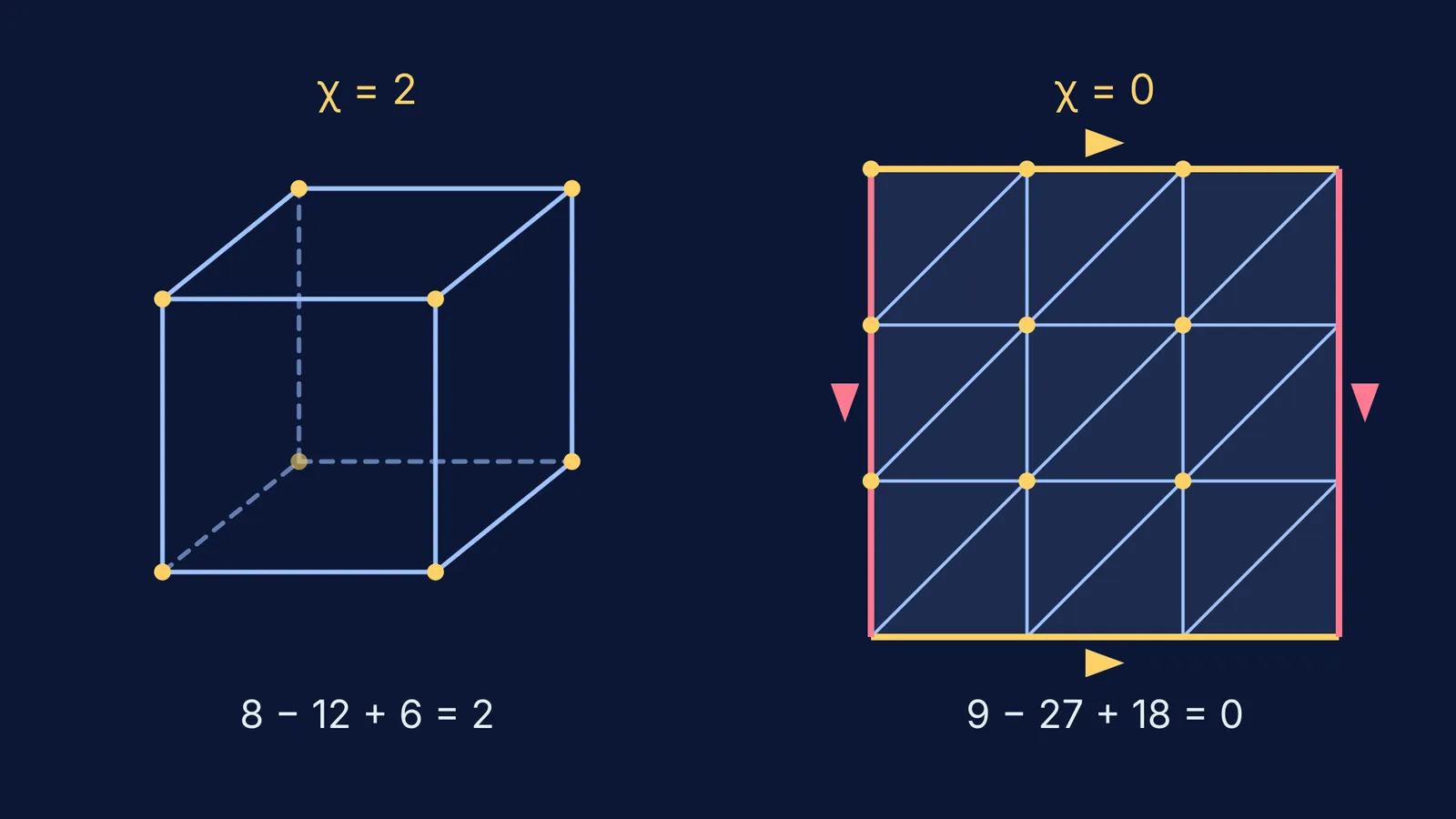
A cube has 8 vertices, 12 edges and 6 square faces, so χ = 8 − 12 + 6 = 2. A tetrahedron has 4 vertices, 6 edges and 4 faces: 4 − 6 + 4 = 2. The surface of any three-dimensional convex polyhedron has χ = 2, which is the Euler characteristic of the sphere (Wikipedia).
Inflate the cube into a ball and its 6 faces become 6 curved patches with the same corners and edges, so the answer belongs to the sphere. Two moves never change χ:
Put a new vertex in the middle of an edge. V goes up by 1 and E goes up by 1, so V − E + F does not change.
Draw a new edge across a face, splitting it in two. E goes up by 1 and F goes up by 1, so again there is no change.
Refining a drawing never changes the count. That is why χ describes the surface rather than one particular way of drawing on it.
Why is the Euler characteristic of a torus 0?
Build a torus from a rubber square: glue top to bottom to make a tube, then glue the tube's ends (the diagram above). Draw a 3 by 3 grid and cut each small square along a diagonal. Count after gluing, because border points and edges are shared.
Vertices: the grid has 4 × 4 = 16 points. The right column is glued to the left column and the bottom row to the top row, which leaves 3 × 3 = 9 different vertices.
Edges: each of the 9 vertices starts exactly one horizontal edge, one vertical edge and one diagonal edge, so E = 27.
Faces: 9 small squares, each cut into 2 triangles, so F = 18.
So χ = 9 − 27 + 18 = 0. The table on the Euler characteristic page gives 0 for the torus, and the same page gives 0 for the surfaces of toroidal polyhedra, meaning polyhedra shaped like a one-holed torus.
The Császár polyhedron, found by Ákos Császár in 1949, is a torus with 7 vertices, 21 edges and 14 triangular faces (Császár polyhedron, Wikipedia). Again 7 − 21 + 14 = 0. It has the fewest vertices possible for a toroidal polyhedron built in space (Toroidal polyhedron, Wikipedia).
Why is it 2 − 2g for a surface with g holes?
A surface with g holes (genus g) is built by joining g tori: cut a small disc out of each of two surfaces and glue the circular edges together. For this connected sum, χ(M # N) = χ(M) + χ(N) − 2 (Surface (topology), Wikipedia)). The 2 comes from the two discs you removed. The glued circle is counted only once, but a circle has as many vertices as edges, so it adds nothing.
Now apply the formula one handle at a time:
Sphere, g = 0: χ = 2.
Torus, g = 1: χ = 0.
Double torus, g = 2: 0 + 0 − 2 = −2.
Triple torus, g = 3: −2 + 0 − 2 = −4.
In general: χ = 2 − 2g, the formula MathWorld gives for a connected orientable closed surface of genus g.
How does the Euler characteristic classify closed surfaces?
The classification theorem says that every connected closed surface is a sphere, a connected sum of g tori, or a connected sum of k real projective planes (Surface (topology), Wikipedia)). The projective plane has χ = 1, so k of them give 2 − k. In that article's words, "Euler characteristic and orientability completely classify closed surfaces up to homeomorphism." Surfaces can share χ: according to MathWorld, the torus and the Klein bottle are the only compact connected closed surfaces with χ = 0. Orientability is what tells them apart.
Use these steps to identify a surface:
Check that it is closed (no boundary edge) and in one piece.
Cut it into disc-shaped faces, count V, E and F, and compute χ.
Decide whether it is orientable. If it contains a Möbius strip, it is not.
Orientable: the number of holes is g = (2 − χ) / 2. Non-orientable: the number of projective planes is k = 2 − χ.
If the step from polyhedra to surfaces feels shaky, the Fermi Concept Library gives each mathematics concept its own lesson and place in the map. For practice, the Fermi Problem Library has a step-by-step solver that explains the reasoning rather than printing an answer. Try a hexagonal prism next, then a picture frame, and check both against 2 − 2g.