

On this page
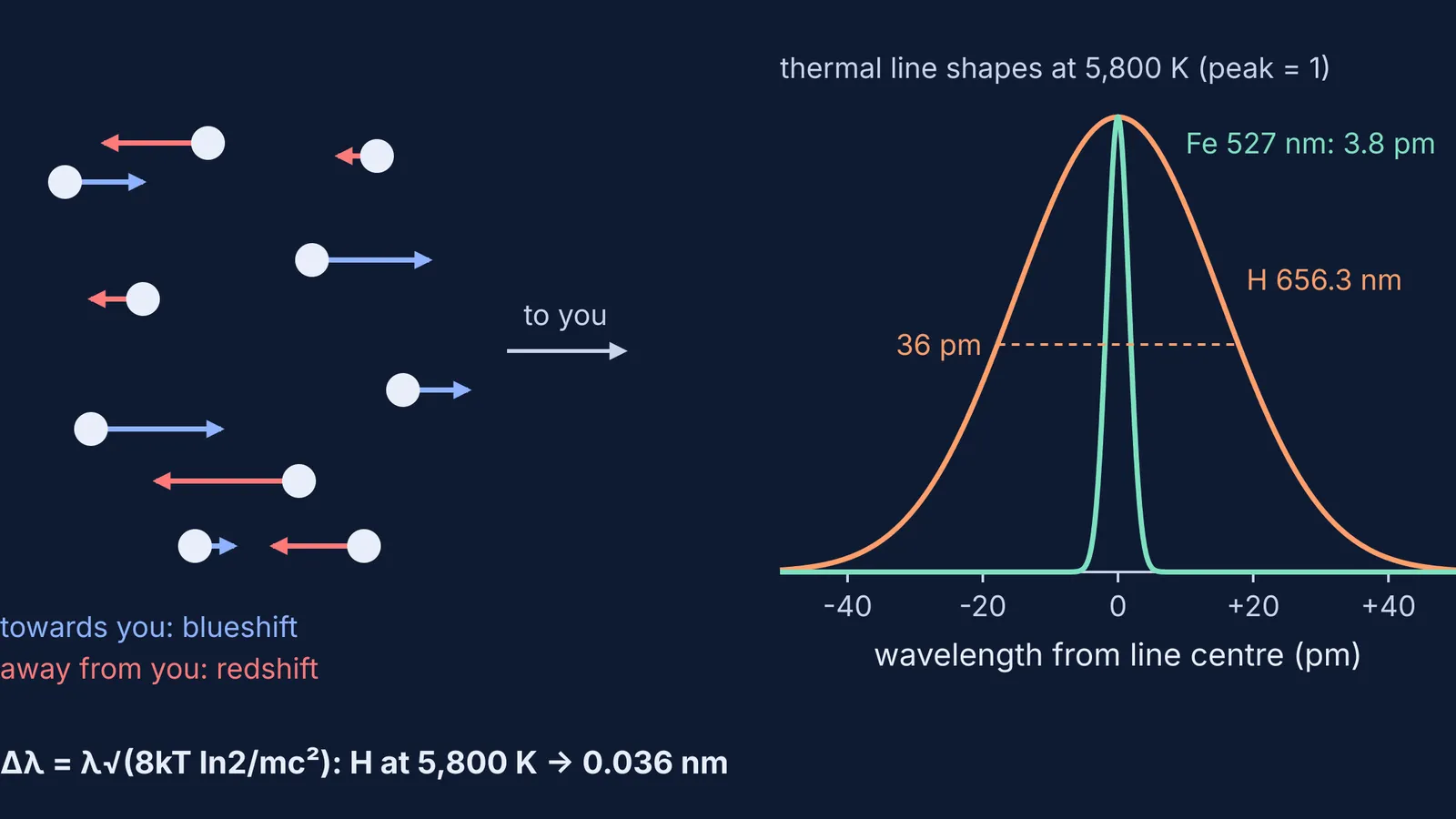
An atom at rest emits or absorbs light at sharply defined wavelengths. Hydrogen's red Hα line sits at 656.3 nm. But the atoms in a hot gas are never at rest. Some move towards you, some away, and each one's light is Doppler shifted by a tiny amount. Add up millions of atoms and the sharp line spreads into a smooth bell-shaped curve. This spreading is called thermal Doppler broadening, and its width tells you how hot the gas is. That is how astronomers take the temperature of gas they can never touch.
What is Doppler broadening of a spectral line?
For light, the Doppler shift is Δλ/λ = v/c, where v is the speed along your line of sight (positive when moving away). An atom moving away at 10 km/s shifts a 656.3 nm line by 656.3 × 10/300,000 = 0.022 nm to the red. An atom moving towards you shifts it by the same amount to the blue.
In a gas, the line-of-sight velocities follow the Maxwell distribution. Along any one direction, that distribution is a Gaussian centred on zero. So the line becomes a Gaussian too, and its full width at half maximum (FWHM) is:
Δλ = λ √(8kT ln 2 / mc²)
Here k is Boltzmann's constant, T the temperature, m the mass of one emitting atom and c the speed of light.
Two things follow straight from the formula:
Δλ ∝ √T. Hotter gas gives wider lines. Doubling the width means four times the temperature.
Δλ ∝ 1/√m. At the same temperature, heavy atoms move more slowly and give narrower lines.
The second point is the same physics as why hydrogen molecules move four times faster than oxygen: speed goes as √(T/m).
Is a broadened line the same as a shifted line?
No. A shift moves the whole line; broadening widens it about its centre.
If a whole star moves away from you at 30 km/s, every atom shares that motion, so every line shifts by the same fraction and keeps its width. Broadening comes from the spread of velocities within the gas, not from the average velocity. A hot gas that is not moving as a whole gives a wide line centred exactly at the rest wavelength.
The same idea works on a much larger scale. In a galaxy, the random motions of whole stars broaden its spectral lines, which is the basis of the method in the Faber–Jackson relation. Here we stay with atoms in a gas.
How wide is hydrogen's Hα line from gas at 5,800 K?
Question. Find the thermal Doppler width (FWHM) of the Hα line, λ = 656.3 nm, from hydrogen atoms at 5,800 K, about the temperature of the Sun's visible surface. Take m = 1.008 u = 1.674 × 10⁻²⁷ kg, k = 1.381 × 10⁻²³ J/K and c = 3.00 × 10⁸ m/s.
Most probable speed. u = √(2kT/m) = √(2 × 1.381 × 10⁻²³ × 5800 / 1.674 × 10⁻²⁷) = 9.8 km/s.
Velocity FWHM. For a line-of-sight Gaussian, FWHM in velocity = 2√(ln 2) × u = 1.665 × 9.78 = 16.3 km/s.
Fractional width. Δλ/λ = 16.3 / 300,000 = 5.4 × 10⁻⁵.
Width. Δλ = 656.3 nm × 5.43 × 10⁻⁵ = 0.036 nm.
Units check. kT/m has units J/kg = m²/s², a speed squared, so kT/mc² is dimensionless and Δλ comes out in nm.
Answer. About 0.036 nm. At 10,000 K the same line would be 0.047 nm wide, larger by √(10,000/5,800) = 1.31.
Why are iron lines about ten times narrower than hydrogen lines?
Take an iron line near 527 nm from the same 5,800 K gas, with m = 55.85 u.
Mass effect: iron is 55.4 times heavier, so its width is smaller by √55.4 = 7.4.
Wavelength effect: 527 nm is shorter than 656.3 nm, which narrows the line by another factor of 1.25.
Result: Δλ = 527 × √(8kT ln 2/mc²) = 0.0038 nm, about 9.3 times narrower than Hα.
This difference is used in real solar research. In a peer-reviewed study of the solar chromosphere, Cauzzi and colleagues compared Hα with a calcium line from atoms 40 times heavier. Because hydrogen is so light, they attributed the generally large core width of Hα to thermal broadening and used the width as a temperature indicator, while for the heavy calcium atoms other motions dominate (Cauzzi et al., Astronomy and Astrophysics, 2009).
How can a line's width give the gas's temperature?
Turn the formula round:
T = mc² (Δλ/λ)² / (8k ln 2)
Example. Hydrogen gas gives an Hα width of 0.10 nm. Then Δλ/λ = 0.10/656.3 = 1.52 × 10⁻⁴, and
T = (1.674 × 10⁻²⁷ × 9.0 × 10¹⁶ × 2.32 × 10⁻⁸) / (8 × 1.381 × 10⁻²³ × 0.693) ≈ 4.6 × 10⁴ K.
So a hydrogen line 0.10 nm wide means gas at roughly 46,000 K, if thermal motion is the only cause of broadening.
That "if" matters. Real lines are also widened by:
Collisions (pressure broadening), strongest in dense gas.
Turbulence, random flows of gas larger than single atoms.
Rotation of the whole star.
Natural width, set by the lifetime of the excited state, worked in the Pound–Rebka post.
So the 0.036 nm figure is the thermal part only. The observed solar Hα line is much wider, because it forms in the chromosphere above the surface and is affected by all of these and by the way light travels out through the gas. Do not compare the thermal width directly with an observed solar line width.
Where else does Doppler broadening matter?
In a helium–neon laser, the neon atoms in the tube move randomly too. Doppler broadening sets the range of frequencies the gas can amplify, a gain bandwidth of about 1.5 GHz. Our formula gives 1.5 GHz for neon at about 400 K, consistent with a warm discharge tube. Because that band is wider than the spacing between the laser cavity's modes, such a laser can run on a few frequencies at once.
To see how temperature changes the spread of molecular speeds, try the gas models in the Simulation Lab, interactive simulations for ideas easier to see than read.
Quick checklist
Doppler broadening comes from the spread of velocities; a shift comes from the average velocity.
FWHM: Δλ = λ√(8kT ln 2/mc²).
Width goes as √(T/m): hot and light means wide.
Hα from hydrogen at 5,800 K: about 0.036 nm; iron at 527 nm: about 0.0038 nm.
Use the line-of-sight Gaussian, not v(rms).
Real lines also have pressure, turbulence, rotation and natural widths.


