On this page
In March 1976, Sandra Faber and Robert Jackson of Lick Observatory and the University of California, Santa Cruz published a paper in The Astrophysical Journal that measured how fast stars move inside 25 galaxies (Faber and Jackson, 1976). Jackson was Faber's student, and Faber had been at Santa Cruz and Lick since 1972 (Bruce Medal profile, Sonoma State University). Their pattern, now called the Faber–Jackson relation, gave astronomers a new way to judge how far away an elliptical galaxy is.
What is the Faber–Jackson relation?
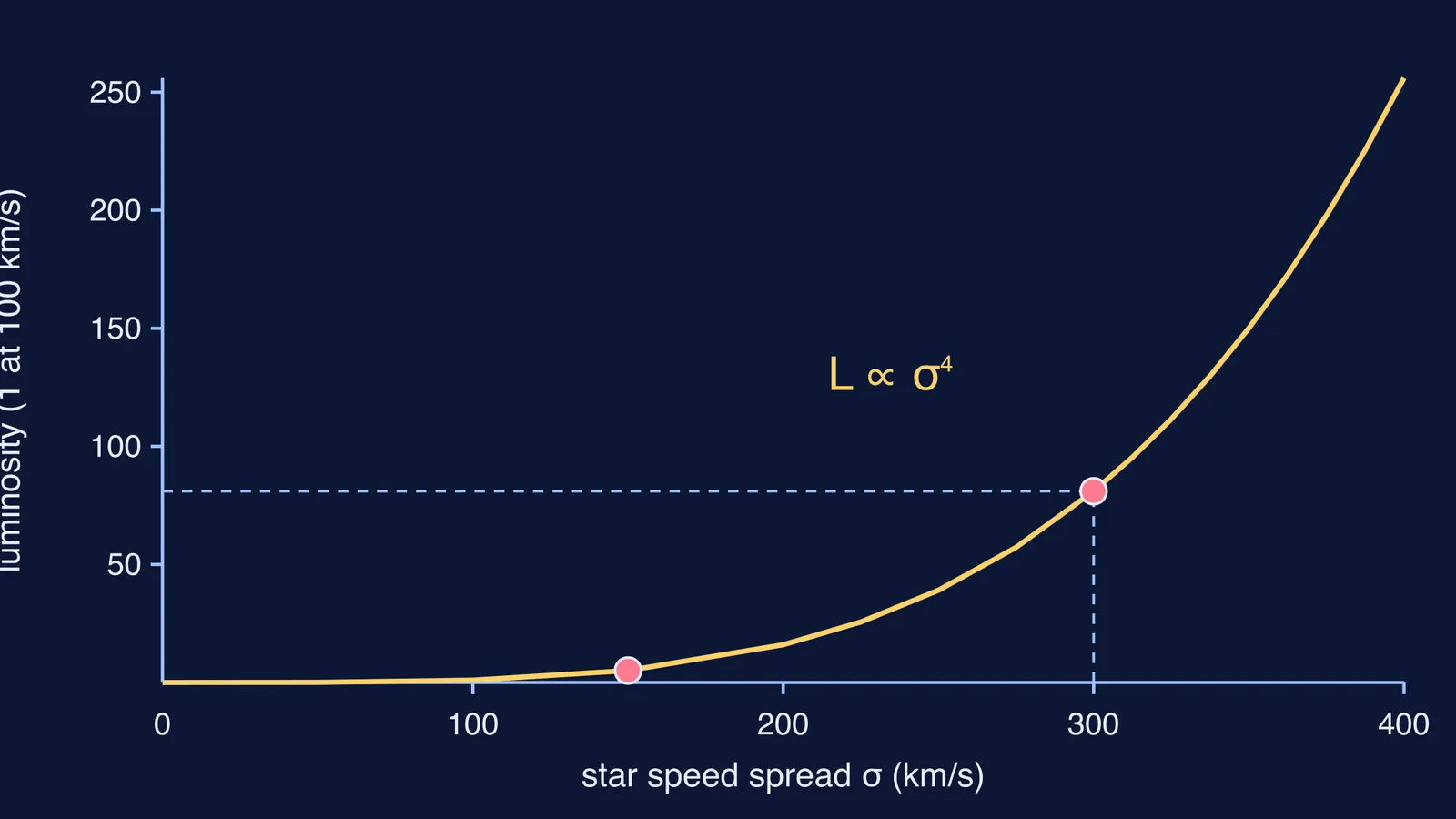
The Faber–Jackson relation is the finding that brighter elliptical galaxies have faster-moving stars, with luminosity roughly proportional to the fourth power of the stars' velocity dispersion: L ∝ σ⁴ (Jacoby et al., 1992, via NASA/IPAC NED). In the 1976 paper, a graph of star speed against galaxy brightness shows the points scattered around a straight line labelled L ∝ v⁴ (Richmond, RIT lecture notes).
Velocity dispersion, σ, is the spread of star speeds along our line of sight. Stars in an elliptical galaxy swarm in all directions, so the Doppler effect shifts some spectral lines blue and some red. Mixed together, the lines come out broader and shallower, and the broadening tells you σ (Richmond, RIT lecture notes).
The 1976 paper concluded that the ellipticals are "very nearly a one-parameter family with total mass as the most important independent variable" (Faber and Jackson, 1976).
How did Faber and Jackson measure the star speeds?
They scanned the light from the central regions of the galaxies with an electronic detector, an image-dissector scanner, on the 120-inch (3 m) telescope (Faber and Jackson, 1976). They then compared each galaxy's spectrum with a star's spectrum that had been smeared out by a series of known amounts, and picked the closest match (Richmond, RIT lecture notes).
Set against absolute magnitude, the results showed that galaxies with larger velocity dispersions tend to be more luminous.
How does the Faber–Jackson relation measure galaxy distance?
The Faber–Jackson relation turns an elliptical galaxy into a rough standard candle. The method has six steps (Richmond, RIT lecture notes):
Take a spectrum of the galaxy.
Measure σ from how broad the lines are.
Use the relation to predict the galaxy's true brightness, its absolute magnitude M.
Take an image of the galaxy.
Measure how bright it looks, its apparent magnitude m.
Use the distance modulus, m − M, to work out the distance.
Compare it with Henrietta Leavitt's period–luminosity relation for Cepheid stars.
How do you use L ∝ σ⁴ in a worked example?
Here is L ∝ σ⁴ (Jacoby et al., 1992) put to work. Galaxy A has σ = 300 km/s and galaxy B has σ = 150 km/s. Both look equally bright in your telescope. How much farther away is A?
Speed ratio: 300 ÷ 150 = 2.
Luminosity ratio: 2⁴ = 16, so A gives out about 16 times as much light.
Apparent brightness falls as 1/d². For A to look as bright as B, d_A² must be 16 times d_B².
Distance ratio: √16 = 4. Galaxy A is about four times farther away.
In magnitudes, a factor of 16 in light is 2.5 × log₁₀16 ≈ 3.0 magnitudes. Real galaxies scatter around the line, so the answer for any one galaxy is an estimate, not an exact distance.
If the inverse-square step feels slippery, the Fermi Simulation Lab has interactive simulations for ideas that are easier to see than to read.
How accurate is the Faber–Jackson relation?
Not very, for a single galaxy. A 1992 review of distance methods reported that when Tonry and Davis used the Faber–Jackson relation, the uncertainty in the distance to a single galaxy was 32% (Jacoby et al., 1992, via NASA/IPAC NED).
Faber helped improve it. She was one of seven authors of a 1987 paper titled "Spectroscopy and photometry of elliptical galaxies. I - A new distance estimator" (Dressler et al., 1987). The group added the galaxy's surface brightness as a second measurement, giving the Dn–σ relation, and the same 1992 review gives a 23% uncertainty in the relative distance to a single galaxy in their sample. Also in 1987, Djorgovski and Davis described a "fundamental plane" linking luminosity, size and σ; the Faber–Jackson relation is that plane seen from one side (Jacoby et al., 1992).
The review says the method is best suited to relative distances, which are then calibrated by other methods. Read how Wendy Freedman measured the Hubble constant, or see where ellipticals sit in Hubble's tuning fork classification of galaxies.
How can you practise this as a student?
Try these drills using L ∝ σ⁴ (Jacoby et al., 1992) and the inverse-square law:
Galaxy C has three times the σ of galaxy D. How many times more luminous should it be? (Answer: 81.)
Two galaxies have the same σ, but one looks 9 times fainter. How much farther is it? (Answer: √9 = 3.)
For more ratio problems like these, the Fermi Problem Library has worked problems with a step-by-step solver that explains the reasoning rather than printing an answer.