On this page
For decades, astronomers' answers for how fast the universe is expanding differed by nearly a factor of two (John Huchra's history). In 2001, a team co-led by the Canadian-American astronomer Wendy Freedman published a number that largely ended that argument, measured with the Hubble Space Telescope and pulsing stars called Cepheids. Here is how they did it.
What is the Hubble constant?
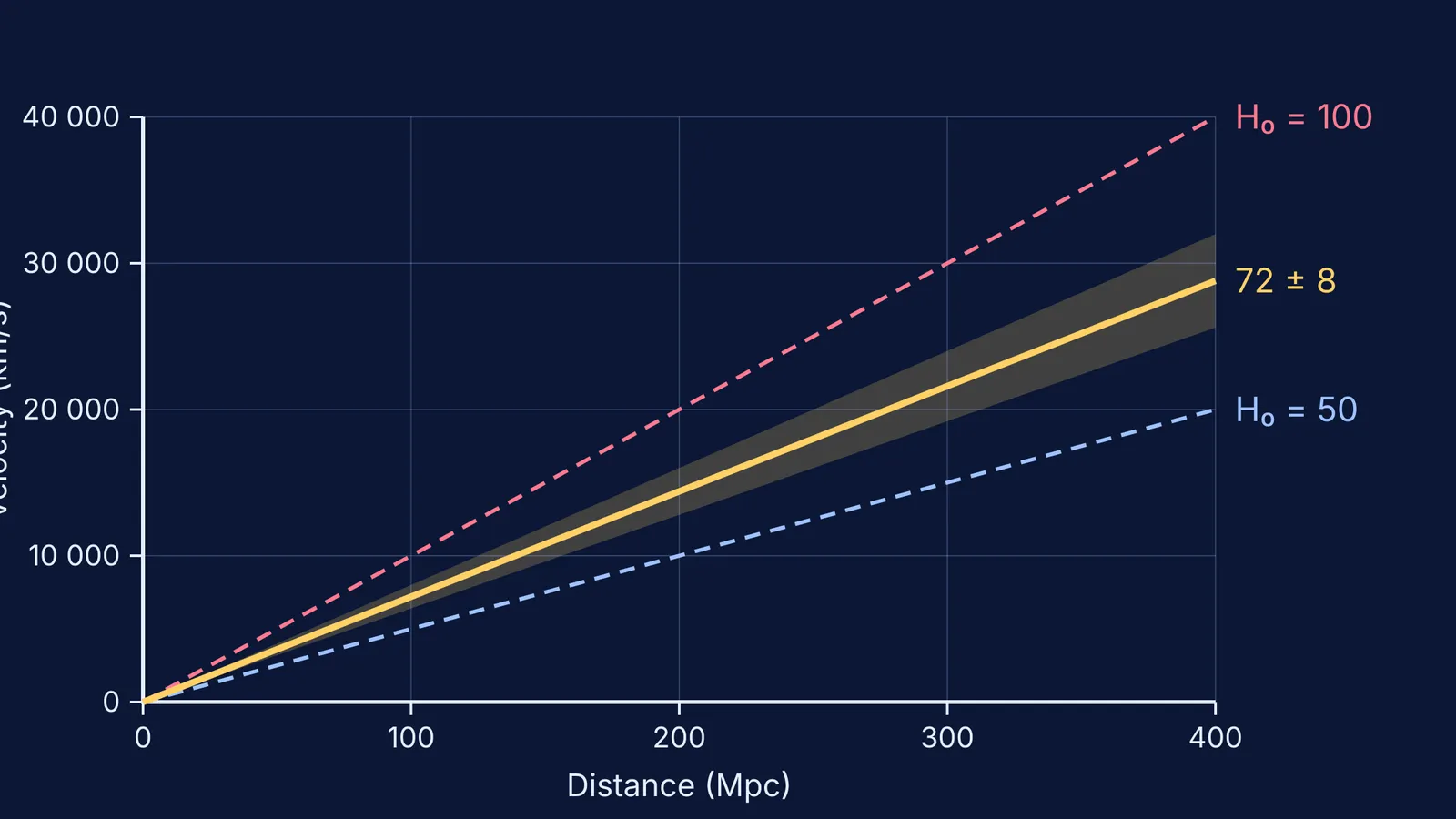
In 1929 Edwin Hubble showed that galaxies farther away from us are moving away faster, in a paper titled A relation between distance and radial velocity among extra-galactic nebulae. The Hubble constant, H0, is the slope of that relation: recession velocity divided by distance.
It is written in kilometres per second per megaparsec (km/s/Mpc). A megaparsec is a million parsecs, and one parsec is about 3.086 × 10^16 metres (parsec definition). For a refresher, see converting light-years, parsecs and AU.
It matters because the inverse of H0 sets the age and size of the observable universe, once you know its total energy density (Freedman et al., review on NED). The idea of an expanding universe itself goes back to the mathematics of Alexander Friedmann.
Why did astronomers disagree for so long?
Velocity is easy to read off a galaxy's redshift; distance is hard. According to Key Project member John Huchra's history of the Hubble constant, Hubble's own value in 1929 was 500 km/s/Mpc. By the early 1970s Allan Sandage and Gustav Tammann were getting values around 55, while Gerard de Vaucouleurs and Sidney van den Bergh kept finding values near 100. Huchra notes that the factor-of-two range was not unexpected, given how many uncertain steps each estimate used.
How did Wendy Freedman's Key Project measure it?
The method starts with Henrietta Leavitt. In 1912 she published her finding that 25 variable stars in the Small Magellanic Cloud followed a simple rule: the longer a star's pulsation period, the brighter it really is (Leavitt Law re-analysis, arXiv).
Measuring H0 to 10% accuracy was named one of the Hubble Space Telescope's three Key Projects, and the team began observing its nearest galaxies in 1991, shortly after launch (Freedman et al. on NED). Freedman co-led an international team of about 30 astronomers, having become in 1987 the first woman on the permanent staff of the Carnegie Observatories (Wikipedia biography).
The final paper, Freedman et al. 2001 in The Astrophysical Journal, used Cepheids in 18 spiral galaxies to calibrate five longer-range methods (abstract on arXiv):
Type Ia supernovae: 71 ± 2 (random) ± 6 (systematic)
Tully-Fisher relation: 71 ± 2 ± 7
Surface brightness fluctuations: 70 ± 5 ± 6
Type II supernovae: 72 ± 9 ± 7
Fundamental plane: 82 ± 6 ± 9
Together they gave H0 = 72 ± 8 km/s/Mpc. In 2009 Freedman, Robert Kennicutt and Jeremy Mould shared the Gruber Cosmology Prize for their work defining the Hubble constant.
Worked example: how old does H0 make the universe?
The Hubble time, 1/H0, is a rough age for the universe. Try it with the Key Project value, using 1 Mpc = 3.086 × 10^19 km (parsec definition).
Write H0 = 72 km/s per 3.086 × 10^19 km.
Flip it: 1/H0 = 3.086 × 10^19 / 72 = 4.29 × 10^17 seconds.
Divide by 3.156 × 10^7 seconds in a year: about 13.6 billion years.
Repeat with 50: about 19.6 billion years. With 100: about 9.8 billion years.
One camp's universe was twice as old as the other's. The real age also depends on how expansion has changed over time, so treat 1/H0 as an estimate.
Is the Hubble constant settled now?
Not quite. The early-universe method using the cosmic microwave background gives about 67.4 (University of Chicago News, 2024), while the SH0ES team's Cepheid-based value is 73.04 ± 1.04 (Riess et al. 2022, arXiv). That gap is called the Hubble tension.
Freedman, now a professor at the University of Chicago, is still at it. Her group's highest-precision estimate, from red giant stars calibrated with Hubble and James Webb Space Telescope data, is 70.39 ± 1.22 (stat) ± 1.33 (sys) km/s/Mpc (Chicago-Carnegie Hubble Program, arXiv). "Based on these new JWST data and using three independent methods, we do not find strong evidence for a Hubble tension," she told UChicago News in 2024.
What can you learn from Freedman's method?
The Key Project's habits work just as well on a JEE Main numerical or a lab report:
Check with independent methods. Solve a problem two ways, say energy and kinematics, before you trust the answer.
Split your errors. The paper lists random and systematic errors separately. Ask which errors shrink with more readings.
Check the bottom rung hardest. In a distance ladder, an error in the first step spreads upward.
The inverse-square law is easier to see than to read; the Fermi Simulation Lab has interactive simulations for ideas like this. If unit conversions trip you up, the Fermi Problem Library has worked problems with a step-by-step solver that explains the reasoning.
For more on how brightness, size and temperature connect, read how a star's luminosity depends on its radius and temperature.