

On this page
When you look at a star in the night sky, its brightness depends on distance and total power output, or luminosity. A star generates thermal energy in its core and pours it into space through its outer photosphere. To calculate how much radiant power a star emits, astrophysicists use the Stefan-Boltzmann law applied over a spherical surface.
How does a star's luminosity depend on radius and temperature?
A star's photosphere radiates thermal energy into space as an approximate black body. By the Stefan-Boltzmann law, radiant energy emitted per second from each square metre, known as energy flux F, depends on the fourth power of absolute temperature:
F = σT⁴
Here, T is effective surface temperature in Kelvin, and σ is the Stefan-Boltzmann constant, recorded as 5.670374419 × 10⁻⁸ W·m⁻²·K⁻⁴ in the NIST CODATA database.
For a spherical star of radius R, total surface area is A = 4πR². Multiplying flux by surface area gives total luminosity L in Watts:
L = 4πR²σT⁴
This law links geometric size and surface temperature. You can explore its physical origins in our guide to black-body radiation and Stefan's law. In the Fermi Concept Library, which covers every concept in physics, chemistry, biology, mathematics and computing, each with its own lesson and its place in the map, students can see where stellar radiation connects to thermodynamics and modern physics.
Why does doubling temperature change radiant power sixteen times?
In curriculum frameworks from OpenStax Astronomy, doubling a mechanical variable usually doubles or quadruples an outcome. In stellar radiation, the fourth power of temperature creates extreme sensitivity.
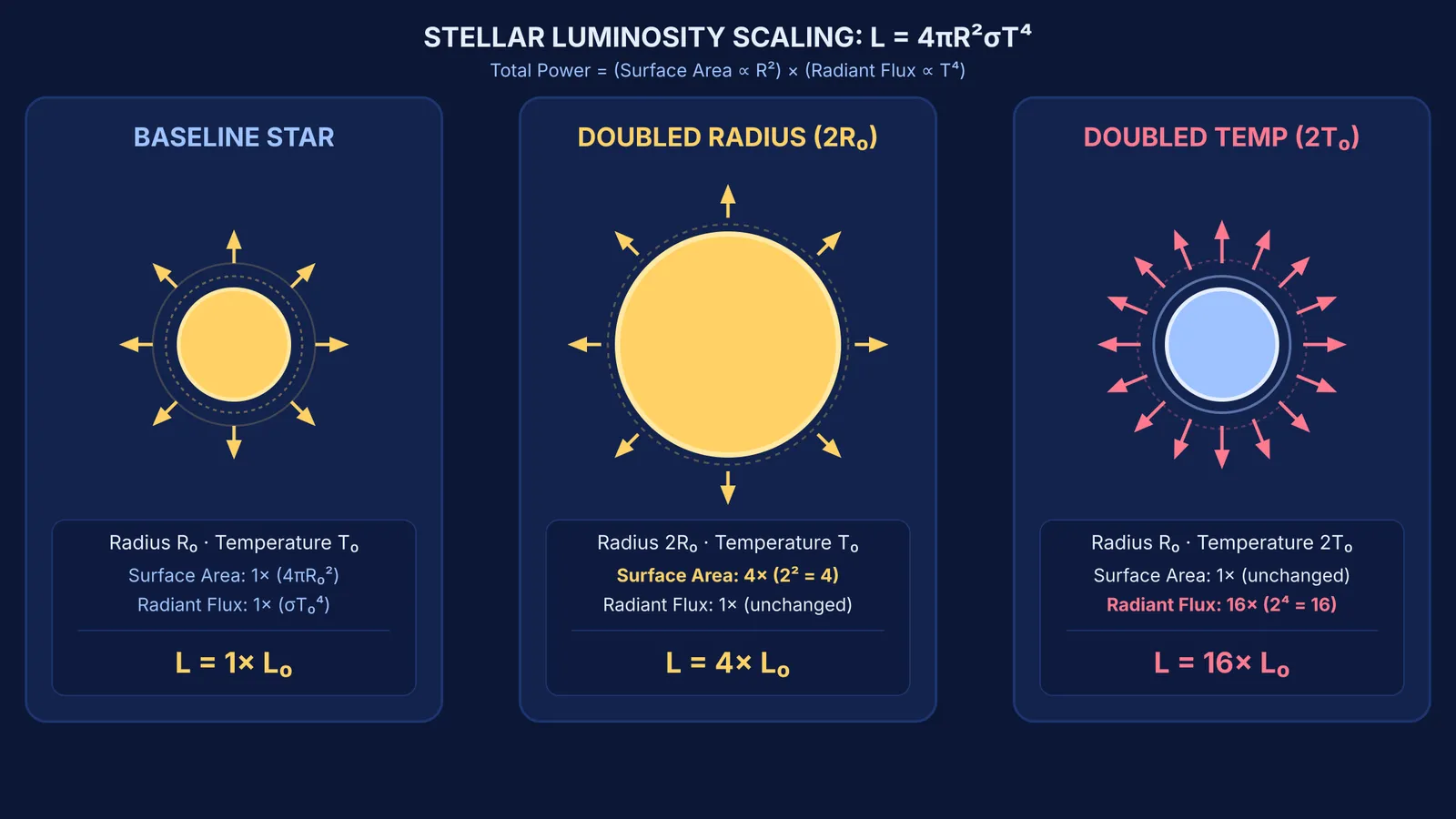
Modifying radius and temperature independently reveals why:
Doubling radius at fixed temperature: Surface area scales as (2)² = 4 times. With flux unchanged, luminosity increases fourfold.
Doubling temperature at fixed radius: Flux per unit area scales as (2)⁴ = 16 times. The star pours 16 times as much radiant power into space.
Doubling both radius and temperature: The two multipliers combine: (2)² × (2)⁴ = 4 × 16 = 64 times initial power.
This T⁴ dependence explains why small surface temperature changes cause vast luminosity differences across spectral types.
How do you compare a star's luminosity with the Sun?
Multiplying out 4π, σ, radius squared, and temperature to the fourth power is tedious and invites calculation errors. In exams like JEE Advanced and NEET-UG, as well as research, working in solar units avoids this entirely.
Dividing a star's luminosity equation by the Sun's cancels 4π and σ:
L / L_sun = (R / R_sun)² × (T / T_sun)⁴
Under IAU 2015 Resolution B3, the International Astronomical Union established exact nominal solar constants:
Nominal solar radius: R_sun = 6.957 × 10⁸ m (695,700 kilometres, in the NASA Sun Fact Sheet)
Nominal solar luminosity: L_sun = 3.828 × 10²⁶ W
Nominal solar effective temperature: T_sun = 5772 K
Working in solar units simplifies calculations to quick ratios. It also underpins the Hertzsprung-Russell diagram and brightness conversions on Norman Pogson's magnitude scale.
If you want to practice multi-step radiation problems without getting bogged down in arithmetic errors, the Fermi Problem Library provides worked problems with a step-by-step solver that explains the reasoning rather than printing an answer.
How do you find the radius of a red supergiant?
Using the solar baseline from IAU 2015 Resolution B3, suppose an astronomical survey detects a cool red supergiant star with effective temperature T = 3600 K and luminosity L = 100,000 L_sun. How large is this star relative to the Sun?
Set up the ratio equation: L / L_sun = (R / R_sun)² × (T / T_sun)⁴.
Rearrange for radius: R / R_sun = √(L / L_sun) × (T_sun / T)².
Insert solar temperature 5772 K: T_sun / T = 5772 / 3600 ≈ 1.6033.
Square the temperature ratio: (1.6033)² ≈ 2.571.
Take the square root of luminosity: √(100,000) ≈ 316.2.
Multiply the factors: R / R_sun ≈ 316.2 × 2.571 ≈ 813.
The supergiant's radius is roughly 813 times the Sun's, enough to engulf Mars and reach the asteroid belt. Simulations by Joyce et al. (2020) in The Astrophysical Journal derive a radius of 764 solar radii for Betelgeuse, confirming how enormous surface area enables cool stars to shine with intense luminosity.
Under the Stefan-Boltzmann scaling in OpenStax Astronomy, keep these mental-math rules in mind:
Temperature 1.5×: flux rises by (1.5)⁴ ≈ 5.06 times (about 5×).
Temperature 2×: flux rises by (2)⁴ = 16 times.
Temperature 3×: flux rises by (3)⁴ = 81 times.
Radius 10×: area rises by (10)² = 100 times.
Radius 0.5×: area drops to (0.5)² = 0.25 (one quarter).
For students visualizing how changing surface area and surface temperature alters the emission curves across the electromagnetic spectrum, the Fermi Simulation Lab offers interactive simulations for the ideas that are easier to see than to read.


