

On this page
When Albert Einstein published his general theory of relativity in 1915, he and most of the scientific establishment assumed the universe was static and unchanging—neither growing larger nor shrinking. To make his new field equations fit this prevailing philosophical belief, Einstein introduced a mathematical fix called the cosmological constant. This constant provided a repulsive force to exactly counterbalance the attractive pull of gravity, keeping the cosmos in a delicate, perfectly still equilibrium. But in 1922, a Russian physicist and mathematician named Alexander Friedmann took the original equations at face value without the constant and found something extraordinary.
In his 1922 paper "Über die Krümmung des Raumes" (On the Curvature of Space), Friedmann proved that a universe filled with matter would not sit still; it had to either expand or contract.
What are the Friedmann equations?
Friedmann derived two main equations that describe how a homogeneous, isotropic universe evolves over time. The first Friedmann equation is essentially an energy conservation law for the entire universe, linking its expansion rate to its density and shape. It balances the kinetic energy of the universe's expansion against the gravitational potential energy of the matter pulling it back together, with the curvature parameter acting like a total energy constant:
(da/dt / a)² = (8πGρ / 3) − (kc² / a²)
Here, a is the scale factor (how much the universe has expanded), ρ is the density of matter and energy, G is the gravitational constant, and c is the speed of light.
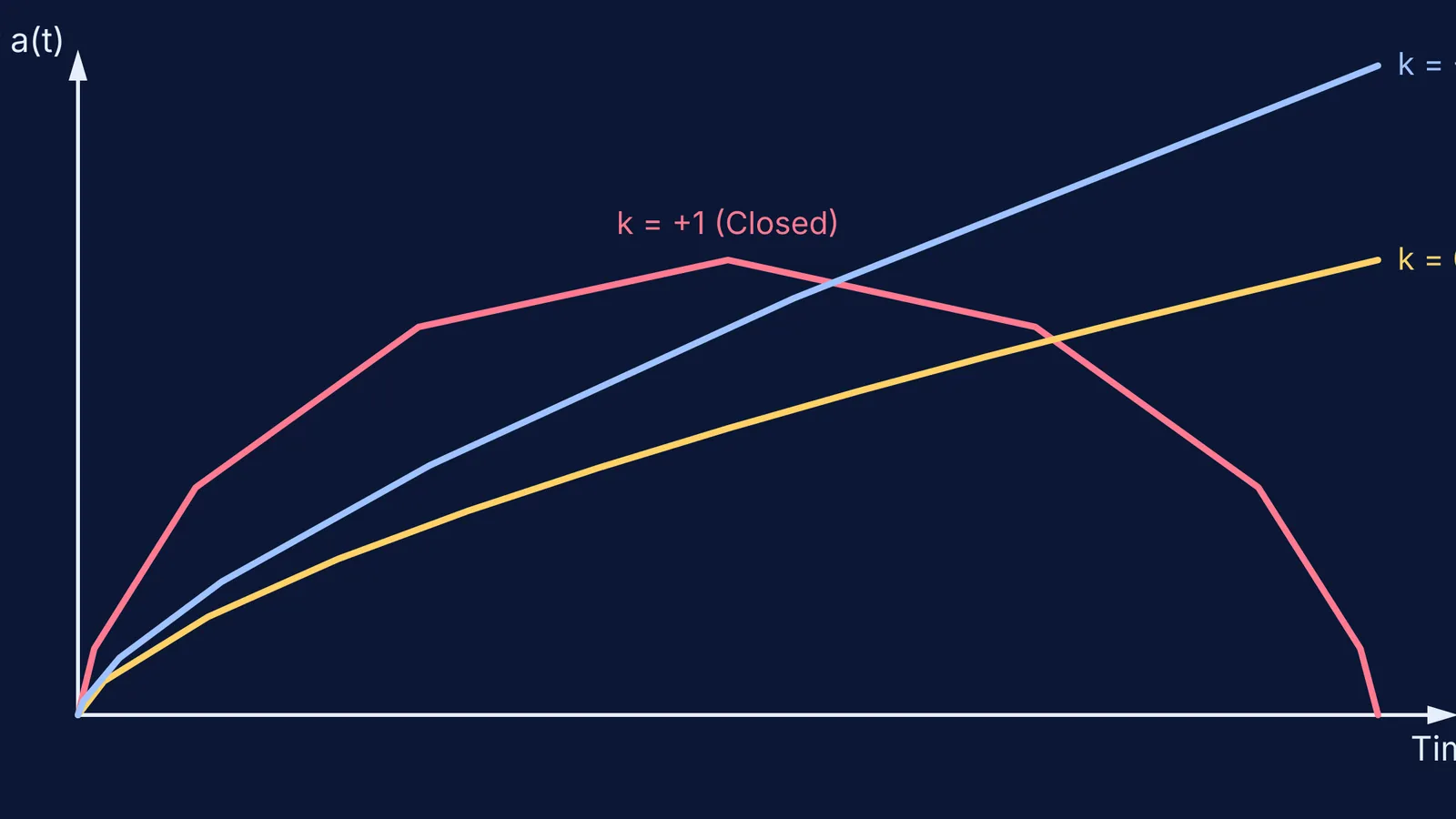
The curvature parameter k determines the shape of the universe [[source]](http://hyperphysics.phy-astr.gsu.edu/hbase/Astro/expand.html). It takes one of three values:
k = +1 (closed): The universe has positive curvature and will eventually collapse.
k = 0 (flat): The universe has zero curvature and expands forever at a slowing rate.
k = -1 (open): The universe has negative curvature and expands forever at a faster rate.
How do the equations predict an expanding universe?
To see how Friedmann's mathematics leads to an expanding universe, we can look at the simplest case: a flat universe (where k = 0) that is filled only with matter.
If we set k = 0, the equation simplifies significantly to: (da/dt)² / a² = 8πGρ / 3
As the universe expands, its physical volume increases proportionally to the cube of the scale factor, a³. Because the total amount of matter in this model remains constant, the density of matter ρ must decrease proportionally to 1/a³. As space stretches, the matter within it becomes increasingly diluted.
Substituting this inverse-cube relationship into the simplified equation shows that (da/dt)² is proportional to 1/a. Taking the square root means the rate of expansion da/dt is proportional to 1/√a. When you integrate this mathematical relationship with respect to time, you find that the scale factor a(t) is proportional to t^(2/3).
This exact mathematical result shows a universe that starts from a dense singularity at t = 0 and expands forever, though the relentless gravitational pull of its matter causes the rate of expansion to continually slow down over time.
Working through the calculus of physical systems can be daunting when you are first learning it. When you get stuck on an integration step like this one, Fermi's AI tutor can work out what you already know and build a plan for the session, guiding you through the derivation instead of just printing the final formula.
Why did Einstein reject the 1922 paper?
Einstein initially resisted Friedmann's findings. He published a brief note in the same journal claiming Friedmann had made a mathematical error, defending his own theoretical model of a static universe.
However, Friedmann wrote a respectful but detailed letter to Einstein, meticulously re-deriving his calculations to prove there was no error. In 1923, Einstein formally retracted his criticism, admitting in print that Friedmann's mathematics were flawless and that expanding solutions were indeed mathematically valid under the laws of general relativity.
Much like George Johnstone Stoney, who named the electron before its discovery, or Victor Hess and the balloon flights that found cosmic rays, Friedmann's theoretical leap preceded the observational evidence. Today, the Friedmann equations remain the absolute mathematical foundation of the standard cosmological model.


