On this page
A dinosaur trackway is a frozen record of motion. Nobody timed the animal, yet palaeontologists quote speeds for it. The method uses only two lengths you can measure on the rock, plus one idea from Class 11 dimensional analysis: animals of different sizes move alike when a dimensionless number is the same. India has such trackways too. Theropod footprints from the Early Jurassic have been described on the Thaiat ridge near Jaisalmer (Pieńkowski and colleagues, Volumina Jurassica, 2015).
What can you measure on a dinosaur trackway?
Two things, both with a tape measure.
Foot length. The length of one print, heel to the tip of the middle toe.
Stride, λ. The distance from one print to the next print of the same foot. That is two steps, left plus right.
What you cannot measure is the size of the animal. The speed rule needs its hip height h, the height of the hip joint above the ground when standing. In his 1976 paper R. McNeill Alexander estimated it as about four times the foot length, from mounted dinosaur skeletons (Alexander, Nature, 1976). A recent study that tested the method with birds notes this rule and the variations later authors have proposed (Prescott and colleagues, Biology Letters, 2025). Treat it as a rough estimate that differs between dinosaur groups.
What is Alexander's formula for dinosaur speed?
Alexander fitted data from living animals walking and running at known speeds. His rule, as quoted in the 2025 paper above, is:
v = 0.25 g^0.5 λ^1.67 h^−1.17
with v in m/s, g = 9.81 m/s², and λ and h in metres. It is an empirical fit, not a law derived from first principles, so the constants are only as good as the animals behind them.
Why does the formula hide a Froude number?
Check the dimensions before you use it. Powers of length on the right: 0.5 from g, plus 1.67 from λ, minus 1.17 from h. That adds up to exactly 1. The time part comes only from g^0.5, giving T⁻¹. So the right side has dimensions L T⁻¹, a speed, and the constant 0.25 has no units. The formula works in any unit system.
Now regroup the same expression:
v / √(gh) = 0.25 (λ/h)^1.67
The left side is the square root of the Froude number, Fr = v²/gh. The right side depends only on the relative stride λ/h. Squaring gives Fr = 0.0625 (λ/h)^3.34.
That is the real content of Alexander's rule. Two animals with the same relative stride are moving at the same Froude number, whatever their size. This is the same dynamic similarity that let William Froude predict a ship's waves from a small model, explained in how William Froude used scale models to predict ship drag. Here the "model" is a living animal and the "ship" is a dinosaur.
Why gh? A walking leg vaults the body over the planted foot like an upside-down pendulum, and gravity sets its natural speed scale √(gh). Why that gives a walking limit at Fr = 1 is worked out in why astronauts lope on the Moon, so it is not repeated here. What is new on a trackway is that you get Fr from lengths alone, without any clock.
How fast was a dinosaur with 40 cm feet and a 3.2 m stride?
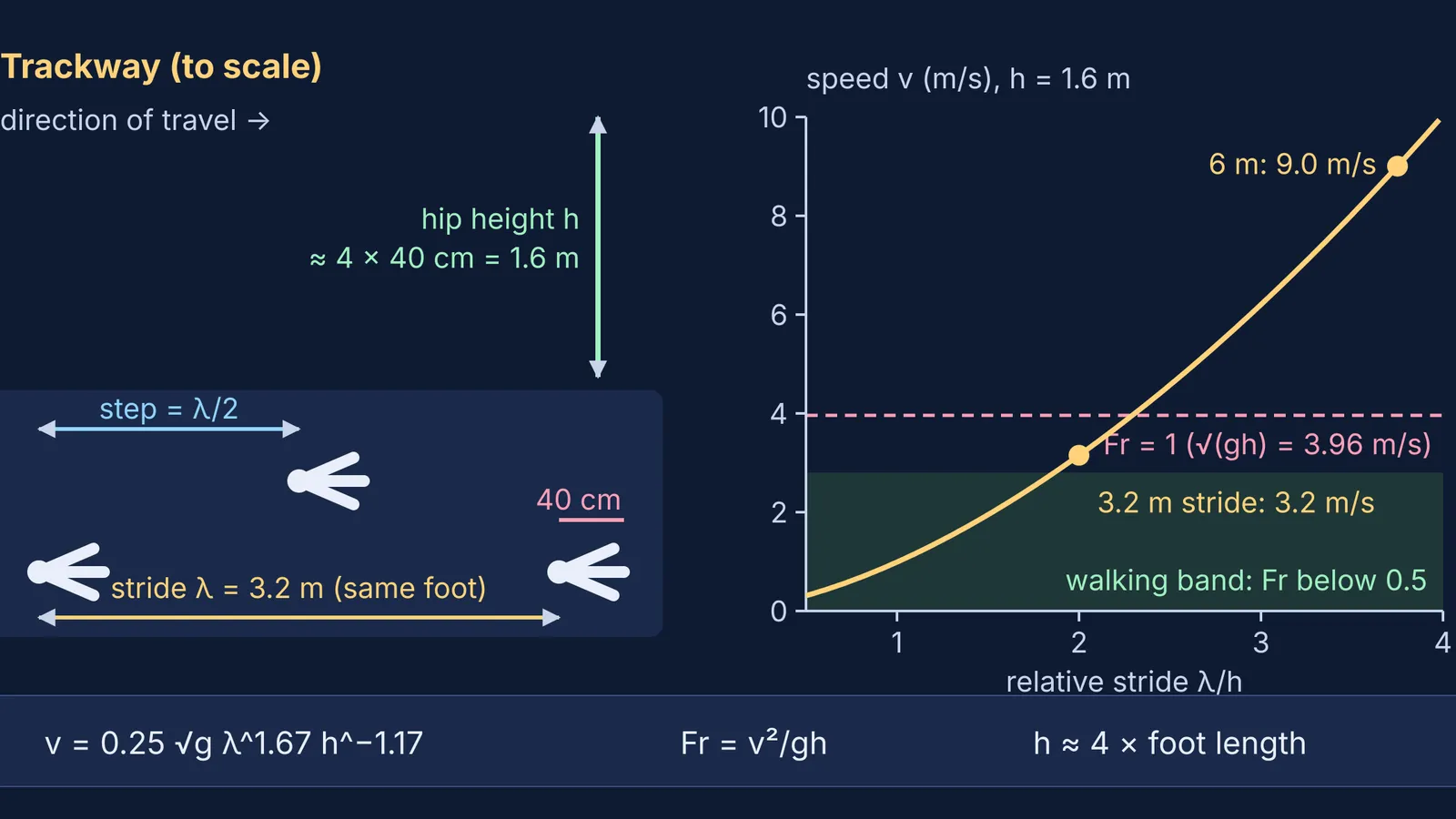
Take a trackway with prints 40 cm long and 3.2 m between prints of the same foot.
Hip height. h ≈ 4 × 0.40 m = 1.6 m.
Relative stride. λ/h = 3.2 / 1.6 = 2.0.
Raise to the power. 2.0^1.67 = 3.18, so v/√(gh) = 0.25 × 3.18 = 0.80.
Speed scale. √(gh) = √(9.81 × 1.6) = √15.7 = 3.96 m/s.
Speed. v = 0.80 × 3.96 = 3.15 m/s, about 11 km/h.
Froude number. Fr = 0.80² = 0.63. Check directly: 3.15² / (9.81 × 1.6) = 9.93 / 15.7 = 0.63.
Units check. √(m/s² × m) = m/s, and λ/h has no units, so v comes out in m/s.
With an empirical formula and a rough hip height, quote this as "about 3 m/s".
Was the dinosaur walking or running?
Compare the Froude number with what living animals do. The walking ceiling from the inverted-pendulum model is Fr = 1. People and many animals change from walking to running well below that, at around Fr = 0.5, as the astronaut post explains. At Fr = 0.63 our dinosaur was walking briskly, close to the point where a living animal would switch gait.
Now suppose the same 40 cm prints were 6.0 m apart.
λ/h = 6.0 / 1.6 = 3.75.
v/√(gh) = 0.25 × 3.75^1.67 = 2.27.
v = 2.27 × 3.96 = 9.0 m/s, about 32 km/h.
Fr = 2.27² = 5.2, five times the walking ceiling.
No walking animal can do that. A stride that long means the feet left the ground between steps: it was running.
Setting Fr = 1 in the regrouped rule gives the relative stride at the walking ceiling: (1/0.25)^(1/1.67) = 2.3. So a quick field test is that λ/h well above about 2.3 points to running.
Does the formula work on people?
Test it on yourself. Take a hip height of 0.9 m.
A walking stride of 1.6 m gives λ/h = 1.78 and v = 1.9 m/s (7 km/h, Fr = 0.43), a fast walk.
A running stride of 3.6 m gives λ/h = 4.0 and v = 7.5 m/s (27 km/h, Fr = 6.4), a good sprint.
Both are about right for an adult.
How accurate are speeds from fossil trackways?
Less accurate than the arithmetic suggests. Three things limit them.
Hip height. The four-times rule is an average, and the speed depends on h^−1.17, so a 20 percent error in h moves v by 20 to 30 percent.
The ground. Prescott and colleagues filmed birds walking and running on firm and soft mud, then applied the trackway formulas to their prints. Calculated speeds ran from 1.17 to 4.74 times the measured speeds, which they put down to animals moving unsteadily on soft ground (Biology Letters, 2025). Mud is exactly where footprints are made.
The fit itself. Exponents like 1.67 come from living mammals and birds. Dinosaur legs may not follow them exactly.
So the honest answer for our trackway is "a walk at roughly 3 m/s", not "3.15 m/s". The Froude number is the more robust result: it tells you walk or run even when the speed is uncertain.
If you want to practise turning a formula like this into dimensionless groups, the Fermi Concept Library covers dimensional analysis and dynamic similarity concept by concept. For the general method of checking an answer's units, see dimensional analysis: a 30-second check for physics answers.
Quick checklist
Stride λ is same foot to same foot, twice the step.
Hip height h ≈ 4 × foot length (rough).
Alexander's rule: v = 0.25 g^0.5 λ^1.67 h^−1.17, which is v/√(gh) = 0.25 (λ/h)^1.67.
The powers of length add to 1, so the rule is dimensionally consistent.
Fr = v²/gh: around 0.5 people switch to running, and above 1 walking is impossible.
40 cm prints, 3.2 m stride: about 3 m/s, Fr 0.63, a brisk walk.
Give trackway speeds to one or two figures.