

On this page
In the Apollo films the astronauts rarely walk the way you do. They push off, float, land and push off again. Part of the reason is circular motion. A walking leg works like an upturned pendulum, and that pendulum has a speed limit, √(gL), set by gravity and leg length. On the Moon the limit falls to about 1.2 m/s, slower than an ordinary stroll on Earth.
How is walking like an inverted pendulum?
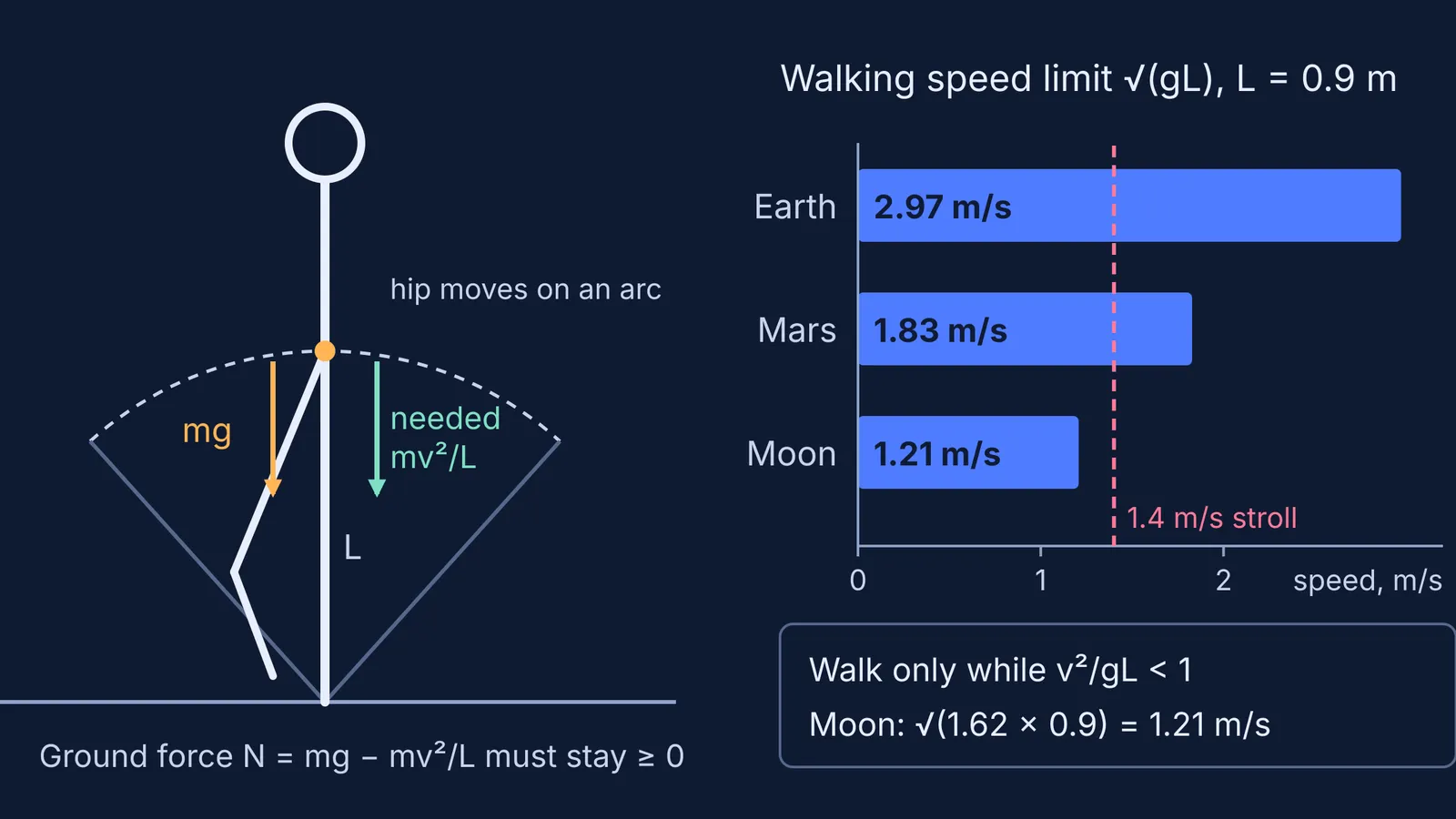
When you walk, your stance leg stays nearly straight. Your foot is planted, and your hip vaults over it like the top of an upside-down pendulum. So your hip, and roughly your whole body's centre of mass, moves along an arc of radius L, where L is your leg length (about 0.9 m for an adult).
Anything moving on an arc needs a net force towards the centre of that arc. Here the centre is the foot, which is below you. At the top of the arc, the net downward force on you must be mv²/L.
Two forces act on you at that moment: your weight mg pulling down, and the ground's push N pushing up. The ground can push but it cannot pull. Treating the leg as a stiff rod pivoting at the foot is a simplification (the inverted-pendulum model), but it captures the key limit.
What is the fastest speed anyone can walk?
At the top of the arc, Newton's second law towards the foot gives:
mg − N = mv²/L, so N = mg − mv²/L
The ground force N cannot go below zero. Setting N ≥ 0 gives:
v ≤ √(gL)
This is the same condition as a bucket swung in a vertical circle, turned upside down. For the bucket, the string must stay tight at the top, which needs v ≥ √(gr); see the minimum speed to swing a bucket of water overhead. For a walker, the ground must keep pushing, which needs v ≤ √(gL). If you go faster, gravity alone cannot bend your path round the arc, and you leave the ground. That is no longer walking.
Biologists turn this into a dimensionless number, the Froude number:
Fr = v²/gL
Walking is only possible while Fr < 1. Note that your mass cancels. A heavy spacesuit adds weight and inertia in the same ratio, so on this model it does not change the limit.
How fast can you walk on the Moon? A worked example
Take a leg length L = 0.9 m and compare three places. Use g = 9.81 m/s² for Earth, about 3.71 m/s² for Mars and about 1.62 m/s² for the Moon (NASA's planetary fact sheet rounds these to 9.8, 3.7 and 1.6).
Earth. v = √(9.81 × 0.9) = √8.83 = 2.97 m/s, or 10.7 km/h.
Mars. v = √(3.71 × 0.9) = √3.34 = 1.83 m/s, or 6.6 km/h.
Moon. v = √(1.62 × 0.9) = √1.46 = 1.21 m/s, or 4.3 km/h.
Ratio check. The Moon limit should be √(1.62/9.81) = 0.406 of Earth's, and 0.406 × 2.97 = 1.21 m/s. It matches.
A normal stroll, 1.4 m/s. On Earth, Fr = 1.4²/(9.81 × 0.9) = 0.22, comfortably walkable. On the Moon, Fr = 1.4²/(1.62 × 0.9) = 1.34, above 1.
The ground force at mid-stance for a 70 kg person. On Earth, N = 70 × (9.81 − 1.4²/0.9) = 70 × (9.81 − 2.18) = 534 N, out of a weight of 687 N. On the Moon, N = 70 × (1.62 − 2.18) = −39 N.
A negative N would mean the ground pulling you down, which it cannot do. So on the Moon an everyday Earth walking pace already throws you off the ground at the top of each step.
Units check: g × L has units (m/s²)(m) = m²/s², and its square root is m/s.
When do people switch from walking to running?
Well before the ceiling. People choose to break into a run at a Froude number of about 0.5, not 1. In an experiment by Kram, Domingo and Ferris (1997) people walked and ran on a treadmill in a simulator that reduced their effective gravity. The walk-to-run switch moved to slower absolute speeds as gravity fell, but stayed at roughly the same Froude number, close to 0.5. They took this as support for the inverted-pendulum picture.
Using Fr = 0.5 with L = 0.9 m:
Earth: v = √(0.5 × 9.81 × 0.9) = 2.10 m/s (7.6 km/h).
Moon: v = √(0.5 × 1.62 × 0.9) = 0.85 m/s (3.1 km/h).
So on the Moon you would expect a person to stop walking and start bounding at a speed most people would call a slow amble.
Did the Apollo astronauts actually hop?
Mostly they loped. NASA's Apollo Lunar Surface Journal page on gaits describes four gaits. Armstrong and Aldrin on Apollo 11 mostly walked flat-footed. Most astronauts on later missions favoured a loping gait: push off, float, land. Ed Mitchell and Gene Cernan favoured a skipping stride. The two-footed kangaroo hop was not used on level ground except in play, though Cernan and Schmitt used it going down a steep slope.
The same page gives speeds that fit the physics. Planners assumed an average of 3.6 km/h (1.0 m/s) for a walk back to the lander, which is Fr = 0.69 on the Moon, already above the 0.5 switch point. Later crews reached sustained running speeds above 5 km/h (1.39 m/s), beyond the 1.21 m/s walking ceiling, so that had to be a run.
Gravity is not the whole story. The pressurised suits resisted bending at the joints, and the backpack added mass behind the body; Armstrong noted a tendency to tip over backwards on a high jump. Researchers still debate how much of the bounding came from the suits. What the physics does say is that ordinary Earth-style walking at Earth-style speeds was not available.
Another place the Moon's 1.62 m/s² shows up is in landing, covered in the physics of Chandrayaan-3's soft landing. To see how the radial and tangential parts of acceleration change round an arc, try the Simulation Lab.
What mistakes do students make with this?
Treating √(gL) as the speed people choose. It is the ceiling; the comfortable switch happens near half that Froude number.
Putting the centre of the circle at the hip. The hip moves on the circle; the centre is the foot.
Thinking a heavier astronaut can walk faster. Mass cancels in v ≤ √(gL).
Saying astronauts cannot move fast on the Moon. They can; they run, lope or skip instead of walking.
Blaming every bound on gravity. The suits mattered too.
Quick checklist
Walking: the hip vaults over a straight leg on an arc of radius L.
At the top: mg − N = mv²/L, and N ≥ 0, so v ≤ √(gL).
L = 0.9 m: Earth 2.97 m/s, Mars 1.83 m/s, Moon 1.21 m/s.
People switch to running near Fr = v²/gL ≈ 0.5.
A 1.4 m/s stroll is Fr 0.22 on Earth but 1.34 on the Moon.
Apollo crews mostly loped or skipped; the kangaroo hop was mainly for play.


