

On this page
Swing a bucket of water over your head and nothing spills, even though the bucket is upside down at the top. The water is still falling, just as it would if you let go, but the bucket moves along the circle fast enough to fall with it. The speed this needs has a short formula, and a common exam slip is using it at the wrong point of the circle.
Why doesn't the water fall out at the top?
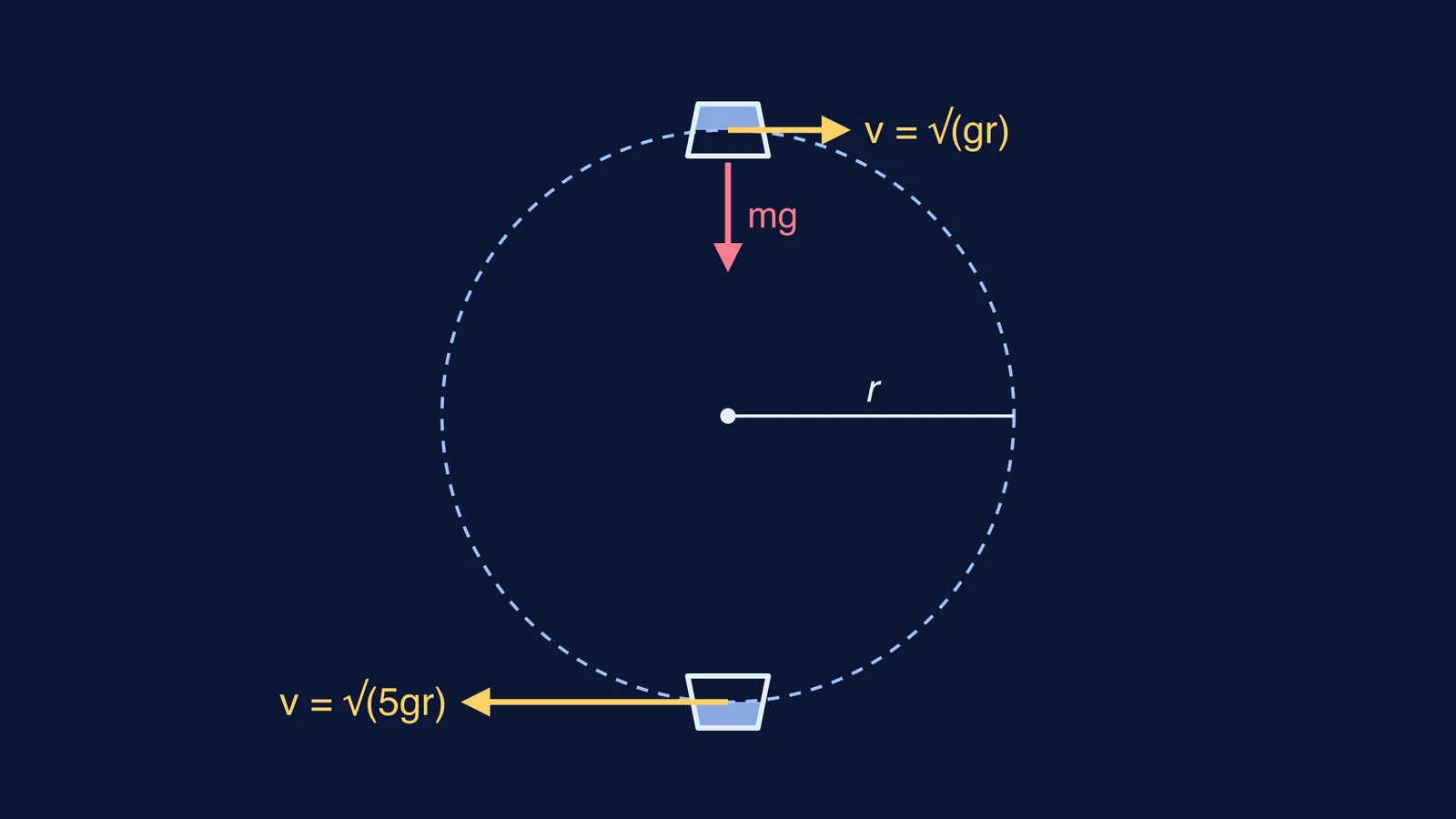
To move in a circle of radius r at speed v, the water needs a net force of mv²/r towards the centre. At the top, the centre is straight down. Two forces can supply that: the water's weight mg, and the push N from the bucket's floor, which also points down at the top.
So at the top: mg + N = mv²/r.
The floor can push on the water, but it cannot pull. N can be zero or positive, never negative. That one fact gives the whole condition.
The UC Santa Barbara lecture-demonstration notes for the twirled bucket put it in one line: the water stays in the bucket as long as v²/r ≥ g.
What is the minimum speed at the top of a vertical circle?
The minimum is the case where the floor only just touches the water, so set N = 0:
mg + 0 = mv²/r
g = v²/r
v = √(gr)
The minimum speed at the top of a vertical circle is v = √(gr), the speed at which gravity alone provides the centripetal force (LibreTexts, General Physics I: circular motion examples). The mass cancels, so a full bucket and a half-full one need the same speed.
Any slower and the water would need the floor to pull it inwards. A floor cannot do that, so the water leaves the circle and lands on you.
Worked example: how fast for a 1 m arm?
Take r = 1.0 m, measured from your shoulder to the bottom of the bucket, and g = 9.8 m/s². The standard acceleration of gravity listed by NIST is 9.80665 m/s².
Minimum speed at the top: v = √(9.8 × 1.0) = √9.8 ≈ 3.13 m/s.
One turn at that speed takes T = 2π√(r/g) ≈ 2.0 s. The LibreTexts example uses the same formula and gets 1.80 s for a 0.8 m circle.
At 4 m/s at the top, the floor pushes on 1 kg of water with N = m(v²/r − g) = 1 × (16 − 9.8) = 6.2 N. That extra speed is your safety margin.
Why is √(5gr) the wrong answer for the top?
The slip goes both ways. Asked for the minimum speed at the top, a student writes √(5gr), about 7 m/s for r = 1 m. Asked for the lowest point, they write √(gr).
The value √(5gr) is the minimum speed at the lowest point for something that then coasts to the top with no energy added, like a stone on a string (GeeksforGeeks: motion in a vertical circle). It comes from energy conservation over a rise of 2r:
u² = v² + 2g(2r) = gr + 4gr = 5gr
For r = 1 m, u = √49 = 7.0 m/s at the bottom, slowing to 3.13 m/s at the top.
Two checks keep you safe:
Read which point the question asks about. "At the top" means √(gr). "At the lowest point, to complete the circle" means √(5gr).
Ask whether energy is conserved. Your arm does work on the bucket during the swing, so a real bucket's bottom speed need not be exactly 7 m/s. The top condition does not care, because it comes from the forces at the top alone.
Put the top speed in at the bottom and the numbers warn you: starting at 3.13 m/s with nothing pushing, v² at the top would be 9.8 − 39.2, which is negative, so the bucket never gets there. The same energy step gives the 6mg tension difference between the top and bottom of a vertical circle.
Does it matter that your arm is stiff?
A string can only pull, so for a stone on a string, √(gr) at the top is the limit. A rigid rod can also push, which is why a rod needs less speed than a string in a vertical circle. Your arm is more like the rod.
But the water is not attached to your arm. It touches only the bucket floor, which can only push. So the water follows the string rule, √(gr), however stiff your arm is. Below that speed it peels away partway up, like a string that goes slack; see the angle at which the string goes slack in a vertical circle.
A four-step method for any vertical-circle question
Draw the forces at the point the question asks about, taking towards the centre as positive.
Write net inward force = mv²/r.
For the "minimum" case, set the contact force (tension or normal force) to zero.
Only then use energy conservation to move between the top and the bottom.
If you keep landing on √(5gr) where √(gr) belongs, the Fermi Problem Library has worked problems with a step-by-step solver that explains the reasoning rather than printing an answer, so you can see which step went wrong.


