

On this page
In a workshop you will often see a chain block hanging from a beam: one person pulls a loop of chain hand over hand, and a heavy motor rises slowly. The oldest design, the differential pulley, does it with two chain wheels of almost the same size. That small difference is the whole trick.
Block-and-tackle systems are covered in how to predict the mechanical advantage of a pulley system.
How does a differential pulley work?
A differential pulley has three parts:
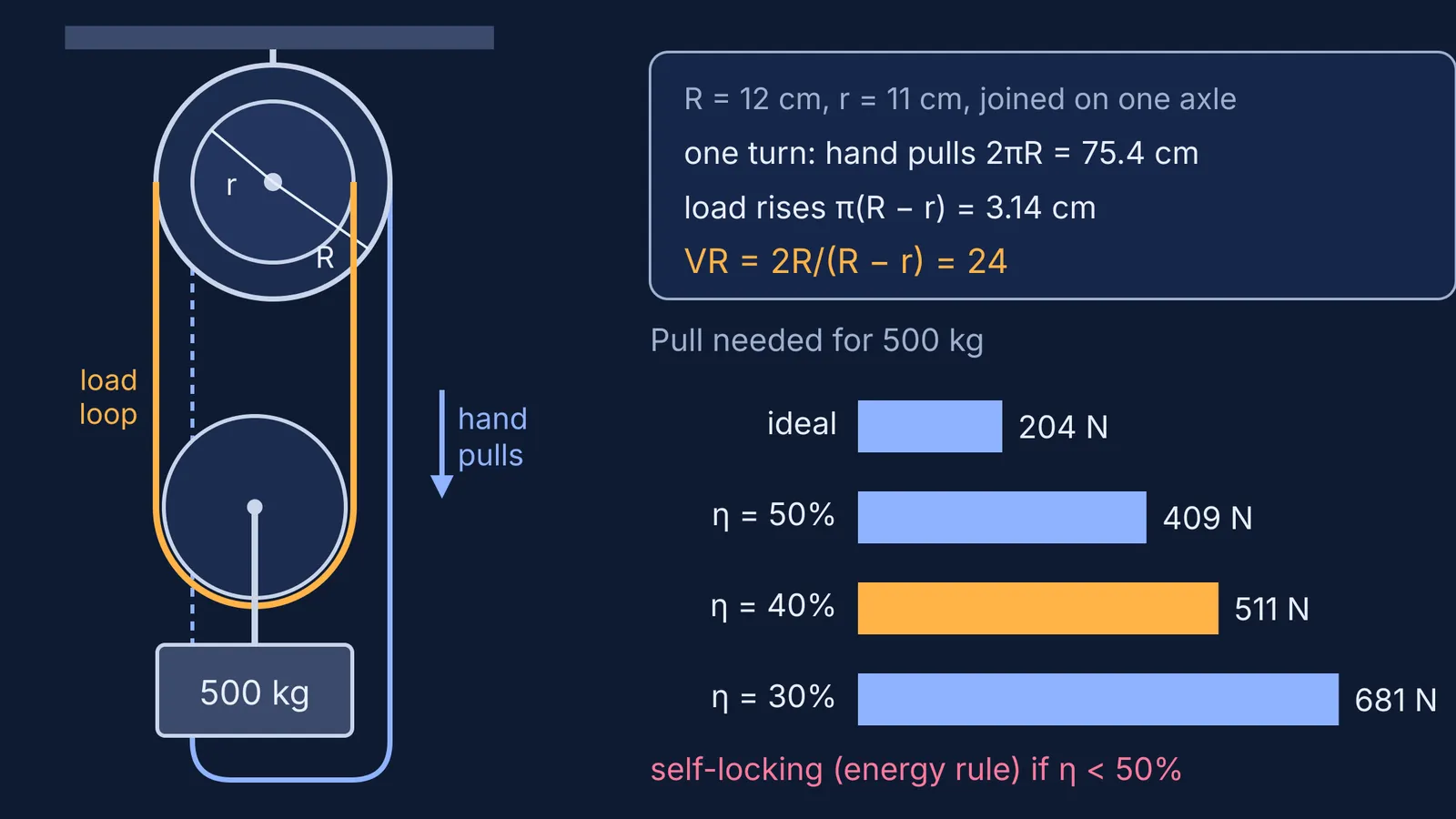
Two chain wheels joined together on one axle in the top block: a larger one of radius R and a smaller one of radius r. They turn as one piece.
A single movable pulley below, which carries the hook and the load.
One endless chain. It leaves the large wheel, goes down round the movable pulley, and comes back up to the small wheel. The rest of the chain hangs as a slack loop that you pull by hand.
Pockets in the wheels grip the chain links, so it cannot slip. When you pull the hand chain down on the large wheel, both wheels turn. On the load side, the large wheel winds chain up while the small wheel lets chain down. Because the large wheel winds up a little more than the small wheel lets down, the loop holding the load gets a little shorter, and the load rises a little.
How do you find the velocity ratio of a differential pulley?
Follow one full turn of the top wheels.
Your hand moves 2πR, the circumference of the large wheel.
The large wheel takes in 2πR of chain from the load loop.
The small wheel gives back 2πr of chain to the load loop.
The load loop shortens by 2πR − 2πr = 2π(R − r).
The load rises by half of that, π(R − r), because the loop has two strands and the movable pulley sits in the middle of it.
So the velocity ratio (distance moved by your hand ÷ distance moved by the load) is
VR = 2πR ÷ π(R − r) = 2R/(R − r).
You can check this with torques instead. Each strand of the load loop carries W/2. Take moments about the axle, with your pull F acting at radius R: F × R + (W/2) × r = (W/2) × R. That gives F = W(R − r)/(2R), so the ideal mechanical advantage W/F is also 2R/(R − r). The two methods agree, as they must for a frictionless machine.
The closer R and r are, the larger the velocity ratio, and the more chain you pull per centimetre of lift.
Worked example: lifting 500 kg with wheels of 12 cm and 11 cm
Take R = 12 cm, r = 11 cm, a load of 500 kg and g = 9.81 m/s². These are illustrative numbers.
Step 1: velocity ratio. VR = 2 × 12/(12 − 11) = 24.
Step 2: per turn. Your hand pulls 2π × 12 = 75.4 cm of chain. The load rises π × 1 = 3.14 cm. 75.4/3.14 = 24, as expected.
Step 3: ideal pull. Weight = 500 × 9.81 = 4905 N. Ideal pull = 4905/24 = 204 N.
Step 4: real pull. Efficiency η = (work out)/(work in) = W/(F × VR), so F = W/(VR × η).
At η = 50%: F = 409 N.
At η = 40%: F = 511 N.
At η = 30%: F = 681 N.
Step 5: energy for a 1 m lift at 40%. You pull 24 m of chain with 511 N, which is 12.3 kJ. The load gains 4905 × 1 = 4.9 kJ. The other 7.4 kJ goes into friction in the chain pockets and the bearings, as heat.
The work in is always more than the work out. That is the subject of why a machine's efficiency is always less than 100%.
Why does a differential pulley hold the load when you let go?
The textbook argument uses energy. Suppose you lift a load of weight W through a height h. You put in work W h/η. The load gains W h, so friction takes W h/η − W h = W h(1/η − 1).
Now let go. For the load to run back down by h, the falling load must supply the friction work for that motion. Take the friction work to be about the same in reverse. The load can supply only W h, so it runs back only if W h > W h(1/η − 1), which simplifies to η > 50%.
So a machine with efficiency below 50% holds its load by friction alone. This is called self-locking. A differential pulley, with η of about 30 to 40%, is self-locking, which is why it stays put when you let go of the chain. The same idea, applied to a screw thread, is in screw jack physics and why it holds a car.
What efficiency do real chain hoists have?
Makers have published these numbers for a long time. An old Yale & Towne chain-block catalogue, scanned by the University of Chicago Library, gives its Weston differential block an efficiency of 31%, quoting tests by Prof. R. H. Thurston of Cornell University. It lists other makers' blocks between about 19% and 32%, and it says that all of them except its geared Triplex block hold the load because of their low efficiency. So the 40% used in the worked example is on the generous side for a real differential pulley; at 31%, lifting 500 kg with VR = 24 would need about 659 N.
Most chain hoists sold today are not differential pulleys. They use gears, which waste less energy. The Crosby Group's hand chain hoist catalogue page lists, for its Accolift hoists, the hand pull to lift full load and the hand chain overhaul ratio (metres of hand chain per metre of lift). Its 0.907 tonne hoist needs a 33 kg pull with a 40:1 ratio. Ideal pull would be 907/40 = 22.7 kg, so the efficiency is 907/(33 × 40) = about 69%. The 1.814 tonne hoist (34 kg pull, 78:1) works out at about 68%.
Those hoists are above 50%, so the energy rule says they would run back on their own. That is why the same page lists a Weston-type multiple disc load brake, which holds the load in any position. Low efficiency and self-locking, or high efficiency and a brake: hoist makers choose one or the other.
If you want more machines problems where you have to find VR, MA and efficiency in the right order, the Fermi Problem Library has a step-by-step solver that explains the reasoning at each stage.
Quick checklist
One turn: hand moves 2πR, load loop shortens 2π(R − r), load rises π(R − r).
VR = 2R/(R − r); R = 12 cm, r = 11 cm gives 24.
Pull F = W/(VR × η): 204 N ideal, 511 N at 40% for 500 kg.
Work in is always more than work out; the difference is friction heat.
η below 50% means self-locking in the simple energy argument.
Geared hoists run near 70% and need a load brake.


