

On this page
If you have heard someone say "we came from monkeys", you have heard one of the most common mix-ups in biology. The accurate version is simpler: humans did not evolve from any animal alive today. We share ancestors with them, the way you share grandparents with your cousins.
Did humans evolve from monkeys or apes?
Not in the way the question means. The Smithsonian's introduction to human evolution describes it as the process by which people originated from apelike ancestors. That ancestor was not a chimpanzee, and it was not a monkey you could see in a zoo today.
Humans, chimpanzees (including bonobos) and gorillas share a common ancestor that lived between 8 and 6 million years ago, according to the Smithsonian Human Origins Program. After that population split, one branch led, through many extinct species, to us; another led to chimpanzees and bonobos. Both have been evolving for the same length of time.
The DNA tells the same story. In 2005 the Chimpanzee Sequencing and Analysis Consortium published the first draft sequence of the chimpanzee genome in Nature. The release from the US National Human Genome Research Institute on that paper said the DNA that can be directly compared between the two genomes is almost 99 percent identical, and that humans and chimps still share 96 percent of their sequence once insertions and deletions are counted. That is what close cousins look like.
What does the primate family tree look like?
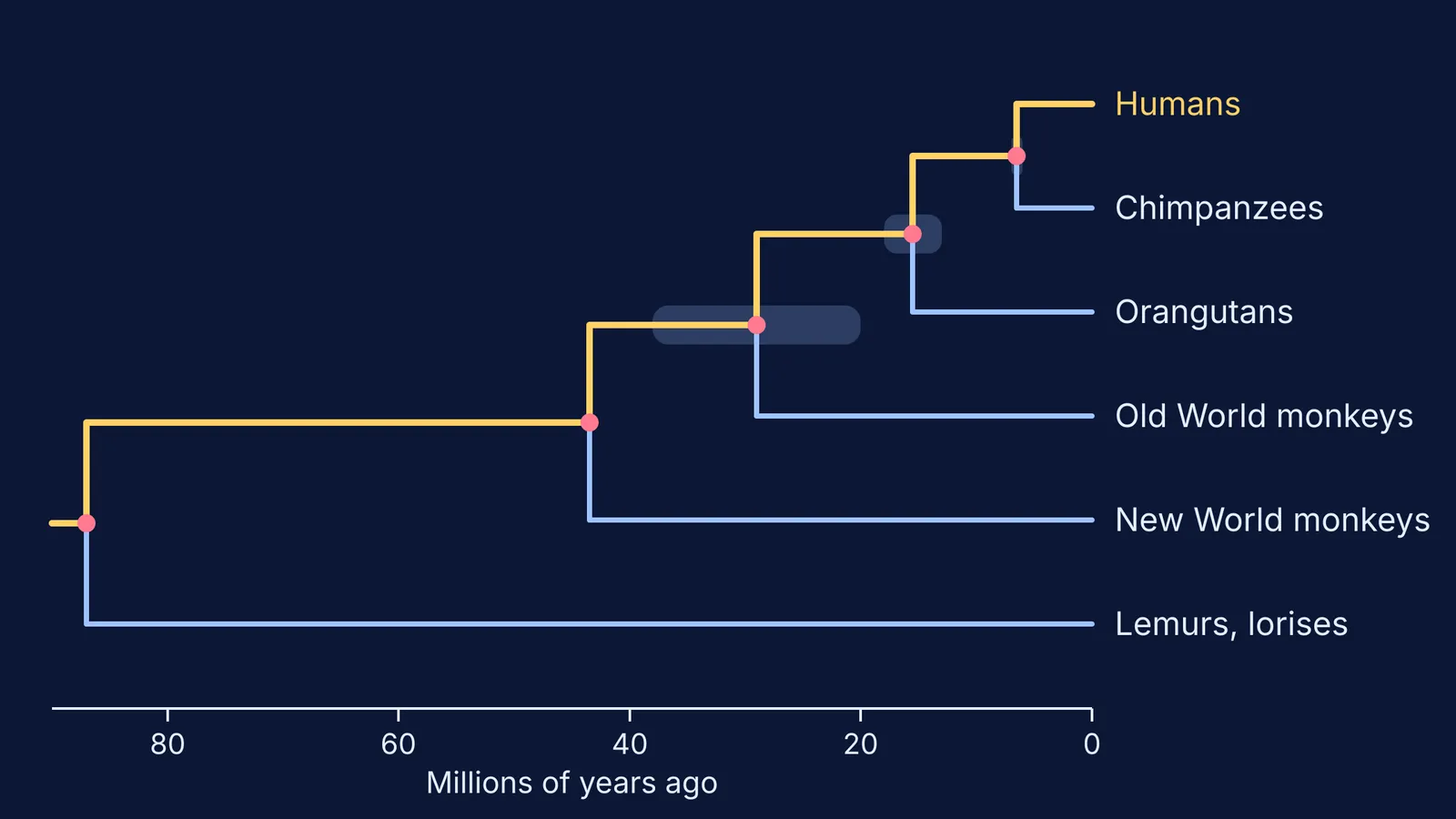
The simplified tree below draws on a 2011 study in PLOS Genetics by Polina Perelman and colleagues, which sequenced 54 nuclear genes from 186 primates (Perelman et al., 2011). The first two dates are the study's own DNA-based estimates; the last three are the fossil-date ranges the authors used to anchor their timeline. Read it from the oldest split to the newest:
About 87 million years ago, the line leading to lemurs and lorises splits from the line leading to monkeys, apes and us.
About 43.5 million years ago, the New World monkeys of Central and South America branch off.
Fossils place the split between the Old World monkeys, the group that includes the macaques and langurs you see in Indian cities, and the apes between 20 and 38 million years ago.
Fossils place the start of the great ape family, when the orangutan line branches off, between 13 and 18 million years ago.
Fossils place the split between the human line and the chimpanzee line between 6 and 7 million years ago.
Notice what the list never says. At no point does a monkey turn into an ape, or an ape turn into a human. Every split produces two branches, and both carry on. The dates are estimates from DNA and fossils, which is why several are ranges.
If humans came from apes, why are there still monkeys?
This question is common enough that William Eric Meikle and Eugenie C. Scott used it as the title of a 2010 article, Why are there still monkeys?, in the journal Evolution: Education and Outreach.
The question pictures evolution as a ladder, where each rung should disappear once the next arrives. Evolution works like a tree instead. When one population splits into two, each group faces its own conditions and changes in its own way. Nothing requires the other branch to vanish.
Think of a family whose children settled in Kolkata and in Pune. The Pune cousins existing does not mean the Kolkata cousins should not. Today's macaques are a separate, successful branch, not an unfinished version of us, and their line has been evolving just as long as ours.
How do you read a family tree to find closer relatives?
One rule does most of the work on any tree question: two groups are more closely related if their branches join more recently.
Worked example: is an orangutan more closely related to you or to a rhesus macaque? Use the fossil-date ranges from Perelman et al.:
Find where the orangutan and human branches meet: 13 to 18 million years ago, when the great ape family appears.
Find where the orangutan and macaque branches meet: 20 to 38 million years ago, at the split between apes and Old World monkeys.
The more recent meeting point wins. The orangutan is closer to you than to the macaque, even though both are hairy and climb trees. Looks are a poor guide to kinship; the branching pattern is what counts.
For the fossil sequence your syllabus expects, see our guide to human evolution for NEET, from Dryopithecus to Homo sapiens, and our list of brain sizes and dates from Australopithecus to Homo sapiens. For how DNA reshaped this story, read about Svante Pääbo and the Neanderthal genome.
If trees and common ancestors still feel slippery, the Fermi Concept Library gives every concept in biology its own lesson and its place in the map, so you can see how evolution connects to genetics and classification.


