

On this page
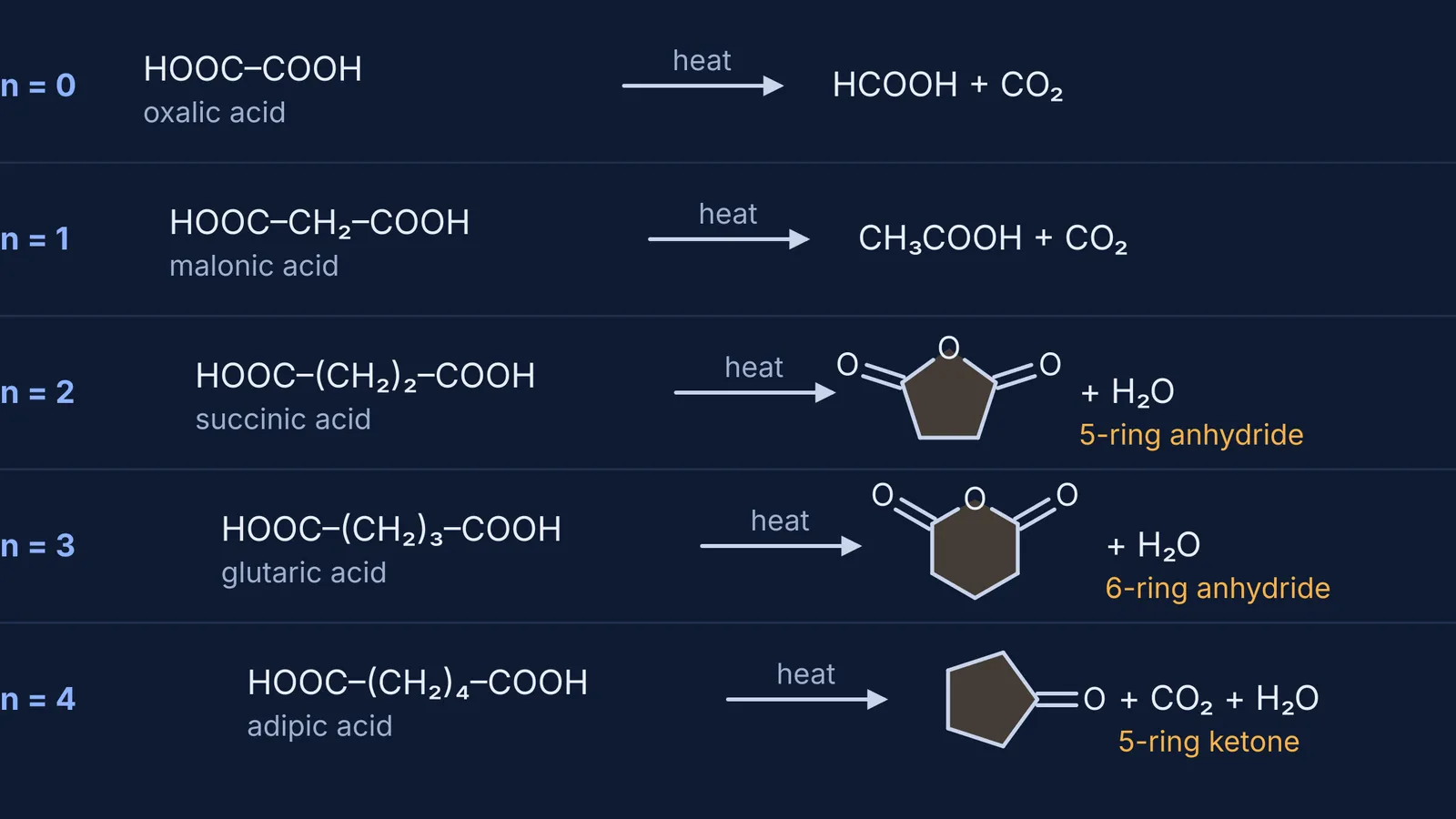
Heat oxalic acid and you get a gas. Heat succinic acid and you get a ring. Heat adipic acid and you get a ketone. These look like five separate facts to memorise, but they come from one rule. In the series HOOC(CH₂)ₙCOOH, the two COOH groups react with each other only if the ring they would close is 5- or 6-membered. When no such ring is possible, the acid breaks apart instead.
What happens when oxalic acid is heated?
Oxalic acid (n = 0) has its two carboxyl carbons bonded directly to each other. A cyclic anhydride would need a 3-membered ring, which is far too strained, so that route is closed. On strong heating, the weak C–C bond between the two carbonyl carbons breaks instead:
HOOC–COOH → HCOOH + CO₂
Some of the formic acid decomposes further at that temperature (HCOOH → CO + H₂O), so heated oxalic acid gives a mixture of gases.
With concentrated H₂SO₄, which removes water, the decomposition goes all the way to the two oxides of carbon:
HOOC–COOH → CO + CO₂ + H₂O (in conc. H₂SO₄)
This is a standard laboratory method for making carbon monoxide; NaOH solution absorbs the CO₂. The same close spacing of the two COOH groups also makes oxalic acid the strongest acid in the series, as shown in why oxalic acid is stronger than malonic acid.
Why does malonic acid lose CO₂ instead of water?
Malonic acid (n = 1) has one CH₂ between the two COOH groups. An anhydride would be a 4-membered ring, still too strained. But the two groups are now in a β relationship: one C=O is two bonds away from the other COOH. That is exactly the arrangement that lets a carboxylic acid lose CO₂ through a cyclic 6-membered transition state.
HOOC–CH₂–COOH → CH₃COOH + CO₂
It happens at a modest temperature, a little above the melting point of malonic acid (about 135 °C). The mechanism, the enol intermediate and why the same thing happens to β-keto acids are worked through in why beta-keto acids decarboxylate easily on heating, so they are not repeated here. Substituted malonic acids behave the same way, which is why the malonic ester synthesis of carboxylic acids ends with a heating step that removes one COOH.
Why do succinic and glutaric acids form cyclic anhydrides?
Count the ring atoms in a cyclic anhydride. There are two carbonyl carbons, one ring oxygen and the n CH₂ groups, so the ring has n + 3 atoms.
Succinic acid (n = 2): 5-membered ring
Glutaric acid (n = 3): 6-membered ring
Five- and six-membered rings have almost no angle strain, and the two ends of a short chain meet often, so ring closure is easy. On strong heating, one COOH attacks the other and a molecule of water leaves:
HOOC(CH₂)₂COOH → succinic anhydride + H₂O
HOOC(CH₂)₃COOH → glutaric anhydride + H₂O
In the lab, acetyl chloride or acetic anhydride is often added to help the dehydration. The same idea explains two other exam favourites. Phthalic acid gives phthalic anhydride (a 5-membered ring fused to benzene). Maleic acid, the cis isomer of butenedioic acid, gives maleic anhydride, while fumaric acid (trans) cannot, because its COOH groups point away from each other.
Why does adipic acid give cyclopentanone?
Adipic acid (n = 4) would need a 7-membered anhydride ring. That ring forms poorly. A second route now becomes possible, and it gives a 5-membered ring.
Heated strongly, classically with a little barium hydroxide at roughly 290 °C, adipic acid loses CO₂ and water to give cyclopentanone:
HOOC(CH₂)₄COOH → cyclopentanone + CO₂ + H₂O
Check the balance: C₆H₁₀O₄ → C₅H₈O + CO₂ + H₂O. Carbon 6 = 5 + 1, hydrogen 10 = 8 + 2, oxygen 4 = 1 + 2 + 1.
The usual picture shows where the ring comes from. The α-carbon next to one COOH attacks the carbonyl carbon of the other COOH. The ring that closes contains that α-carbon, three more CH₂ groups and the attacked carbon: five atoms. The attacked carbon becomes the ketone C=O. The COOH on the α-carbon is now β to that ketone, so it is a β-keto acid, and it loses CO₂ for the same reason malonic acid does. In a ketone ring of this kind, the ring has n + 1 atoms.
How do you predict the product for any HOOC(CH₂)ₙCOOH?
Work out both possible ring sizes and pick the one that is 5 or 6.
Anhydride ring = n + 3 atoms.
Ketone ring = n + 1 atoms.
If the anhydride ring is 5 or 6 (n = 2 or 3), you get the cyclic anhydride and lose H₂O.
If the ketone ring is 5 or 6 (n = 4 or 5), you get the cyclic ketone and lose CO₂ + H₂O.
If neither works and n = 1, the β arrangement lets it lose CO₂. If n = 0, the C–C bond breaks.
This pattern is known as Blanc's rule. For pimelic acid (n = 5), the anhydride would be 8-membered but the ketone is 6-membered, so you get cyclohexanone: C₇H₁₂O₄ → C₆H₁₀O + CO₂ + H₂O. For suberic acid (n = 6), neither ring is 5 or 6; cycloheptanone does form, but only in low yield.
Worked example: two acids with the same formula
Two acids, A and B, both have the formula C₅H₈O₄ (molar mass about 132.1 g mol⁻¹). One is dimethylmalonic acid, (CH₃)₂C(COOH)₂. The other is glutaric acid, HOOC(CH₂)₃COOH. On heating, A loses about 33% of its mass and B loses about 14%. Identify A and B, and name the products.
Dimethylmalonic acid. Both COOH groups are on the same carbon, so it is a substituted malonic acid. It loses CO₂: (CH₃)₂C(COOH)₂ → (CH₃)₂CHCOOH + CO₂. The product is 2-methylpropanoic acid. Check: C₅H₈O₄ → C₄H₈O₂ + CO₂.
Mass lost. CO₂ is 44.0 g mol⁻¹. 44.0 ÷ 132.1 × 100 ≈ 33.3%. So A is dimethylmalonic acid.
Glutaric acid. Here n = 3, so the anhydride ring has 3 + 3 = 6 atoms. It loses water to give glutaric anhydride: C₅H₈O₄ → C₅H₆O₃ + H₂O.
Mass lost. H₂O is 18.0 g mol⁻¹. 18.0 ÷ 132.1 × 100 ≈ 13.6%. So B is glutaric acid.
How much gas? If you heat 1.32 g of A, that is 1.32 ÷ 132.1 ≈ 0.0100 mol, giving 0.0100 mol of CO₂ (about 224 mL at STP) and about 0.880 g of 2-methylpropanoic acid.
If you want more questions like this checked one step at a time, the Fermi Problem Library has a step-by-step solver that explains the reasoning, not just the final product.
Quick checklist
Oxalic acid (n = 0): HCOOH + CO₂ on heating; CO + CO₂ + H₂O with conc. H₂SO₄.
Malonic acid (n = 1): CH₃COOH + CO₂, through a cyclic 6-membered transition state.
Succinic (n = 2) and glutaric (n = 3) acids: 5- and 6-membered cyclic anhydrides + H₂O.
Adipic (n = 4) and pimelic (n = 5) acids: cyclopentanone and cyclohexanone + CO₂ + H₂O.
Anhydride ring = n + 3 atoms; ketone ring = n + 1 atoms. Pick the one that is 5 or 6.


