

On this page
An aircraft cares less about how high the ground is than about how much air there is to push on. At a hill airport such as Leh in Ladakh, the air is already thin because the pressure is low. On a warm afternoon it gets thinner still, because warm air expands. Pilots fold both effects into one number called density altitude. This post shows where that number comes from, using only pV = nRT, the lift formula and v² = 2as, and works out how much faster an aircraft must go and how much more runway it uses.
What is density altitude?
Density altitude is the height in the standard atmosphere at which the air would have the same density as the air you actually have. The FAA's leaflet on density altitude defines it as pressure altitude corrected for a temperature that differs from standard, and says an aircraft performs as if it were at that height.
The standard atmosphere is a reference table: 1013.25 hPa and 15 °C at sea level, with temperature falling by 6.5 °C per kilometre. On a hotter day than the table, the air is less dense, so density altitude is above the real height. Height lowers the pressure; heat lowers the density at that pressure.
How thin is the air at Leh?
Start from the ideal gas law written for density. Since pV = nRT and the mass of gas is nM, the density is
ρ = pM/RT
where M = 0.02897 kg/mol for dry air and T must be in kelvin.
Why pressure falls with height is covered in why atmospheric pressure decreases with height, so here we just use the standard-atmosphere value. For the numbers in this post, take a round illustrative airfield height of 3,250 m, which is close to Leh's; the Airports Authority of India publishes the exact figure. The standard atmosphere gives about 679 hPa and −6.1 °C at that height.
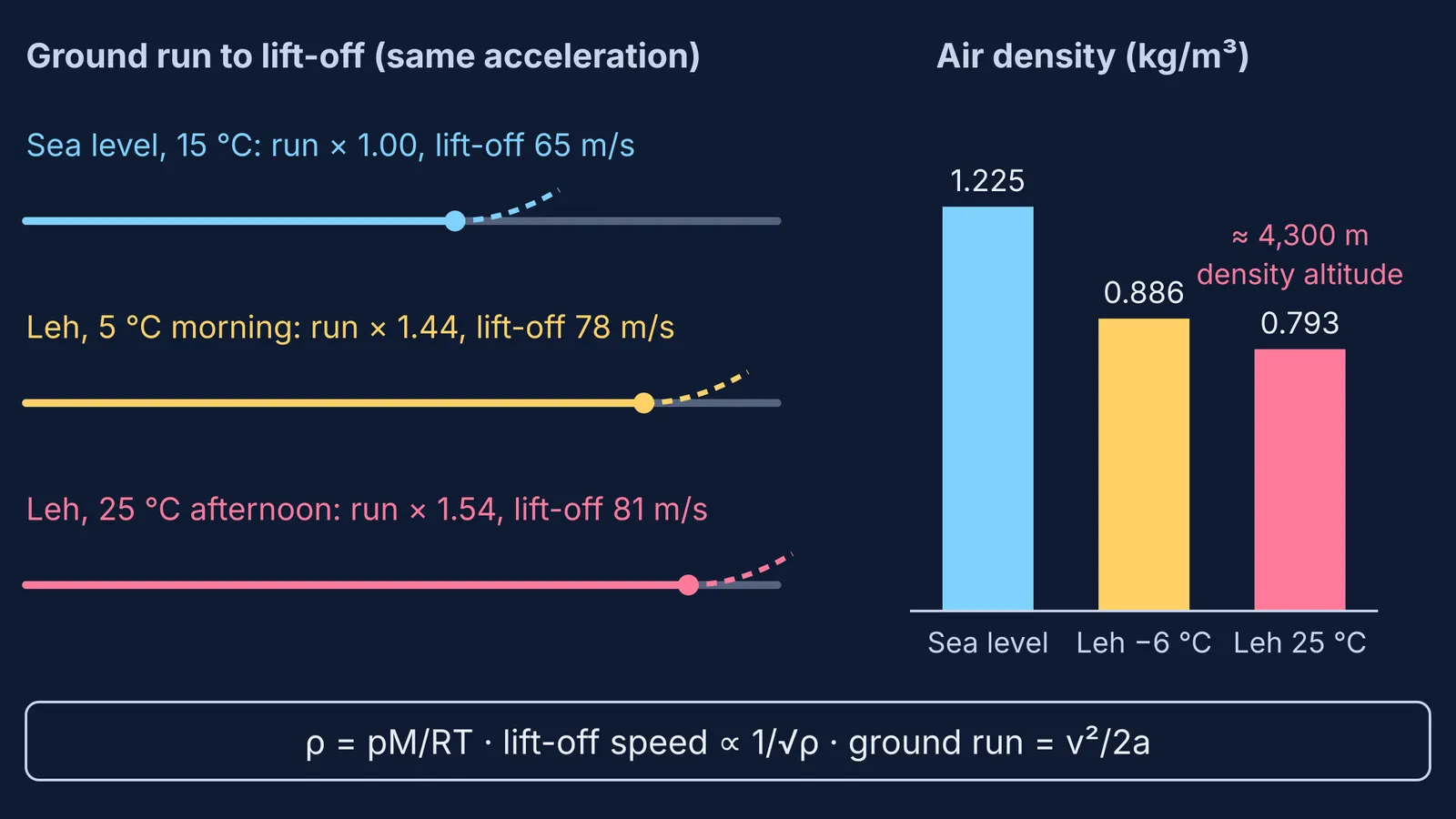
Sea level, 15 °C: ρ = 101325 × 0.02897 / (8.314 × 288.15) ≈ 1.225 kg/m³.
3,250 m, standard day (−6.1 °C): ρ ≈ 0.886 kg/m³, about 72% of sea level.
3,250 m, 25 °C afternoon: ρ ≈ 0.793 kg/m³, about 65% of sea level.
So on that afternoon the air is about 35% thinner than at sea level. Look up 0.793 kg/m³ in the standard atmosphere and you find it at about 4,300 m (roughly 14,100 ft). That is the density altitude: the aircraft is on a runway at 3,250 m but has the air of a place more than a kilometre higher.
Why does thinner air need a faster take-off?
At lift-off the wing's lift must equal the weight:
L = ½ρv²SC_L = mg
S is the wing area and C_L the lift coefficient. For a given aircraft, weight and flap setting at lift-off, everything except ρ and v is fixed. So ρv² is fixed, and the lift-off speed goes as
v ∝ 1/√ρ
Halve the density and the speed must rise by a factor of √2, not 2. This is the step students most often get wrong.
The airspeed indicator in the cockpit works by measuring the dynamic pressure ½ρv². Because lift depends on the same ½ρv², the indicator shows the same lift-off speed at Leh as at sea level. What changes is the true speed through the air, and with no wind, the speed over the ground. The FAA leaflet says the same thing for landing: indicated airspeed stays the same while true airspeed rises.
How much longer is the ground run?
For constant acceleration from rest, v² = 2as, so the ground run is s = v²/2a. The post on why planes take off into the wind uses the same square law for wind, so we will not repeat it. Here the speed itself changes. Since v² ∝ 1/ρ, the run grows in proportion to 1/ρ if the acceleration stays the same.
But the acceleration does not stay the same. The FAA's handbook chapter on aircraft performance calls this a twofold effect of density altitude: a greater take-off speed and a smaller net accelerating force. Engines breathe air, so in thin air they give less thrust. If, as a rough model, thrust also falls in proportion to density, then a ∝ ρ and the run goes as 1/ρ². How much thrust a real engine loses depends on the engine, so treat that second number as an upper estimate from a simple model.
Worked example: sea level versus a 25 °C afternoon at 3,250 m
An aircraft lifts off at a true airspeed of 65 m/s at sea level (an illustrative round value). Find its lift-off speed and ground run at 3,250 m on a 25 °C afternoon, with no wind.
Density at sea level. ρ₀ = 1.225 kg/m³.
Density at the airfield. p = 67,900 Pa, T = 25 + 273.15 = 298.15 K. ρ = 67,900 × 0.02897 / (8.314 × 298.15) ≈ 0.793 kg/m³.
Density ratio. ρ₀/ρ = 1.225/0.793 ≈ 1.544.
New lift-off speed. v = 65 × √1.544 ≈ 65 × 1.243 ≈ 80.8 m/s, or about 291 km/h. That is 24% faster.
Ground run, same acceleration. s ∝ v², so the run is 1.544 times longer, about 54% more.
Ground run, thrust ∝ ρ. s ∝ v²/a ∝ 1/ρ², so the run is 1.544² ≈ 2.38 times longer.
Check units. ρ = pM/RT has units Pa × (kg/mol) / (J/mol K × K) = (N/m²) × kg / (N m) = kg/m³. Speeds are in m/s, and the ratios have no units.
Why do morning and afternoon differ at the same airport?
The pressure at the airfield hardly changes during the day, so the density goes as 1/T. Compare a 5 °C morning with a 25 °C afternoon:
ρ(5 °C) = 67,900 × 0.02897 / (8.314 × 278.15) ≈ 0.851 kg/m³, a density altitude of about 3,640 m.
ρ(25 °C) ≈ 0.793 kg/m³, a density altitude of about 4,300 m.
Ratio of temperatures: 298.15/278.15 ≈ 1.072.
The lift-off speed rises by √1.072, about 3.5%. The ground run rises by 7% at the same acceleration, and by about 15% (1.072²) if thrust also falls with density. A 20 °C swing moves the density altitude by about 660 m without the aircraft moving at all. The FAA density altitude leaflet makes the same physical point: performance is better in the cooler hours of the day.
At cruise, thin air helps by cutting drag, which is why passenger planes cruise at 35,000 feet.
If you want to see how lift changes as you vary density and speed, the Simulation Lab has interactive simulations for ideas that are easier to see than read. For more gas-law and kinematics problems worked step by step, try the Fermi Problem Library.
Quick checklist
Density altitude is the standard-atmosphere height with the same air density as today's air.
Use ρ = pM/RT with T in kelvin; height lowers p, heat raises T.
Lift = weight at lift-off, so lift-off speed ∝ 1/√ρ.
Ground run = v²/2a: ∝ 1/ρ at fixed acceleration, up to ∝ 1/ρ² if thrust falls with density.
Indicated airspeed at lift-off stays the same; true airspeed and ground speed rise.
At 3,250 m and 25 °C the air is about 35% thinner than at sea level, a density altitude of about 4,300 m.


