

On this page
Whenever they can, planes take off and land facing the wind. The reason is one of the most useful ideas in Class 11 physics: relative velocity.
Why do planes take off into the wind?
A wing cares how fast air flows over it, not how fast it moves over the ground. NASA's lift equation writes lift as L = Cl × (ρV²/2) × A, where ρ is air density, V is velocity, A is wing area and Cl is the lift coefficient. For a wing, the V that matters is the speed of the air relative to the wing: the airspeed.
So a plane must reach its lift-off airspeed whatever the wind does. The FAA's Pilot's Handbook of Aeronautical Knowledge puts it plainly: a headwind lets the aircraft reach lift-off speed at a lower groundspeed, while a tailwind forces it to reach a greater groundspeed first.
Lower ground speed at lift-off means less runway used.
What does relative velocity have to do with it?
In the ground frame, let the plane roll at ground speed v while the wind blows at its nose at speed w. Relative to the plane, air arrives at v + w. That sum is the airspeed.
If the plane needs an airspeed V to lift off, then v + w = V, so the ground speed at lift-off is only v = V − w. With a tailwind the sign flips: the plane must reach v = V + w before the air over its wings is fast enough.
It is the same vector subtraction you use for boats and rain. Our walk-through of a boat crossing a river with relative velocity builds the picture step by step, and the post on how a pilot picks a heading in a crosswind covers the case where the wind blows across the runway instead of along it.
How much runway does a headwind save?
Assume the plane accelerates at a steady rate a. From v² = 2as, the distance needed to reach ground speed v is s = v²/2a. The FAA handbook uses the same idea: with acceleration essentially unaffected, takeoff distance varies with the square of the takeoff speed.
A worked example, with illustrative round numbers for a small trainer:
Lift-off airspeed V = 60 knots. In still air, ground speed at lift-off is 60 knots. Call the ground roll s₀.
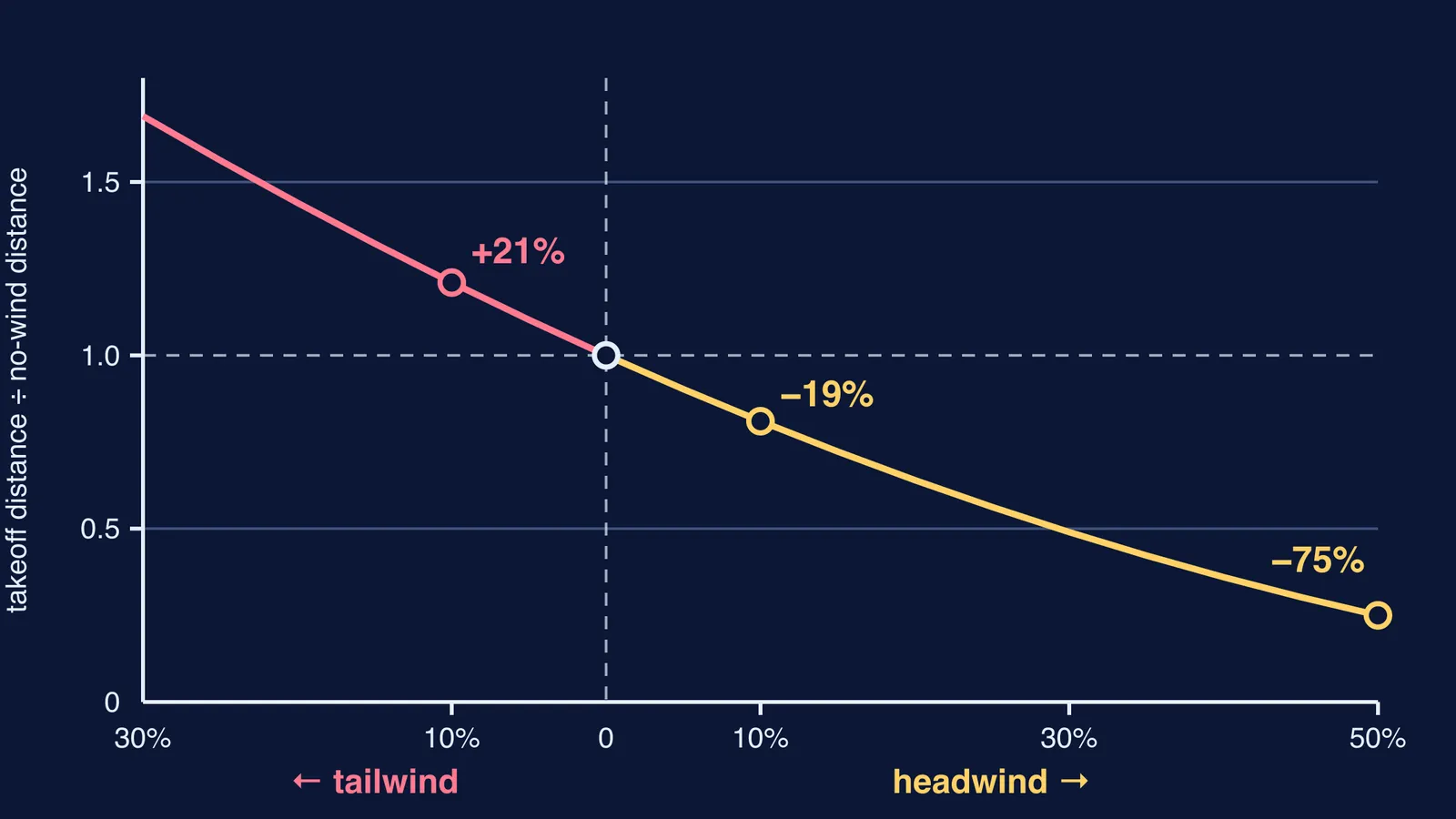
Headwind of 12 knots: ground speed at lift-off is 60 − 12 = 48 knots. Distance becomes (48/60)² s₀ = 0.64 s₀, about 36% shorter.
Tailwind of 12 knots: ground speed must reach 60 + 12 = 72 knots. Distance becomes (72/60)² s₀ = 1.44 s₀, about 44% longer.
If s₀ were 300 m, that is 192 m into the wind against 432 m with the wind behind you.
The squared term explains the FAA's rule of thumb. A headwind that is 10% of the takeoff airspeed reduces takeoff distance by about 19%, and a tailwind of 10% increases it by about 21%, according to the FAA handbook. Check it yourself: 0.9² = 0.81 and 1.1² = 1.21. A headwind of half the takeoff speed leaves about 25% of the no-wind distance.
Aircraft performance charts are more cautious: a sample takeoff distance chart in the same FAA chapter cuts distances by only 10% per 10 knots of headwind, but for tailwinds up to 10 knots adds 10% per 2.5 knots.
Why do planes land into the wind too?
The plane touches down at a fixed airspeed, so a headwind means a lower ground speed at touchdown and less energy for the brakes to remove. The FAA handbook says the effect of wind on landing distance is identical to its effect on takeoff distance, and that a 10-knot tailwind increases landing distance by about 21%.
The same chapter adds that on wet runways, landing into the wind gives the best directional control.
How do you solve wind problems in a physics exam?
Use this check on any plane, boat or rain question:
Name the frames: ground, air (or water), and the moving object.
Write one vector equation: velocity relative to ground = velocity relative to medium + velocity of medium.
Decide which speed the physics needs. Lift and drag need airspeed; runway length and travel time need ground speed.
For runway distances at constant acceleration, square the speed ratio rather than the raw numbers.
For why faster air over a wing means lower pressure, read our explainer on Bernoulli's principle in lift and atomisers.
Relative velocity is easier to see than to read, which is what the interactive simulations in the Fermi Simulation Lab are for. If a numerical goes wrong halfway, the Fermi Problem Library has worked problems with a step-by-step solver that explains the reasoning rather than printing an answer.
On your next flight, look for the windsock. It streams downwind, so expect your plane to take off in the opposite direction to the way it points.


