

On this page
On a sunny day in Delhi, ozone is low at dawn, climbs through the morning and is highest in the afternoon. After dark it falls, and next to a busy road it can drop close to zero. You already know the reactions behind this from the photochemical smog reactions, step by step. Apply the steady-state idea from JEE kinetics and they collapse into one equation that explains the afternoon peak, the night dip and a 2020 lockdown puzzle.
Which reactions control ozone near the ground?
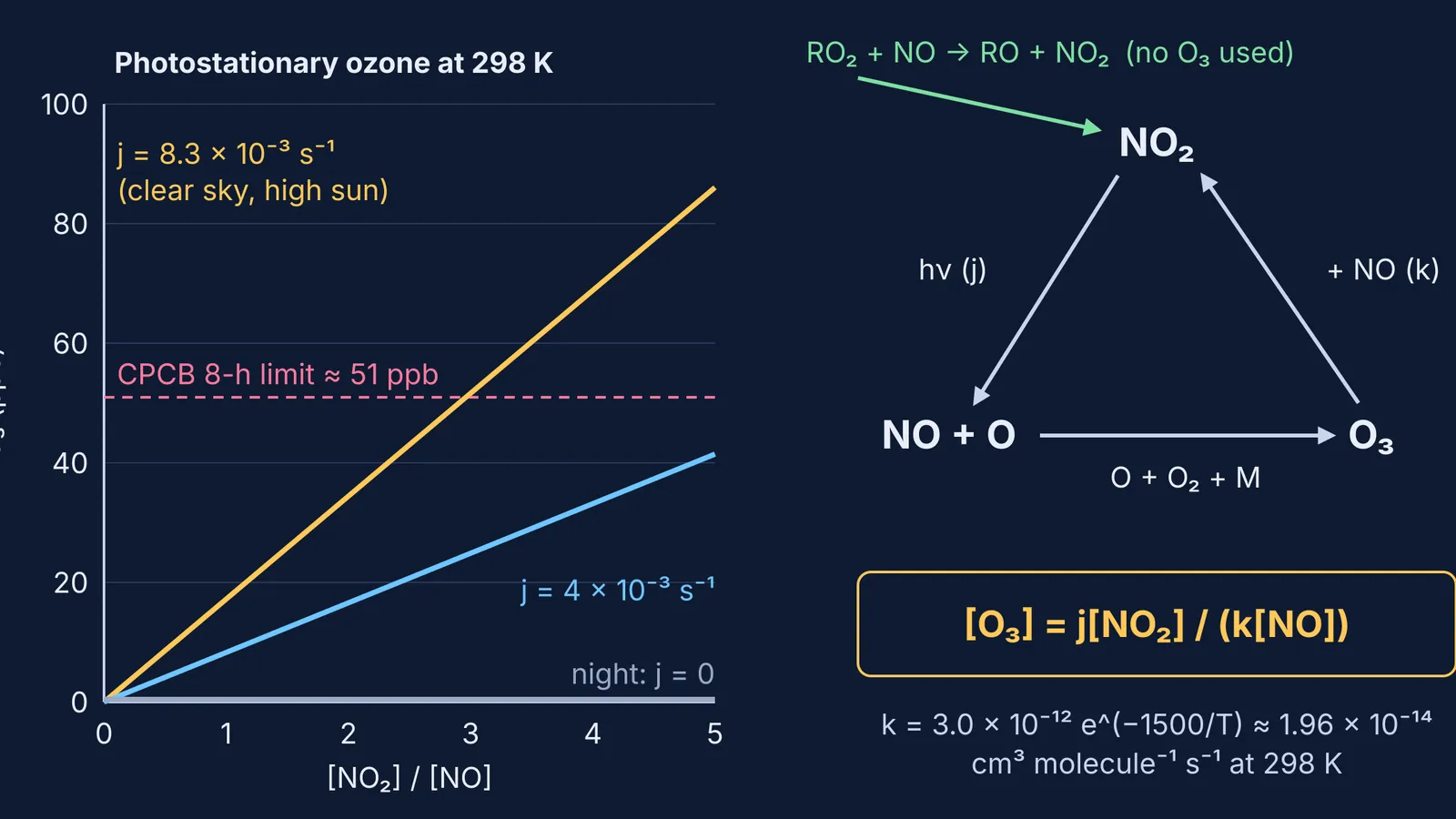
Three reactions run in a loop whenever the sun is up:
NO₂ + hν → NO + O, with rate = j[NO₂]
O + O₂ + M → O₃ + M, where M is any air molecule that carries away the extra energy
O₃ + NO → NO₂ + O₂, with rate = k[O₃][NO]
Step 1 is first order, so j (the photolysis rate constant) is in s⁻¹. Step 3 is second order, and air chemists count molecules per cm³, so k is in cm³ molecule⁻¹ s⁻¹.
Why does sunlight split NO₂ near the ground but not O₂? The O–NO bond energy is about 300 kJ mol⁻¹. Using λ (nm) ≈ 119 600 / E (kJ mol⁻¹), that is about 398 nm, the threshold the smog post uses (NO₂ still splits weakly up to about 420 nm). That near-UV light reaches the ground. The O=O bond, about 498 kJ mol⁻¹, needs light below about 240 nm, which the ozone layer absorbs high above us.
How does the steady-state approximation give the Leighton relationship?
The O atom is a classic reactive intermediate, used up almost as soon as it forms. Ozone is not, but in sunlight the whole loop turns over in minutes, much faster than ozone changes over the day. So you can make the same move as in the steady-state approximation and set d[O₃]/dt = 0.
Ozone is made at the rate NO₂ is split, j[NO₂], and destroyed at the rate k[O₃][NO]. Setting these equal:
j[NO₂] = k[O₃][NO]
[O₃] = j[NO₂] / (k[NO])
This is the photostationary state, or Leighton relationship. Ozone depends on how bright the sun is (j) and how much of the nitrogen oxide is NO₂ rather than NO. It is an approximation: it holds in steady sunlight away from fresh exhaust, not right next to a tailpipe.
Worked example: how much ozone does the equation predict?
(a) Midday, clear sky, 298 K.
Aircraft measurements found j(NO₂) ≈ 8.3 × 10⁻³ s⁻¹ at sea level under clear skies with the sun about 34° from overhead (Volz-Thomas and colleagues, 1996). Haze, cloud and a lower sun all reduce it. For k, the NASA-JPL kinetics evaluation gives k = 3.0 × 10⁻¹² e^(−1500/T) cm³ molecule⁻¹ s⁻¹.
k at 298 K = 3.0 × 10⁻¹² × e^(−1500/298) = 1.96 × 10⁻¹⁴ cm³ molecule⁻¹ s⁻¹.
NO₂ lifetime = 1/j ≈ 120 s, about 2 minutes, which is why the loop settles fast.
j/k = 8.3 × 10⁻³ / 1.96 × 10⁻¹⁴ = 4.2 × 10¹¹ molecules cm⁻³.
Convert to ppb. At 298 K and 1 atm, air has P/(k_B T) = 2.46 × 10¹⁹ molecules cm⁻³, so 1 ppb = 2.46 × 10¹⁰ molecules cm⁻³. Then j/k = 4.2 × 10¹¹ / 2.46 × 10¹⁰ ≈ 17 ppb.
So [O₃] ≈ 17 ppb × [NO₂]/[NO]. If NO₂ and NO are equal, ozone is about 17 ppb. If NO₂ is three times NO, it is about 52 ppb.
India's National Ambient Air Quality Standards cap ozone at 100 µg/m³ over 8 hours and 180 µg/m³ over 1 hour. At 25 °C, ppb = µg/m³ × 24.45 / 48, so these are about 51 ppb and 92 ppb. A ratio of 3 at noon sits right at the 8-hour limit.
(b) Night, next to traffic.
After sunset j = 0, so only step 3 runs. Evening air carrying 40 ppb O₃ meets 60 ppb of fresh NO from traffic.
O₃ + NO → NO₂ + O₂ is 1 : 1, and ozone is the limiting reagent.
Ozone falls to 0. NO falls by 40 ppb, leaving 20 ppb. NO₂ rises by 40 ppb.
O₃ + NO₂ before: 40 + 0 = 40 ppb. After: 0 + 40 = 40 ppb. Unchanged.
Why does ozone vanish near busy roads at night?
Part (b) is called NO titration, and Delhi has plenty of NO. In a winter campaign, Haslett and colleagues (2023) measured NO averaging 84 ppb at night against 22 ppb in the day, while ozone averaged 43 ppb in the daytime and was very low at night.
The sum O₃ + NO₂ is called odd oxygen, Ox, and steps 1 to 3 never change it. So the ozone has not really gone: it is parked as NO₂ until the morning sun splits it. Parks and downwind suburbs get less fresh NO, so their ozone is often higher than at the roadside.
If the cycle only shuffles ozone, where does the extra ozone come from?
If Ox never changes, the loop alone cannot make a smoggy afternoon. The extra comes from hydrocarbons. Their peroxy radicals do the job of step 3 without using ozone:
RO₂ + NO → RO + NO₂
Each time, one NO becomes NO₂ and no O₃ is spent, so the NO₂/NO ratio and Ox both grow through the sunny hours.
That is why the peak comes after noon rather than at it. j is largest near solar noon, but ozone keeps piling up while the radical chain runs, and the growing daytime mixed layer stirs down ozone left aloft from the day before. A study of five Delhi sites found ozone highest in the afternoon, with NOx highest at 06:00–09:00 and 19:00–24:00 (Sinha and colleagues, 2022). The exact peak hour shifts with season, site and pollution, so do not learn it as a fixed time.
Why did ozone rise when traffic stopped in 2020?
Less traffic means less NO, so less ozone is titrated. At 13 monitoring stations in and around New Delhi, NO₂ fell during the 2020 lockdown phases while ozone rose at every station (Chaudhary and colleagues, 2021). The authors caution that meteorology played a part: the mixing layer was about twice as deep, and late March to May is when sunlight strengthens anyway. Results differ between stations and studies, so say ozone rose "at several sites", not "everywhere". The lesson still holds: in NO-rich city centres, cutting NOx alone can raise ozone; cutting hydrocarbons too brings it down.
If the algebra in step 4 or the ppb conversion keeps slipping, the Fermi Problem Library has a step-by-step solver that explains the reasoning at each line.
Quick checklist
Loop: NO₂ + hν → NO + O; O + O₂ + M → O₃ + M; O₃ + NO → NO₂ + O₂.
Photostationary state: [O₃] = j[NO₂]/(k[NO]). It is an approximation for steady sunlight away from fresh emissions.
Clear-sky midday j ≈ 8 × 10⁻³ s⁻¹ and k ≈ 1.96 × 10⁻¹⁴ at 298 K give about 17 ppb × [NO₂]/[NO].
At night j = 0 and NO titrates O₃ 1 : 1; O₃ + NO₂ stays the same.
Net ozone needs RO₂ + NO → RO + NO₂, which uses no ozone.
CPCB 8-hour limit: 100 µg/m³, about 51 ppb at 25 °C.


