

On this page
This set follows Current Electricity NEET practice questions, set 1 with eight new questions, mostly on topics set 1 did not test.
Which Current Electricity topics does set 2 cover?
The NMC syllabus for NEET (UG)-2026 lists Unit 12 as drift velocity and mobility, V-I characteristics of ohmic and non-ohmic conductors, electrical energy and power, resistivity and conductivity, resistor combinations, temperature dependence, internal resistance and emf, cells in series and parallel, Kirchhoff's laws, the Wheatstone bridge and the metre bridge.
The NCERT Class 12 chapter (reprint 2026-27) defines mobility as the magnitude of the drift velocity per unit electric field, μ = |v_d|/E, with SI unit m²/(V s). For a chapter plan, see how to prepare Current Electricity for NEET.
How should you use this set?
Cover the answers; allow about 12 minutes.
Write the law you are using before any numbers.
Mark each miss as concept, algebra or misreading.
Redo the misses in three days.
If the same step keeps going wrong, the Fermi Problem Library has worked problems with a step-by-step solver that explains the reasoning rather than printing an answer.
Easy: mobility, energy and V-I graphs
Q1 (easy). A potential difference of 1.5 V is applied across a copper wire 5.0 m long. Electrons drift at 1.2 × 10⁻⁵ m/s. What is their mobility?
(A) 3.6 × 10⁻⁶ m²/(V s) (B) 8.0 × 10⁻⁶ m²/(V s) (C) 4.0 × 10⁻⁵ m²/(V s) (D) 2.5 × 10⁴ m²/(V s)
Answer: (C). The field is E = V/L = 1.5/5.0 = 0.30 V/m, so μ = v_d/E = 1.2 × 10⁻⁵/0.30 = 4.0 × 10⁻⁵ m²/(V s).
Trap: (B) divides by the voltage instead of the field. See our note on the mobility of electrons formula.
Q2 (easy). A 2.0 kW geyser runs for 45 minutes every day for 30 days. At ₹7 per kWh, what does it cost?
(A) ₹10.50 (B) ₹315 (C) ₹18,900 (D) ₹3,15,000
Answer: (B). Energy = 2.0 kW × 0.75 h × 30 = 45 kWh, and 45 × ₹7 = ₹315.
Trap: (C) treats 45 minutes as 45 hours.
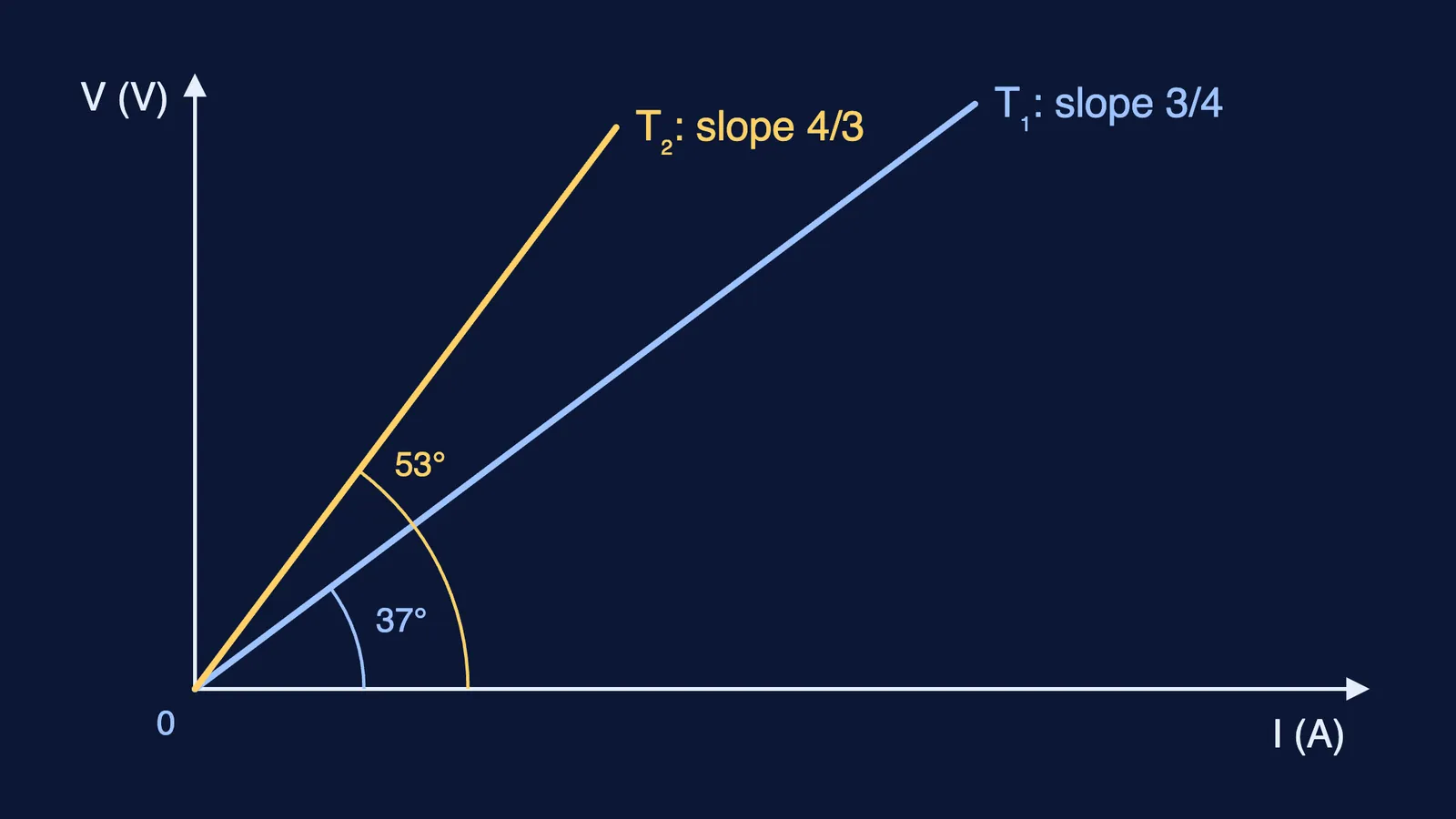
Q3 (easy). The V-I graphs of a metal wire at temperatures T₁ and T₂ are straight lines through the origin, with V on the vertical axis. The T₁ line makes 37° with the current axis and the T₂ line makes 53°. Take tan 37° = 3/4. What is R(T₂)/R(T₁), and which temperature is higher?
(A) 4/3; T₂ is higher (B) 16/9; T₂ is higher (C) 16/9; T₁ is higher (D) 9/16; T₁ is higher
Answer: (B). With V on the vertical axis, slope = V/I = R. The ratio is tan 53°/tan 37° = (4/3)/(3/4) = 16/9. A metal's resistance rises with temperature, so T₂ is higher.
Trap: (D) reads the slope as 1/R, true only with I on the vertical axis.
Medium: cell groups, charging and the Wheatstone bridge
Q4 (medium). Twelve identical cells, each of emf 1.5 V and internal resistance 0.5 Ω, are arranged in equal rows: each row has its cells in series, rows in parallel. The battery drives a 1.5 Ω resistor. Which arrangement gives the largest current?
(A) one row of 12 cells, 2.4 A
(B) 4 rows of 3 cells, 2.4 A
(C) 3 rows of 4 cells, 2.8 A
(D) 2 rows of 6 cells, 3.0 A
Answer: (D). With m rows of n cells, the emf is 1.5n and the internal resistance 0.5n/m. Current peaks when 0.5n/m = 1.5; with nm = 12, n = 6 and m = 2. Then I = 9/(1.5 + 1.5) = 3.0 A.
Trap: (A) assumes all-in-series is best, but its 6 Ω internal resistance outweighs the extra emf.
Q5 (medium). A battery of emf 12 V and internal resistance 0.5 Ω is charged from an ideal 20 V DC supply through a series resistor R. The charging current is 4.0 A. What is R?
(A) 1.5 Ω (B) 2.0 Ω (C) 4.5 Ω (D) 7.5 Ω
Answer: (A). While charging, the battery's emf opposes the supply: 20 − 12 = 4.0(R + 0.5), so R = 1.5 Ω.
Trap: (C) ignores the battery's emf.
Q6 (medium). In a Wheatstone bridge, P = 4 Ω (A to B), Q = 8 Ω (B to C), R = 6 Ω (A to D) and an unknown S (D to C). A galvanometer joins B and D, and an ideal 18 V battery is connected across A and C. The galvanometer shows no deflection. What current does the battery supply?
(A) 0.6 A (B) 1.5 A (C) 2.5 A (D) 3.5 A
Answer: (C). Balance needs P/Q = R/S, so S = 12 Ω. The galvanometer carries no current, so the 12 Ω and 18 Ω arms are in parallel: 7.2 Ω. I = 18/7.2 = 2.5 A.
Trap: (D) inverts the ratio and takes S = 3 Ω.
Hard: can you solve a wire ring and a non-ohmic device?
Q7 (hard). A uniform wire 1.8 m long, with resistance 20 Ω per metre, is bent into a closed circle. An ideal 12 V battery is connected across two points A and B that divide the circle into arcs in the ratio 1:2. What power does the ring draw?
(A) 4 W (B) 12 W (C) 16 W (D) 18 W
Answer: (D). The wire is 36 Ω, so the arcs are 12 Ω and 24 Ω, in parallel: 8 Ω. P = V²/R = 144/8 = 18 W.
Trap: (C) assumes A and B are ends of a diameter; (B) uses only the short arc.
Q8 (hard). A non-ohmic device obeys I = kV² for positive V, with k = 0.10 A/V². It is connected in series with a 5.0 Ω resistor across an ideal 4.0 V battery, with V across the device positive. What is the current?
(A) 0.40 A (B) 0.53 A (C) 0.80 A (D) 1.6 A
Answer: (A). The loop rule gives V + 5.0 × 0.10V² = 4.0, that is V² + 2V − 8 = 0, so V = 2.0 V. Then I = 0.10 × 4 = 0.40 A.
Trap: (B) gives the device a fixed resistance of 2.5 Ω, its value at 4 V, but that changes with voltage. (C) ignores the device; (D) puts all 4 V across it.
Scored 6 or more? Time sets 1 and 2 together. Under 6? Rework the traps first.


