

On this page
If you push an electron through a material with an electric field, it does not speed up forever. It scatters off atoms, settling into an average cruising speed called the drift velocity. The electron mobility formula measures exactly this: how much drift velocity you get for a given push.
What is electron mobility?
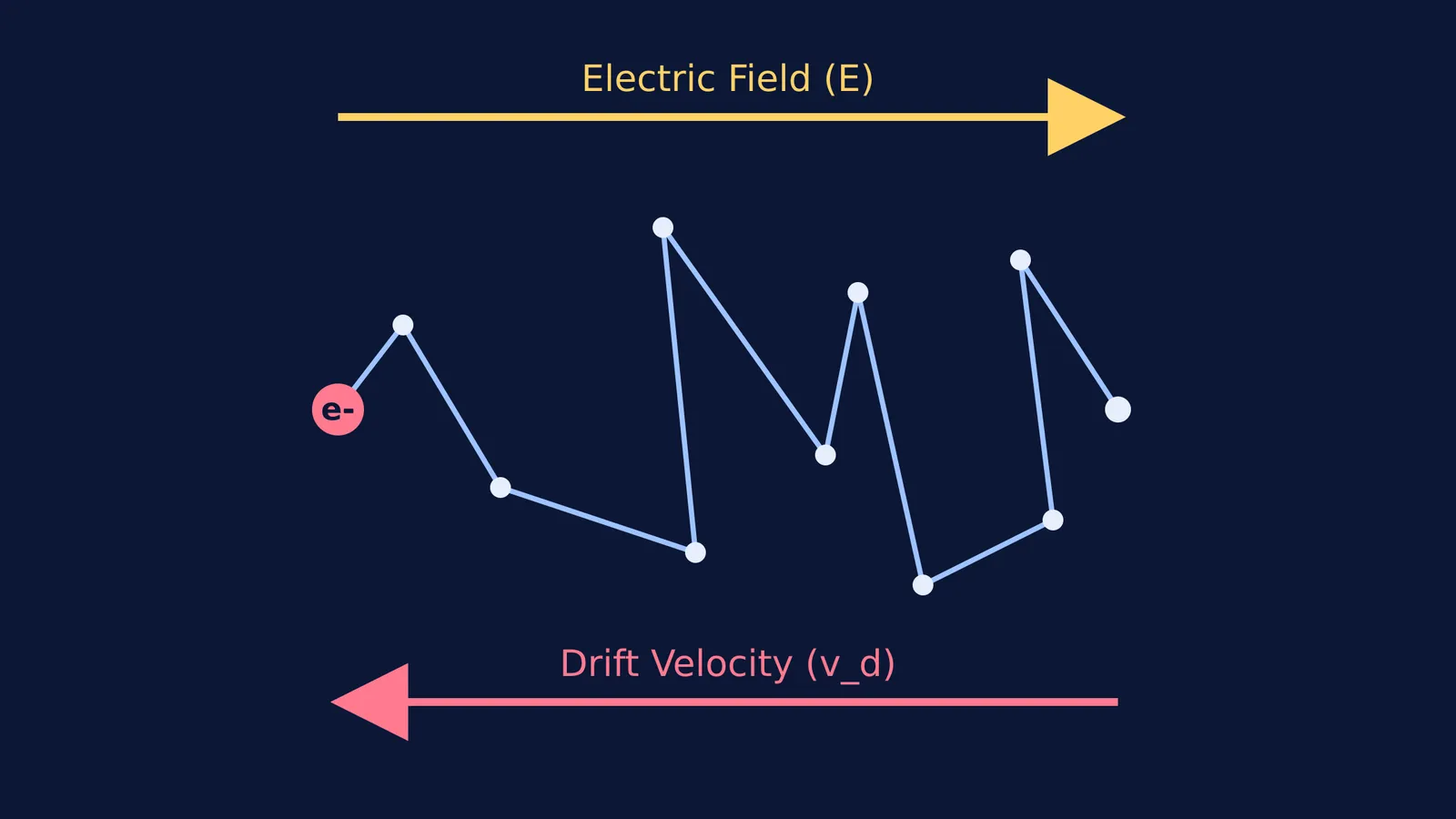
When an electric field (E) is applied to a wire, electrons accelerate. But they keep colliding with the lattice, losing speed and changing direction. The net result of this stop-and-start motion is a slow average speed in one direction, known as the drift velocity (v_d).
Mobility (μ) is defined as the magnitude of this drift velocity per unit electric field. This gives us the electron mobility formula:
μ = v_d / E
A higher mobility means the electron can easily glide through the lattice without scattering as much. For example, the electron mobility of copper at room temperature is typically 10 to 50 cm²/(V·s), whereas crystalline silicon has a much higher mobility of 1,400 cm²/(V·s).
What is the unit of electron mobility?
Because mobility is velocity divided by an electric field, we can divide their SI units:
Velocity is measured in m/s.
Electric field is measured in V/m.
Dividing the two yields m²/(V·s). In semiconductor physics, you will often see it written in cm²/(V·s), where 1 m²/(V·s) equals 10,000 cm²/(V·s). If a problem gives you a voltage drop instead of a direct field value, you can calculate the electric field from the potential gradient first, then substitute it into the mobility formula.
How does temperature affect mobility?
Mobility is not a fixed constant; it changes drastically with temperature depending on what gets in the electron's way. The total scattering in a semiconductor is a combination of two main roadblocks: lattice vibrations and ionized impurities.
At high temperatures, atoms in the crystal lattice vibrate more violently. These vibrations, known as phonons, crash into the passing electrons. Because these collisions happen more often as things heat up, mobility due to lattice scattering decreases as temperature increases.
At low temperatures, however, a different effect takes over: ionized impurity scattering. When electrons move slowly in the cold, they spend more time near charged dopant ions, allowing those electrical forces to deflect them strongly. As the material warms up, the electrons move faster and zip past the ions too quickly to be deflected, meaning impurity-limited mobility actually increases with temperature.
Because these two effects work in opposite directions, a semiconductor's overall electron mobility peaks at an intermediate temperature before falling off as the lattice gets too hot.
How does conductivity depend on mobility?
Mobility is the bridge between the microscopic motion of a single electron and the macroscopic current you measure with an ammeter. When learning about energy bands in conductors and insulators, it becomes clear that moving charge is what defines a conductor.
The conductivity (σ) of a material depends on three things:
The number density of charge carriers (n).
The elementary charge (e).
The electron mobility (μ).
The relationship is σ = n e μ.
If you are solving numericals on this for your exams and get stuck on how conductivity connects to the drift velocity, a step-by-step solver can show you the algebra. The Fermi Problem Library takes your question and explains the reasoning, whether you are trying to find the mean free time or substitute variables to find the final conductivity.
A quick checklist for exam problems
Check the units: If a question gives mobility in cm²/(V·s) but the field in V/m, convert the mobility to m²/(V·s) by multiplying by 10⁻⁴.
Identify the carriers: In n-type and p-type semiconductors, the total conductivity includes both electrons and holes: σ = e(n μ_e + p μ_h).
Do not mix up speeds: Drift velocity is on the order of millimetres per second. The random thermal speed of electrons is much faster, often around 10⁶ m/s. Mobility applies only to the slow, field-driven drift.


