

On this page
This set follows set 1 of our Current Electricity JEE Main practice questions and covers topics set 1 skipped.
Which Current Electricity topics does this set cover?
Current Electricity is Unit 12 of the JEE (Main) 2027 Physics syllabus published by NTA (linked from jeemain.nta.nic.in). It runs from drift velocity and conductivity to Kirchhoff's laws and the metre bridge. Every question also fits the NCERT Class 12 chapter on Current Electricity. For theory and a plan, see our guide on how to prepare Current Electricity for JEE Main.
How should you use this set?
Cover the answers and allow 20 minutes for all eight.
Label each miss: concept, algebra or misreading.
Redo the misses two days later, without notes.
Easy: charge, current density and heating
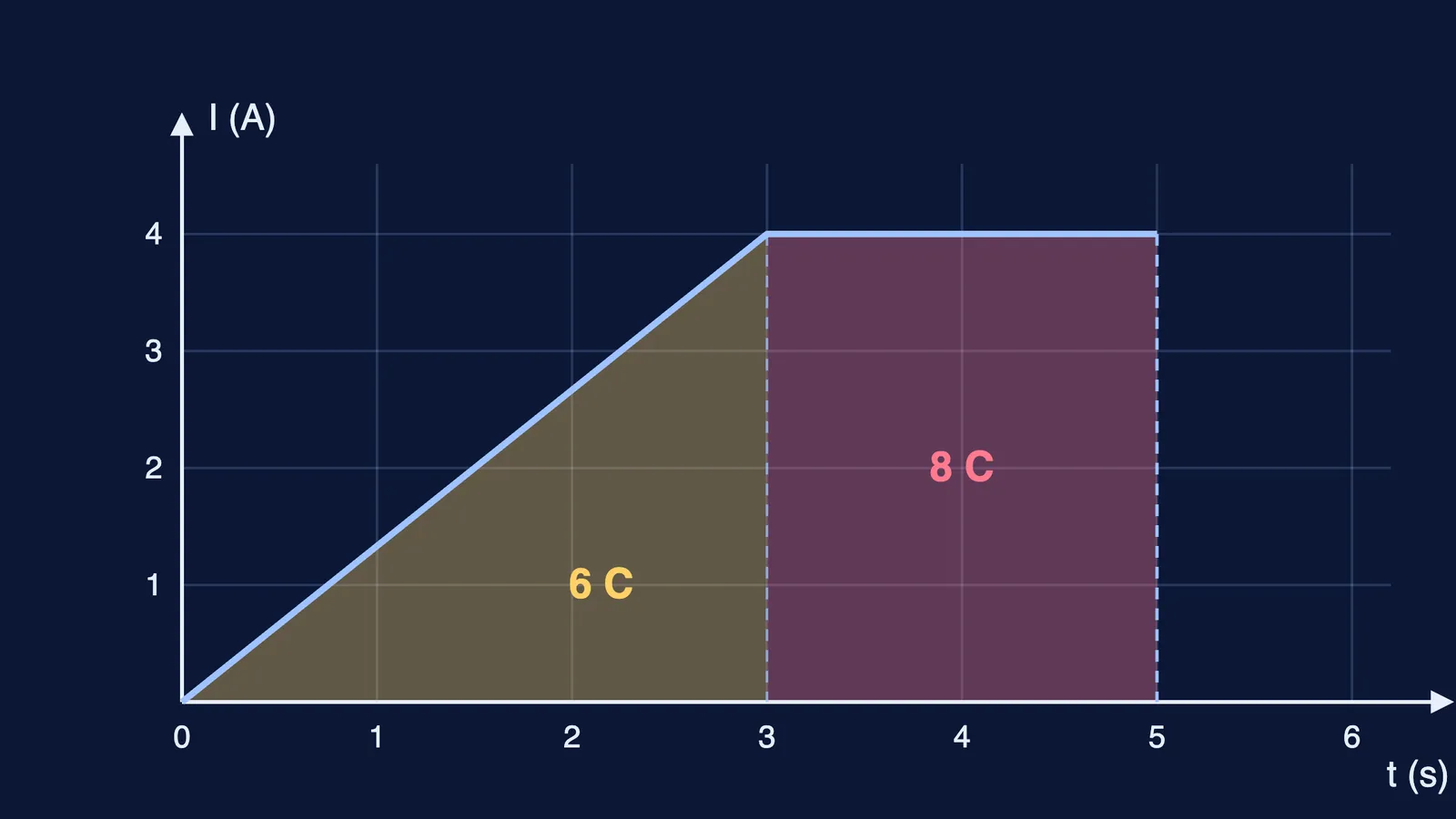
Q1 (easy). The current in a wire rises uniformly from 0 to 4.0 A in the first 3.0 s, then stays at 4.0 A for the next 2.0 s. How much charge passes a cross-section in these 5.0 s?
(A) 8 C (B) 10 C (C) 14 C (D) 20 C
Answer: (C). Charge is the area under the I-t graph: a triangle, ½ × 3.0 × 4.0 = 6 C, plus a rectangle, 2.0 × 4.0 = 8 C, giving 14 C. Trap: (D) uses 4.0 A for the whole 5 s.
Q2 (easy). A wire of resistivity 2.0 × 10⁻⁸ Ω m and cross-section 1.0 mm² carries a steady 5.0 A. What is the electric field inside the wire?
(A) 1.0 × 10⁻⁷ V/m (B) 1.0 × 10⁻⁴ V/m (C) 0.10 V/m (D) 2.5 × 10¹⁴ V/m
Answer: (C). The current density is j = I/A = 5.0/(1.0 × 10⁻⁶) = 5.0 × 10⁶ A/m², and E = ρj = 2.0 × 10⁻⁸ × 5.0 × 10⁶ = 0.10 V/m. Trap: (B) converts mm² with 10⁻³.
Q3 (easy). On the same mains supply, heating coil P alone boils a kettle of water in 12 min and coil Q alone in 24 min. Both are now joined in parallel. Ignoring heat loss, how long does the water now take?
(A) 6 min (B) 8 min (C) 18 min (D) 36 min
Answer: (B). At fixed voltage each coil's power is inversely proportional to its boiling time, and in parallel the powers add: 1/t = 1/12 + 1/24, so t = 8 min. Trap: (D) is the series result. If the power formulas blur, see which electric power formula to use.
Medium: a failed lamp, the metre bridge and symmetry
Q4 (medium). Three identical 4 Ω lamps (constant resistance) are joined to an ideal 12 V battery: lamp A in series with B and C, which are in parallel. Lamp C's filament breaks. What powers do A and B now use?
(A) A: 16 W, B: 4 W (B) A: 9 W, B: 9 W (C) A: 12 W, B: 6 W (D) A: 16 W, B: 16 W
Answer: (B). Before the break the total is 4 + 2 = 6 Ω, so A takes 2 A (16 W) and B takes 1 A (4 W). After it, A and B are in series: 8 Ω, 1.5 A, and each uses 1.5² × 4 = 9 W. Trap: (A) assumes the other lamps are unaffected, as with household sockets.
Q5 (medium). In a metre bridge, a 3.0 Ω standard resistor is in the left gap and a wire 0.50 m long and 0.40 mm in diameter in the right. The null point is 37.5 cm from the left end. What is the wire's resistivity?
(A) 4.5 × 10⁻⁷ Ω m (B) 1.3 × 10⁻⁶ Ω m (C) 3.1 × 10⁻⁷ Ω m (D) 5.0 × 10⁻⁶ Ω m
Answer: (B). Balance gives 3.0/X = 37.5/62.5, so X = 5.0 Ω. Then ρ = XπD²/(4L) = 5.0 × π × (0.40 × 10⁻³)²/(4 × 0.50) ≈ 1.26 × 10⁻⁶ Ω m. Trap: (A) flips the ratio, giving X = 1.8 Ω.
Q6 (medium). Six wires form the edges of a tetrahedron ABCD, joining each corner to the other three. Edge AB is 6 Ω; the other five edges are 12 Ω each. What is the resistance between A and B?
(A) 3 Ω (B) 4 Ω (C) 4.8 Ω (D) 6 Ω
Answer: (B). By symmetry, corners C and D are at the same potential, so wire CD carries no current. That leaves AB (6 Ω) in parallel with ACB and ADB (24 Ω each): 1/R = 1/6 + 1/24 + 1/24, so R = 4 Ω. Trap: (C) keeps only one 24 Ω path.
Hard: can you handle a tapered wire and a non-uniform current?
Q7 (hard). A conductor of resistivity 1.0 × 10⁻⁶ Ω m and length 0.50 m is a truncated cone: its radius grows uniformly from 0.50 mm at one end to 1.0 mm at the other. Taking the current as axial, what is its resistance between the flat ends?
(A) 0.16 Ω (B) 0.28 Ω (C) 0.32 Ω (D) 0.64 Ω
Answer: (C). With end radii a and b, a slice at distance x has radius r = a + (b − a)x/L and resistance ρ dx/(πr²). In series, the integral gives ρL/(πab) = (1.0 × 10⁻⁶ × 0.50)/(π × 0.50 × 10⁻³ × 1.0 × 10⁻³) = 1/π ≈ 0.32 Ω. Trap: (B) uses the average radius, 0.75 mm.
Q8 (hard, numerical value). In a long wire of radius 2.0 mm, the current density falls linearly from 3.0 × 10⁶ A/m² on the axis to zero at the surface: J = J₀(1 − r/R). The total current is xπ amperes. Find x.
Answer: 4. Summing rings, I = ∫ J₀(1 − r/R) 2πr dr from 0 to R = J₀πR²/3 = 3.0 × 10⁶ × π × (2.0 × 10⁻³)²/3 = 4π A. Trap: x = 6 averages J over the radius (J₀/2), but outer rings have more area, so the true average is J₀/3.
What should you do after this set?
7 or 8 right: do both sets together in one 40-minute sitting.
4 to 6 right: redo the misses, then attempt set 1 if you have not.
Under 4: reread the NCERT sections on current density, power and the Wheatstone bridge.
If one step keeps going wrong, the Fermi Problem Library has worked problems with a step-by-step solver that explains the reasoning rather than printing an answer.


