

On this page
A coal-fired power station burns coal around the clock, and the flue gas leaving the boiler carries fine ash. Most of that ash is pulled out before the gas reaches the chimney top by an electrostatic precipitator, a device first made to work on an industrial scale in the early 1900s by the American chemist Frederick Cottrell. NCERT gives it a short paragraph in the Surface Chemistry chapter as an application of colloids. Here is the chemistry behind it, and why the same box lets SO₂ straight through.
Why is smoke a colloid?
A colloid is a mixture in which one substance (the dispersed phase) is spread through another (the dispersion medium) as particles roughly 1 nm to 1000 nm across. Smoke is solid particles of carbon, ash and other material dispersed in a gas, so it is a solid-in-gas colloid, called an aerosol. Fog is the liquid-in-gas version. The full set of eight types is laid out in types of colloids: aerosol, emulsion, foam and gel.
Coarse grit settles on its own. The fine particles, in or near the colloidal range, are kept suspended by collisions with gas molecules and leave with the gas unless something else acts on them.
Why do colloidal particles carry a charge?
In a liquid sol, NCERT gives three reasons for the charge on colloid particles:
Selective adsorption of one kind of ion, such as Fe³⁺ on Fe(OH)₃ particles.
Dissociation of surface groups, as in soap micelles.
Capture of electrons during electrical preparation, as in Bredig's arc method.
Particles of the same sign repel, so the sol does not clump. The double layer around each particle is explained in how J. N. Mukherjee explained the charge on colloid particles.
Smoke particles carry only a little charge, of both signs. NCERT's short version says smoke passes between plates charged opposite to its particles; a working precipitator first gives every particle the same charge, then pulls them all one way.
How does a Cottrell electrostatic precipitator work?
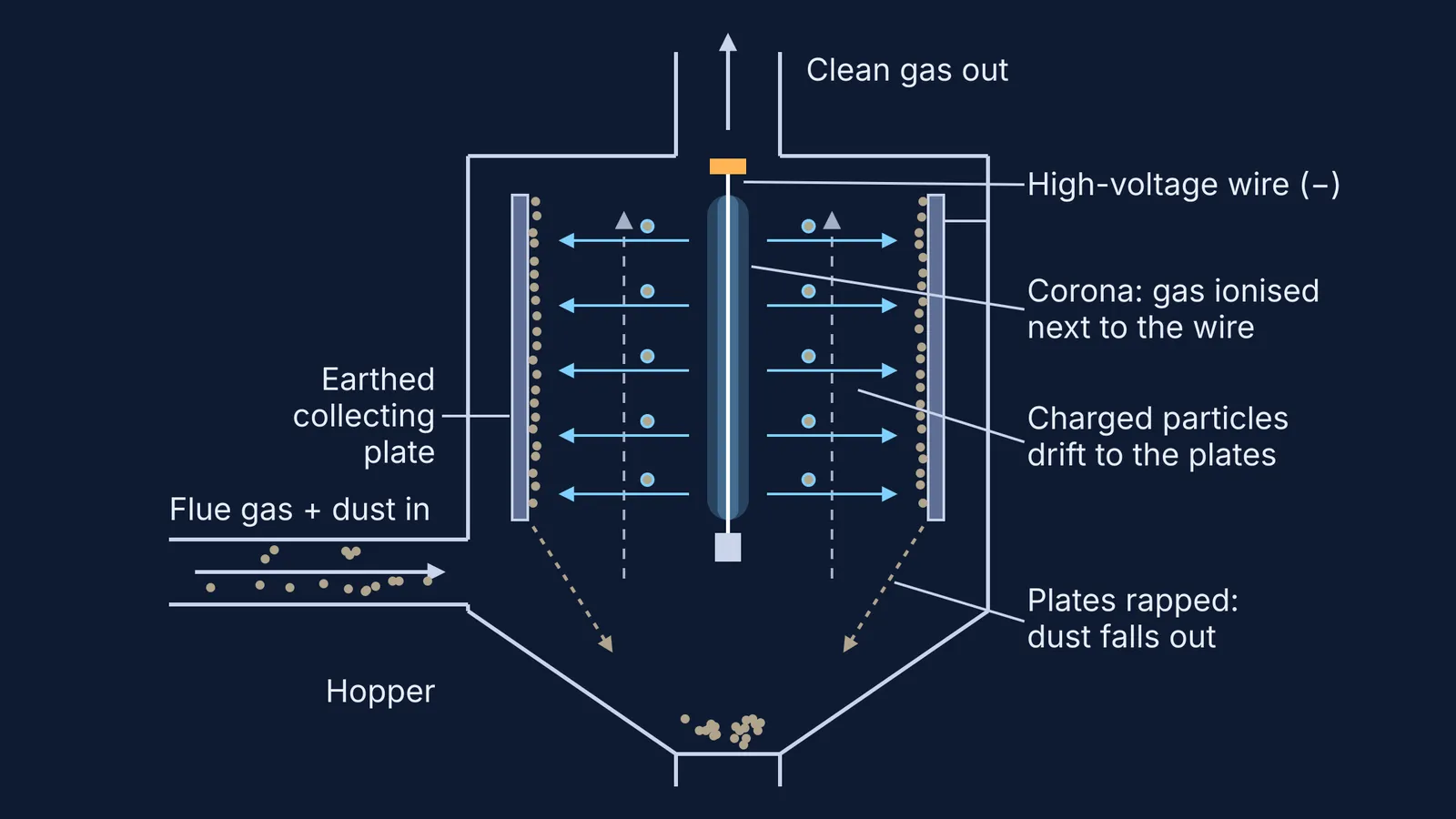
Follow the gas through the hero diagram above.
Discharge electrode. Thin wires hang between metal collecting plates. The wires are held at a high negative DC voltage, typically tens of kilovolts; the plates are earthed.
Corona discharge. Close to a thin wire the electric field is very strong, strong enough to ionise the gas. Electrons knock more electrons out of gas molecules, and a faint glowing sheath, the corona, forms.
Charging the particles. Away from the wire the field is weaker and no new ions form. Electrons there attach to gas molecules such as O₂, and these negative ions stream outward towards the plates. Dust particles in their path are hit and pick up negative charge. A large particle can collect many charges.
Drift to the plates. The field pushes the negatively charged particles sideways, away from the negative wire and towards the earthed plates, while the gas keeps moving along the plates.
Collection. At the plate a particle gives up its charge and sticks to the dust already there. The layer thickens.
Rapping. Mechanical hammers jolt the plates at intervals. The dust layer falls into hoppers below and is carried away. The cleaned gas goes on to the chimney.
How is a precipitator linked to electrophoresis and coagulation?
In electrophoresis, colloidal particles move under an applied electric field towards the electrode of opposite charge. When they reach it, their charge is neutralised and they coagulate. The details, and how it differs from electro-osmosis, are in electrophoresis vs electro-osmosis: what moves in a colloid.
A precipitator is the same idea in a gas: charged particles move in a field, reach the oppositely charged surface, lose their charge and pile up. Two differences are worth stating:
The dispersion medium is a gas, not water.
The charge does not come from adsorbed ions. It is put on the particles by the corona.
NCERT's other routes to coagulation, adding an electrolyte or mixing oppositely charged sols, are no use on a moving chimney gas, so the precipitator takes the electrical route.
Worked example: field near the wire, particle direction and SO₂
Question. A tube-type precipitator has a wire of radius 1 mm along the axis of an earthed metal tube of radius 15 cm. The wire is at −40 kV, a typical value. For this coaxial shape the field at distance r from the axis is E = V / (r ln(R/r₀)), where r₀ is the wire radius and R the tube radius. Air at ordinary pressure breaks down at about 3 × 10⁶ V/m.
(a) Find the field at the wire surface and at the tube wall. (b) How far from the axis does the corona reach? (c) Which way do dust particles move? (d) Will the device remove SO₂ from the gas?
Step 1: the log term. R/r₀ = 0.15 m / 0.001 m = 150, and ln 150 = 5.01.
Step 2: field at the wire. E = 40 000 / (0.001 × 5.01) = 8.0 × 10⁶ V/m. This is above 3 × 10⁶ V/m, so the gas next to the wire ionises.
Step 3: field at the wall. E = 40 000 / (0.15 × 5.01) = 5.3 × 10⁴ V/m. This is far below breakdown, so the gas near the wall is not ionised and the gap does not spark across.
Step 4: edge of the corona. Set E = 3 × 10⁶ V/m and solve for r: r = 40 000 / (3 × 10⁶ × 5.01) = 2.7 × 10⁻³ m. The ionising zone reaches only about 2.7 mm from the axis. This estimate ignores the ions' own charge, but it shows why the wire is thin: E falls off as 1/r, so the field is concentrated right at the wire.
Step 5: direction. The wire is negative, so the ions it makes are negative and the dust becomes negative. Negative particles are pushed away from the negative wire, towards the earthed wall, which is positive relative to the wire.
Step 6: SO₂. SO₂, CO₂ and nitrogen oxides are dispersed as single molecules, a true gaseous mixture rather than a colloid, so there is no particle to charge and collect, and the gas passes through. Plants remove SO₂ separately in a scrubber, where a lime or limestone slurry reacts with it, for example CaCO₃ + SO₂ → CaSO₃ + CO₂.
Where are electrostatic precipitators used?
They are fitted wherever a large volume of gas carries fine solid particles:
coal-fired thermal power plants, to collect fly ash before the flue gas reaches the chimney
cement plants, on kilns and clinker coolers
steel plants, metal smelters and some waste incinerators
If a field that is strong at a thin wire and weak a few centimetres away is hard to picture, the Simulation Lab has interactive simulations for ideas that are easier to see than read.
Quick checklist
Smoke is an aerosol: solid particles dispersed in a gas.
A high negative voltage on a thin wire makes a corona that ionises the gas.
Ions charge the particles; the field drives them to the earthed plates.
At the plates they lose their charge and coagulate, as in electrophoresis.
Rapping drops the dust into hoppers.
Gases such as SO₂ are not colloids and need a scrubber.


