On this page
Put two electrodes into a colloid and switch on the voltage. Something starts to move. Whether it is the particles or the liquid around them is the whole difference between electrophoresis and electro-osmosis.
What is a sol, and why is it charged?
NCERT's Class 12 chemistry laboratory manual defines a sol as a colloid with a solid dispersed phase in a liquid dispersion medium, with colloidal particles between 10^-9 and 10^-6 m across.
The same manual explains that lyophobic sols are kept stable by the charge on their particles: like charges repel, so the particles stay suspended instead of clumping. That charge can be positive or negative. The manual's examples of charged sols:
Negative: starch and arsenious sulphide sols.
Positive: hydrated ferric oxide, made by adding FeCl3 to excess hot water.
Negative again: hydrated ferric oxide, made by adding ferric chloride to NaOH solution.
The same substance can carry either charge, depending on how it is prepared. So you cannot always read the charge off the formula. You have to measure it, and electrophoresis is how.
What is the difference between electrophoresis and electro-osmosis?
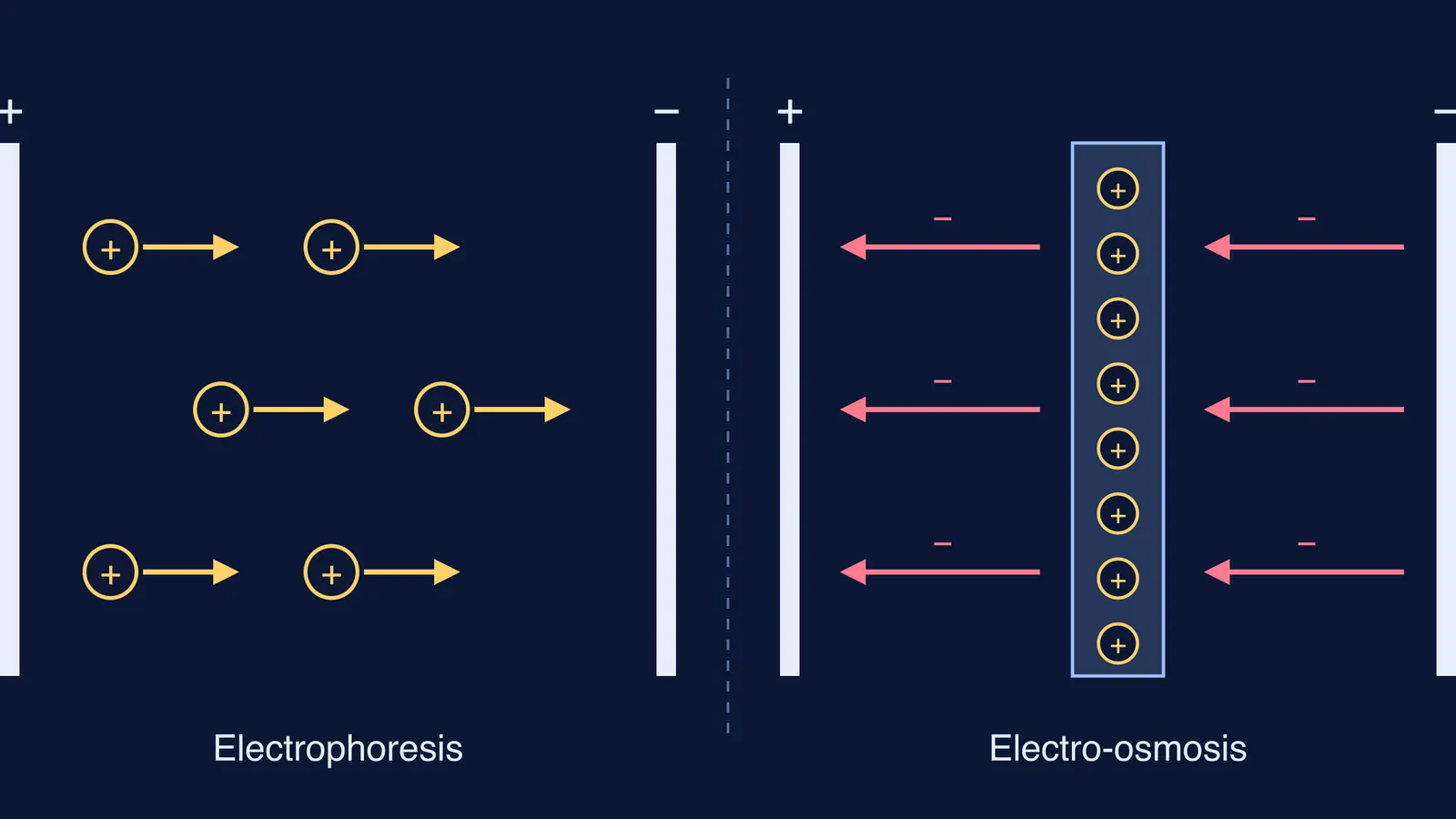
Electrophoresis is the motion of charged dispersed particles relative to a fluid under a uniform electric field, as Wikipedia's electrophoresis article defines it. Positively charged particles drift towards the negative electrode (cathode); negatively charged ones drift towards the positive electrode (anode).
Electro-osmosis is the motion of a liquid caused by a potential applied across a porous material, membrane, capillary or channel, according to Wikipedia's electro-osmosis article. The same article records that Ferdinand Friedrich Reuss first reported in 1807, and published in 1809, that water flows through a plug of clay when a voltage is applied.
The link between them is charge balance. A colloid is electrically neutral overall, so if the particles carry one sign, the liquid layer around them carries the other. Let the particles move freely and you see electrophoresis. Hold the particles still, with a membrane or a packed plug, and the field pushes the oppositely charged liquid instead: electro-osmosis. In that second case the medium flows towards the electrode with the same sign as the particles.
A quick comparison:
What moves: particles (electrophoresis) or the dispersion medium (electro-osmosis).
What is held still: nothing (electrophoresis); the particles, by a membrane or plug (electro-osmosis).
Direction for a positive sol: particles to the cathode (electrophoresis); medium to the anode (electro-osmosis).
How does electrophoresis show the charge on a sol?
The direction tells you the sign. Fill a U-tube with sol, add a little clear electrolyte on top in each arm, dip in electrodes and apply a voltage. Watch the coloured boundary. If it rises on the cathode side and falls on the anode side, the particles are positive. If it does the reverse, they are negative.
The speed tells you more. The Smoluchowski equation, given in the electrophoresis article, links the electrophoretic mobility (speed per unit field) to the zeta potential: mobility = εr ε0 ζ / η, where η is the viscosity. It holds when the particle is much larger than the Debye length, which the article says is true of most water-based systems. The zeta potential is the electrical potential at the slipping plane, the boundary between liquid that moves with the particle and liquid that stays attached to its surface (Wikipedia: zeta potential).
A worked example: from a moving boundary to a zeta potential
Suppose the electrodes are 20 cm apart at 100 V, and a ferric hydroxide boundary moves 2.0 mm towards the cathode in 100 s. These are illustrative numbers; the constants are sourced.
Field: E = 100 V / 0.20 m = 500 V/m.
Speed: v = 2.0 × 10^-3 m / 100 s = 2.0 × 10^-5 m/s.
Mobility: v / E = 4.0 × 10^-8 m² V^-1 s^-1, positive because the particles went to the cathode.
Constants for water at 25 °C: viscosity 0.890 mPa·s (Wikipedia: properties of water), relative permittivity 78.4 (Wikipedia: relative permittivity), and ε0 = 8.854 × 10^-12 F/m (NIST CODATA).
Zeta: ζ = mobility × η / (εr ε0) = (4.0 × 10^-8 × 8.90 × 10^-4) / (78.4 × 8.854 × 10^-12) ≈ +0.051 V, about +51 mV.
The positive sign matches NCERT's charge for this sol made in hot water; a real result depends on preparation.
How to avoid mixing them up in an exam
Underline what is prevented from moving. "Particles prevented from moving" means electro-osmosis.
For electro-osmosis, flip the sign: the medium goes to the electrode with the same sign as the particles.
If you want to see the double layer and the slipping plane as a lesson rather than a line in a textbook, the Fermi Concept Library has every concept in chemistry with its own lesson and its place in the map. When a mobility or zeta calculation goes wrong, the Fermi Problem Library has worked problems with a step-by-step solver that explains the reasoning rather than printing an answer.