
On this page
Jnanendra Nath Mukherjee (1893–1983), born in Mahadevpur in present-day Bangladesh, studied at Presidency College in Calcutta and published his first colloid paper in 1915, according to his biographical memoir from the Indian National Science Academy. His question is one you meet in surface chemistry: why do tiny particles in a sol carry a charge at all, and why does a little salt make them clump?
What did J. N. Mukherjee discover about the charge on colloids?
In 1919 Mukherjee joined F. G. Donnan's laboratory at University College London, where his main work was to develop "his theory of the electrokinetic double layer and its ionic constitution", the same memoir records. He presented it at a discussion on colloids held by the Faraday Society and the Physical Society of London, published in 1921 as The origin of the charge of a colloidal particle and its neutralisation by electrolytes. A reviewer in Nature called it "perhaps the most important paper of the whole discussions", the memoir notes.
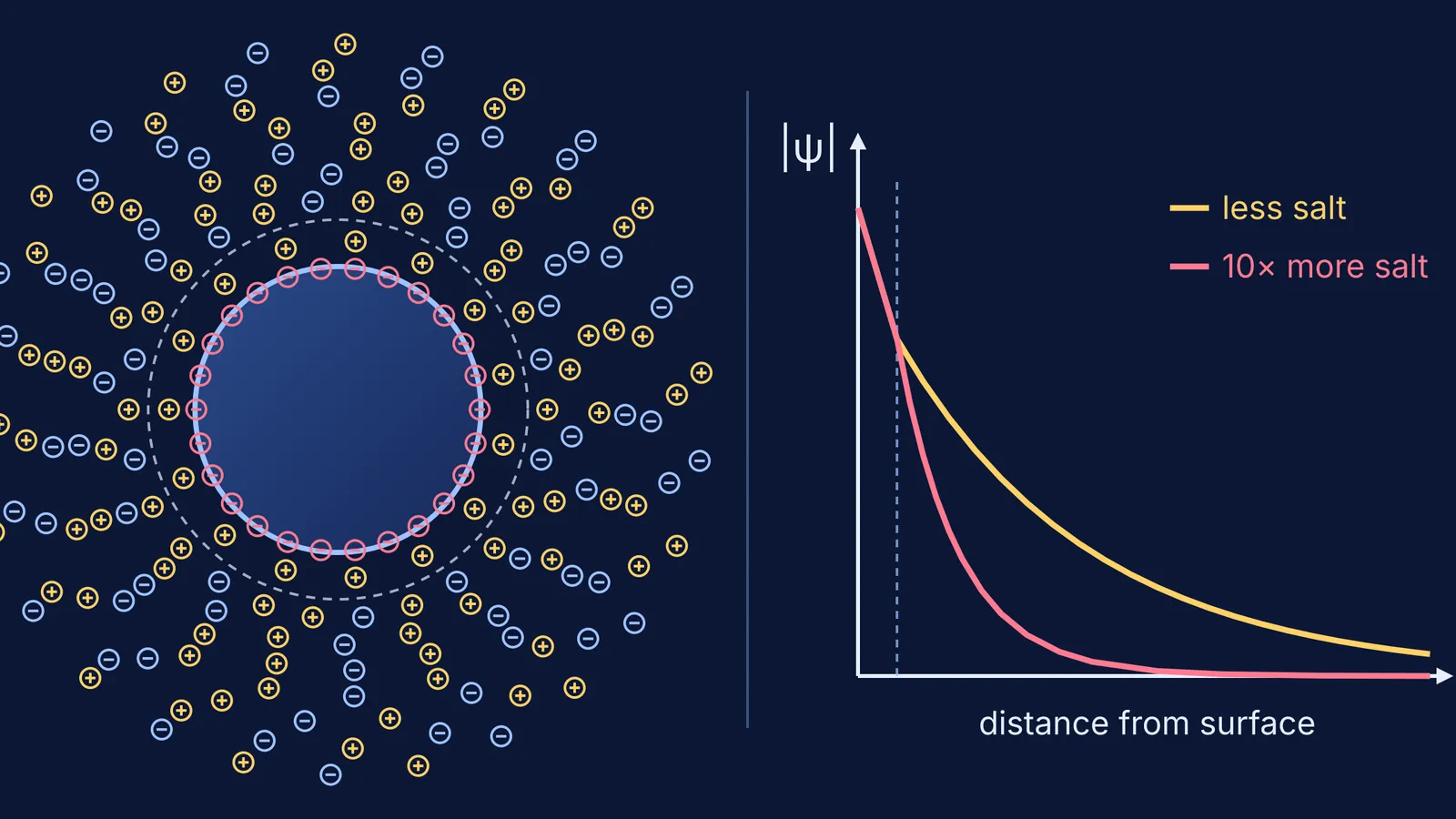
In Mukherjee's account, the charge is ionic. Particular ions from the solution adsorb onto the particle's surface and give it its sign. An equal opposite charge, carried by counter-ions, gathers in the liquid around it. Together they make the electrical double layer, and electrolytes neutralise a sol by changing that layer.
He developed the argument in The adsorption of ions in 1922. In 1924, with B. C. Roy, he reported experiments on reversing the charge of colloids, including stable sols with the opposite sign to the usual one. He also sharpened the measurement itself: a 1923 Royal Society paper tackled errors in the moving-boundary method, which times colloid particles travelling in an electric field.
What is the electrical double layer in simple terms?
A Malvern technical note on zeta potential describes an inner Stern layer, where counter-ions are strongly bound, and an outer diffuse layer, where they are held loosely. The potential at the boundary that moves with the particle is the zeta potential. Particles with a zeta potential more positive than +30 mV or more negative than −30 mV are normally considered stable, the note says.
Salt changes this. Higher ionic strength compresses the double layer, and a trivalent ion such as Al3+ compresses it more than a monovalent ion such as Na+, the note explains. A thinner layer means weaker repulsion, so particles touch and stick. That is the logic behind the Hardy-Schulze rule for coagulation and how alum clears muddy water.
How do you predict the charge on a sol?
Silver iodide is the classic case. The Malvern note explains that when silver ions dissolve preferentially the surface is negative, and adding Ag+ first cancels the charge, then makes it positive. Use four steps:
Find which ion, shared with the particle, is in excess in the solution.
That ion adsorbs, so the particle takes its sign.
The oppositely charged ions in the solution become the counter-ions.
To coagulate the sol, add ions with the opposite charge to the particle; the higher their charge, the stronger the effect.
Now try it. Add silver nitrate to excess potassium iodide. Iodide is in excess, so I− adsorbs, the sol is negative (AgI/I−), and K+ ions form the diffuse layer; Al3+ coagulates it more readily than Na+. Reverse the order, adding potassium iodide to excess silver nitrate, and Ag+ adsorbs instead: the sol is positive (AgI/Ag+), with NO3− as counter-ions, and now the charge on added anions matters.
Why did his colloid work matter for soil science?
Clay is a natural colloid. A Soil Quality fact sheet on cation exchange capacity explains that clay and organic matter carry negatively charged sites that hold cations such as calcium, magnesium and potassium; as soils acidify, H+, Al3+ and Mn2+ replace them.
Mukherjee turned his colloid tools on this problem as early as 1922, in a Nature letter on experiments on the theory of soil acidity. His INSA memoir describes how he began with sols of silica and alumina, moved to clays from Indian soils, and later studied hydrogen clays and the release of H+, Al3+ and Fe3+ ions by neutral salts. C. E. Marshall called his group the "Calcutta School of Soil Science". Sir John Russell, in a report to the Government of India, wrote that "his investigations on soil colloids are recognized in Europe as being both sound and important".
The memoir adds that he helped found the Indian Society of Soil Science in 1934, became Director of the Imperial (now Indian) Agricultural Research Institute in 1945, and guided a revised 1954 soil map of India showing 20 soil classes.
How should you revise the charge on colloids?
Draw it before you memorise it: a circle, its adsorbed ions, a tight ring of counter-ions, then a looser cloud. Run the four steps on every sol in your notes, and revise the types of colloids alongside.
If the double layer is still hard to picture, the Fermi Simulation Lab has interactive simulations for ideas that are easier to see than to read. If terms like adsorption feel shaky, each concept has its own lesson in the Fermi Concept Library.