

On this page
Photograph a plain white wall with a wide-angle lens and the corners of the picture come out darker than the middle, even though the wall is evenly lit. This darkening is called vignetting. Part of it is not a fault in the lens at all. It is geometry: light heading for a point near the edge of the sensor has to come in at an angle, and that costs it brightness in three separate ways. Multiply them and you get the cos⁴ law, which you can work out with nothing more than the inverse-square law and a bit of projection.
Why are the corners of a photo darker than the centre?
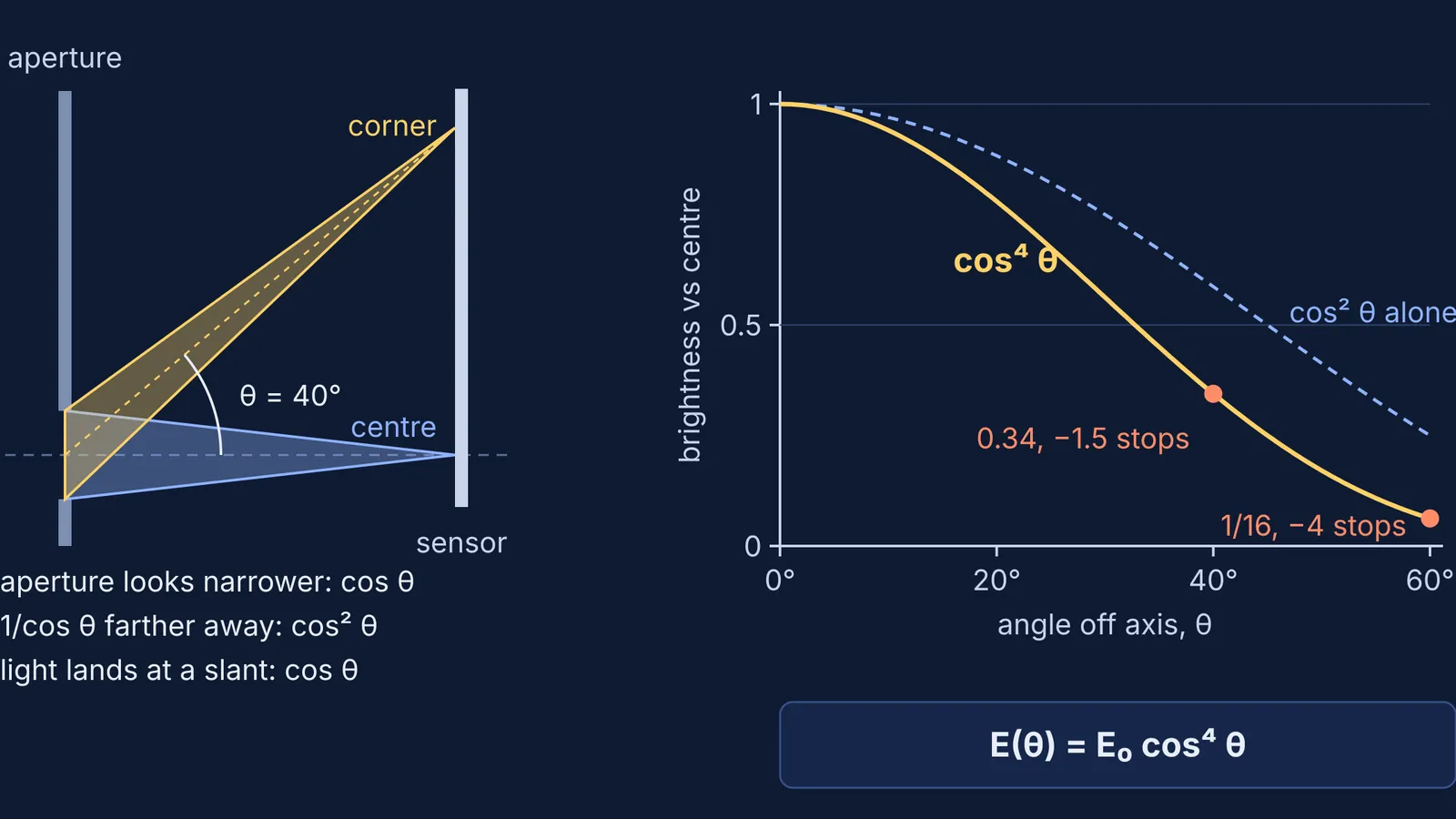
Think of the lens opening (the aperture) as a small, evenly bright window, a distance L in front of a flat sensor. Light reaching the centre of the sensor comes straight down the axis. Light reaching a point at an angle θ off the axis loses out three times:
The aperture looks narrower. A round opening seen from the side looks like an ellipse. Its area as seen from that point shrinks by cos θ.
The aperture is farther away. The slanted path is L/cos θ long instead of L. Brightness falls as 1/distance², so this costs a factor of cos² θ. If you want to revise that step, see how the inverse square law predicts brightness at 2x and 3x distance.
The light lands at a slant. A beam hitting a surface at angle θ to the normal spreads over 1/cos θ more area, so the light per square millimetre drops by another cos θ. This is the same reason winter sunlight warms the ground less.
Put together, the illuminance at angle θ is
E(θ) = E₀ cos⁴ θ
where E₀ is the illuminance at the centre. Optical engineers call this natural vignetting, or the cosine-fourth law. It is one of several factors that set how bright the edge of an image is, as Reshidko and Sasian note in their SPIE paper on relative illumination, alongside lens aberrations and light physically blocked by the lens barrel.
How much darker is a corner at 40°?
Photographers measure brightness in stops. One stop is a factor of 2, so the number of stops darker is log₂(E₀/E). For f-numbers and how one stop relates to aperture size, see how camera aperture size affects brightness and blur.
Here is cos⁴ θ at a range of angles, worked out with a calculator:
10°: 0.941 of the centre, 0.09 stops darker.
20°: 0.780, 0.36 stops.
30°: 0.563, 0.83 stops.
40°: 0.344, 1.54 stops.
45°: 0.250, exactly 2 stops.
60°: 0.0625, exactly 4 stops.
At 40°, the light is cut to about a third. The loss is gentle near the middle and then speeds up: going from 0° to 20° costs a third of a stop, but going from 40° to 60° costs about two and a half stops.
Worked example: how dark are the corners of a phone's ultra-wide camera?
Samsung lists the ultra-wide camera on its Galaxy S22 phones with a 120° field of view. Camera field of view is normally quoted across the diagonal (the check after the steps confirms it here), so the corner of the picture sits 60° off axis. Treat the lens as a simple one that follows cos⁴.
Half the field of view. The corner of the frame is at θ = 120°/2 = 60°.
Cosine. cos 60° = 0.5.
Fourth power. 0.5⁴ = 1/16 = 0.0625.
In stops. log₂ 16 = 4 stops darker than the centre.
Gain needed. To make the corner match the centre, the camera must multiply the corner pixels by 16.
Check against 40°. A corner at 40° would need a gain of only 1/0.344 = 2.9. Widening the view from 80° to 120° raises the needed gain more than five times.
As a check on the angle, Samsung quotes the Galaxy S21 Ultra ultra-wide as 120° at a 13 mm full-frame equivalent focal length. The diagonal of a full-frame sensor is 43.3 mm, and 2 × tan⁻¹(21.6/13) gives 118°, consistent with 120°.
Treat the 4 stops as what a simple cos⁴ lens would give, not a measured figure for any phone. Real wide-angle lenses are designed so the aperture appears larger when seen from the side, and many beat the cos⁴ prediction. Phone makers do not usually publish the corner falloff of their lenses.
How do phones fix dark corners, and what does it cost?
Phones correct this in software. Android's camera documentation describes a lens shading correction map, a grid of gain factors used to correct vignetting and colour shading. The least shaded part of the picture has a gain of 1 and every other part has a gain above 1.
The gain brightens the corner, but it cannot add light that never arrived. If the corner collects 1/16 as many photons as the centre, the random photon noise there is relatively larger. Photon noise grows as the square root of the count, so the signal-to-noise ratio at the corner is √16 = 4 times worse than at the centre. That is why dim indoor shots from an ultra-wide camera often look grainier at the edges than in the middle.
If the inverse-square and slanted-area steps are hard to picture, the Fermi Simulation Lab has interactive simulations for ideas that are easier to see than read.
Is cos⁴ vignetting the same as other dark edges?
No. Keep three things apart:
Natural vignetting (cos⁴). Pure geometry, present even in a perfect lens with nothing in the way. Closing the aperture does not remove it.
Mechanical vignetting. The lens barrel or a lens hood physically blocks part of a slanted bundle of light. It usually shrinks when you close the aperture.
A cut-off view in an eyepiece. In a telescope or microscope, placing your eye away from the eye ring trims the field of view. That is covered in where to put your eye on a telescope, and it is a different effect.
Quick checklist
E(θ) = E₀ cos⁴ θ for light reaching the sensor at angle θ off axis.
Three causes: smaller-looking aperture (cos θ), longer path (cos² θ), slanted landing (cos θ).
One stop is a factor of 2; stops darker = log₂(1/cos⁴ θ).
40° gives 0.344 (1.5 stops); 60° gives 1/16 (4 stops).
Corner angle = half the diagonal field of view.
Software gain fixes brightness but not noise; real lenses can beat or fall short of cos⁴.


