

On this page
Put your eye right against the eyepiece of a telescope and you often see a small, vignetted circle of sky. Pull your head back a little and the view suddenly opens out to its full width. That sweet spot has a name: the eye ring, also called the exit pupil. An NCERT Class 12 Ray Optics exercise asks how far from the eyepiece the eye should be, and the answer is a neat use of the lens formula. Here is how to find it, and why binocular labels such as 7 × 50 are about it.
What is the eye ring of a telescope?
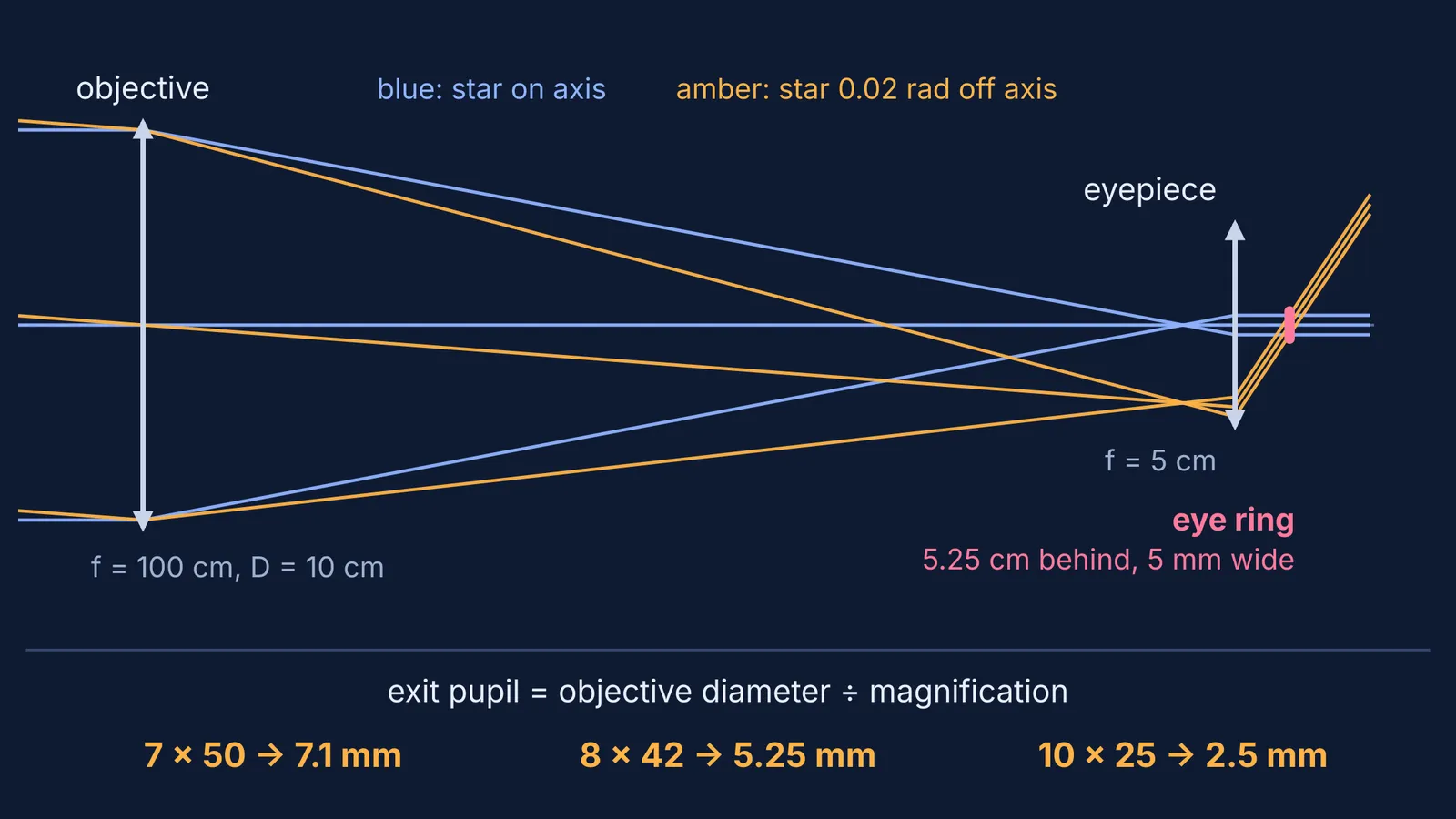
The eye ring is the real image of the objective lens formed by the eyepiece. It is not an image of the star or the object you are looking at.
Think about every ray that enters the telescope. Each one passes through the objective, so the objective is the opening that limits the light. The eyepiece then forms an image of that opening behind itself. Since every ray that got in had to pass through the objective, every ray that leaves the eyepiece has to pass through the image of the objective. That image is a small bright disc floating in the air behind the eyepiece.
Why should your eye sit at the eye ring?
Your pupil is a small opening, a few millimetres across. You want all the light the telescope collects, from every direction in the field of view, to fit through it.
At the eye ring, the bundles of light from every star in the field cross each other in one small disc. If your pupil is there and at least as wide as the disc, you see the full field at full brightness.
At the eyepiece itself, the bundles from different stars leave the lens at different heights. Light from stars near the edge of the field leaves the eyepiece far from the axis and misses a small pupil placed on the axis. The view is clipped to a narrow circle.
Further back than the eye ring, the bundles separate again, and the edge of the field is lost once more.
How far behind the eyepiece is the eye ring?
Question. An astronomical telescope has an objective of focal length 100 cm and diameter 10 cm, and an eyepiece of focal length 5 cm. It is in normal adjustment. Where should you place your eye, and how wide is the eye ring?
Find the separation of the lenses. In normal adjustment the final image is at infinity, so the lenses are f_o + f_e = 100 + 5 = 105 cm apart.
Treat the objective as the object for the eyepiece. It is a real object 105 cm in front of the eyepiece, so with the Cartesian sign convention u = −105 cm and f = +5 cm.
Apply the lens formula. 1/v − 1/u = 1/f gives 1/v = 1/5 − 1/105 = 20/105, so v = +5.25 cm. The positive sign means a real image 5.25 cm behind the eyepiece.
Find the size. Magnification m = v/u = 5.25/(−105) = −0.05. The ring is 0.05 × 10 cm = 0.5 cm = 5 mm across, and inverted, which does not matter for a disc.
Check with D/M. The magnifying power is M = f_o/f_e = 100/5 = 20, and D/M = 10 cm/20 = 0.5 cm. The two answers agree.
So the eye should be about 5.25 cm behind the eyepiece, and the beam there is 5 mm wide, which a normal pupil can take in.
Why is the eye ring width equal to D/M?
In general, v = f_e(f_o + f_e)/f_o, and the ring diameter is D × v/(f_o + f_e) = D × f_e/f_o = D/M. Two things follow. When f_o is much larger than f_e, the eye ring sits just beyond one focal length of the eyepiece. And the D/M result holds for a telescope in normal adjustment; if the lenses are moved to put the final image at the near point, the separation changes and so do the position and size of the ring.
The same idea gives another meaning to magnifying power: M = D/d, the objective's diameter divided by the eye ring's diameter. For the length and magnifying power of the other common design, see the Galilean telescope: magnifying power fo/fe and length fo − fe.
Where is the eye ring of a compound microscope?
The same method works. Take a compound microscope with an eyepiece of focal length 6.25 cm and the two lenses 15 cm apart, values used in a common textbook exercise.
Object for the eyepiece: the objective, u = −15 cm, f = +6.25 cm.
Lens formula: 1/v = 1/6.25 − 1/15 = 0.1600 − 0.0667 = 0.0933 cm⁻¹, so v = 10.7 cm.
Size: m = 10.71/15 = 0.71, so the eye ring is about 0.71 times the diameter of the objective.
Here the separation is not much larger than f_e, so the eye ring is well beyond one focal length of the eyepiece. Why microscope objectives are so short in focal length is a separate question, covered in why a microscope objective has a short focal length.
What does 7 × 50 on a pair of binoculars mean?
Binoculars are labelled magnification × objective diameter in millimetres, so the exit pupil is simply the second number divided by the first.
7 × 50: 50/7 = 7.1 mm.
8 × 42: 42/8 = 5.25 mm.
10 × 25: 25/10 = 2.5 mm.
Now compare with the pupil of the eye. As a round illustrative value, a young eye fully adapted to the dark opens to about 7 mm, and many older eyes open to nearer 5 mm. Real pupils vary a lot from person to person, so treat these as rough guides, not limits. A 7 × 50 matches a wide young pupil, which is why it is a classic choice for night use. In bright daylight the pupil is much smaller, so a compact 10 × 25 gives all the light it can use.
If the exit pupil is wider than your own pupil, the outer part of the beam lands on your iris and is wasted. A bigger objective at the same magnification then makes the view no brighter for you. How much light an objective gathers in the first place is covered in light gathering power of a telescope and the aperture ratio.
If ray diagrams with two lenses are hard to picture, the Concept Library covers every concept in physics, and the Fermi Problem Library has a step-by-step solver that explains the reasoning for lens problems like these.
Quick checklist
The eye ring is the eyepiece's real image of the objective.
All light entering the objective passes through it, so the eye there sees the full field.
Object distance for this step is the lens separation (f_o + f_e in normal adjustment).
Telescope: v = f_e(f_o + f_e)/f_o, diameter D/M; here 5.25 cm and 5 mm.
Microscope with f_e = 6.25 cm, lenses 15 cm apart: 10.7 cm behind the eyepiece.
Binoculars: exit pupil = objective mm ÷ magnification; match it to your pupil.


