

On this page
If two telescopes differ only in the size of their front lens or mirror, the bigger one shows fainter stars. Exam questions turn this into one line: find the ratio of light gathering powers. The answer is the ratio of the diameters, squared.
What is the light gathering power of a telescope?
A telescope's objective, the big lens or mirror at the front, works like a bucket held out in the rain. Starlight from a distant star arrives as an even shower across the opening, so the wider the opening, the more you catch each second. The aperture is the diameter D of that objective.
As OpenStax Astronomy 2e puts it, "The amount of light a telescope can collect increases with the size of the aperture." More light per second means fainter objects become visible.
Why does light gathered grow as D², not D?
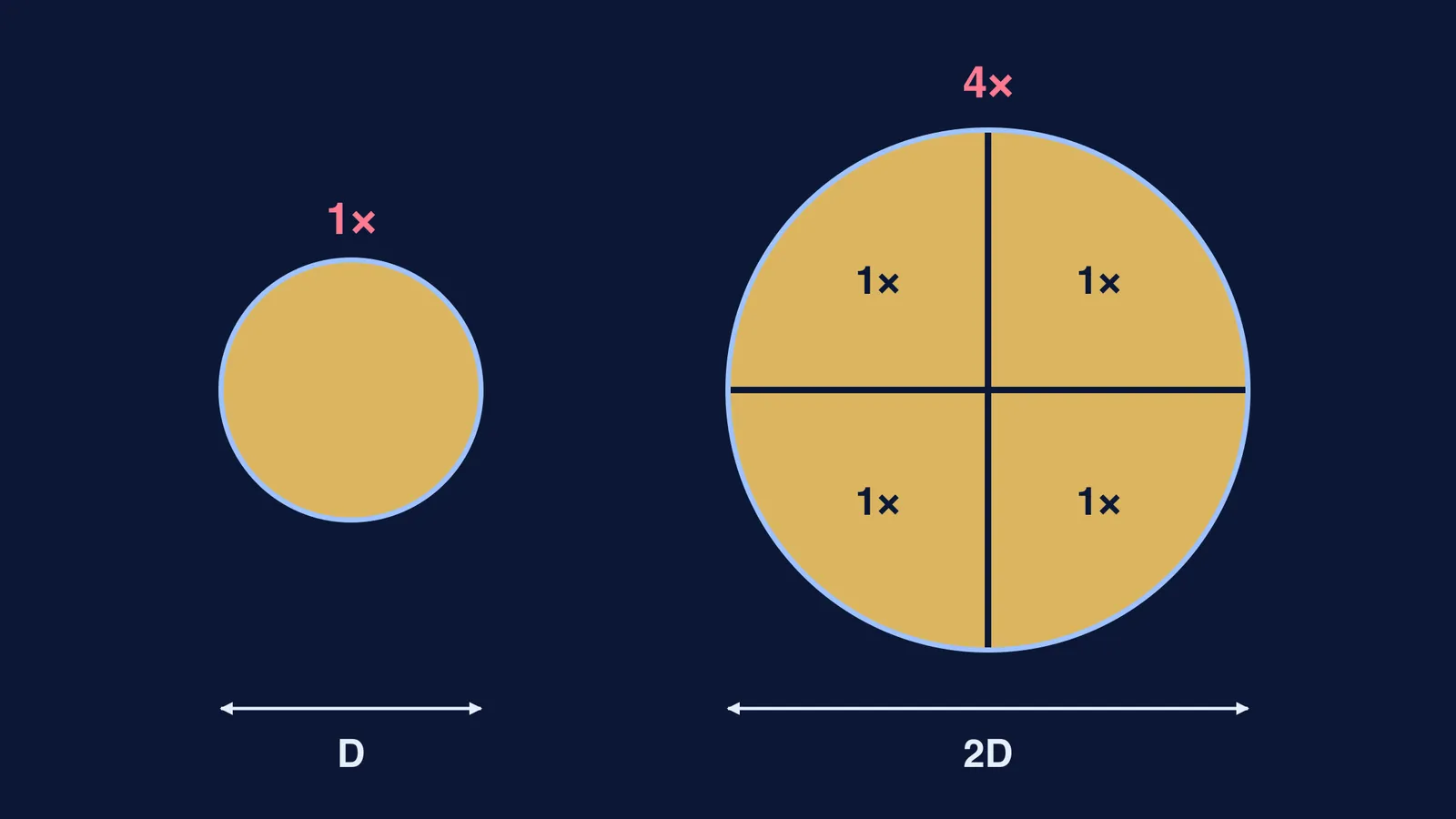
The light collected is proportional to the collecting area, and the area of a circle is πD²/4, which is why the diameter gets squared (OpenStax Astronomy 2e). The π/4 is the same for every telescope, so it cancels when you compare two:
LGP₁ / LGP₂ = (D₁ / D₂)²
The same OpenStax section gives the standard example: a telescope with a 4 m mirror collects 16 times as much light as one with a 1 m mirror. Doubling D gives 4 times the light, and tripling it gives 9 times.
Worked example: how do two telescopes compare?
Telescope A has an objective of diameter 5 cm, objective focal length 100 cm and eyepiece focal length 2 cm. Telescope B is identical except that its objective is 10 cm across. We use the area rule from OpenStax Astronomy 2e.
Light gathering power: (10/5)² = 4. B collects 4 times as much light as A.
Exposure time: to collect the same total light from a faint galaxy, B needs a quarter of A's time, so a 40-minute photo on A takes 10 minutes on B.
Magnifying power: in normal adjustment it is fo/fe. OpenStax University Physics Volume 3 writes it as M = −fobj/feye, the minus sign marking an inverted image. Both telescopes give 100/2 = 50. No change.
Resolving power: the smallest angle a telescope can separate is θ = 1.22λ/D, the Rayleigh criterion in OpenStax University Physics Volume 3. For λ = 550 nm, A gives 1.34 × 10⁻⁵ rad and B gives 6.7 × 10⁻⁶ rad. B separates details twice as fine.
So doubling the aperture gave 4 times the light, twice the resolving power and the same magnification.
Now a real pair. The 3.6 m Devasthal Optical Telescope, run by ARIES, has a primary mirror of optical diameter 3.6 m. The Hubble Space Telescope's mirror is 2.40 m across (OpenStax University Physics Volume 3). The ratio is (3.6/2.4)² = 1.5² = 2.25, so on the area rule alone Devasthal collects about 2.25 times as much light.
On paper, Devasthal should also resolve finer detail: the same OpenStax example gets 2.80 × 10⁻⁷ rad for Hubble, and the formula gives about 1.86 × 10⁻⁷ rad for 3.6 m at 550 nm. But on the ground, turbulent air twists and bends light rays, which astronomers call "bad seeing" (OpenStax Astronomy 2e). You can read more about India's 3.6 m Devasthal telescope.
How is light gathering power different from magnifying and resolving power?
Keep them apart by the question each one answers:
Light gathering power grows as D². It answers: how faint an object can I see?
Resolving power grows as D, since θ = 1.22λ/D. It answers: can I split two close stars? Our explainer on resolving power of microscopes and telescopes goes further.
Magnifying power is fo/fe. It depends on focal lengths, not aperture, and it answers: how big does the image look? Swapping the eyepiece changes it. See magnifying power of microscopes and telescopes, worked step by step.
OpenStax adds a useful caution: "Stars look like points of light, and magnifying them makes little difference" (OpenStax Astronomy 2e).
What mistakes cost marks on aperture questions?
Writing the diameter ratio and forgetting to square it.
Squaring for resolving power, which is linear in D.
Comparing diameters in different units, such as 50 mm against 10 cm. Convert first.
Assuming more magnification shows fainter stars. Only a larger aperture does that.
If you keep getting the method wrong, the Fermi Problem Library has worked problems with a step-by-step solver that explains the reasoning rather than printing an answer. If the three powers still blur together, the Fermi Concept Library gives each physics concept its own lesson and its place in the map.
Next time you see an aperture question, write (D₁/D₂)² before anything else.


