On this page
Search "what is the Devasthal telescope" and you get two answers from the same observatory near Nainital, Uttarakhand. One is India's 3.6 m Devasthal Optical Telescope, a telescope that can be pointed and steered. The other is a 4 m mirror made of liquid mercury that spins to hold its shape. That second one is a Class 11 rotation problem built at full size, and we will work through it below.
What is the Devasthal telescope?
The 3.6 m Devasthal Optical Telescope (DOT) is an optical Ritchey–Chrétien telescope at an altitude of 2,540 m, according to ARIES, the institute that runs it. ARIES, the Aryabhatta Research Institute of Observational Sciences, is an autonomous institute under the Department of Science and Technology.
The telescope was activated remotely on 31 March 2016 by Prime Minister Narendra Modi and Belgian Prime Minister Charles Michel from Brussels, and its optics were built in collaboration with the Belgian firm AMOS. The same page describes an active optics system: a wavefront sensor and pneumatic actuators correct small distortions in the 4.3-tonne mirror caused by gravity or the atmosphere.
Its instruments, listed by ARIES, cover visible and infrared light: an optical imager working from 400 to 900 nm, the TIRCAM2 near-infrared camera from 1.0 to 3.7 μm, and two spectrographs, ADFOSC and TANSPEC. India also observes from orbit; our explainer on AstroSat, India's space telescope covers that side of the story.
How can a spinning pool of mercury be a mirror?
The International Liquid Mirror Telescope (ILMT) has a 4 m primary mirror that is a rotating container of highly reflective mercury. It saw first light on 29 April 2022 and was inaugurated on 21 March 2023, ARIES says.
The project paper by Jean Surdej and colleagues gives the working numbers: about 650 kg of mercury, spun at about 8 turns per minute, giving a focal length of about 8 m. A very thin mylar film covers the mercury so that moving air does not ripple the surface.
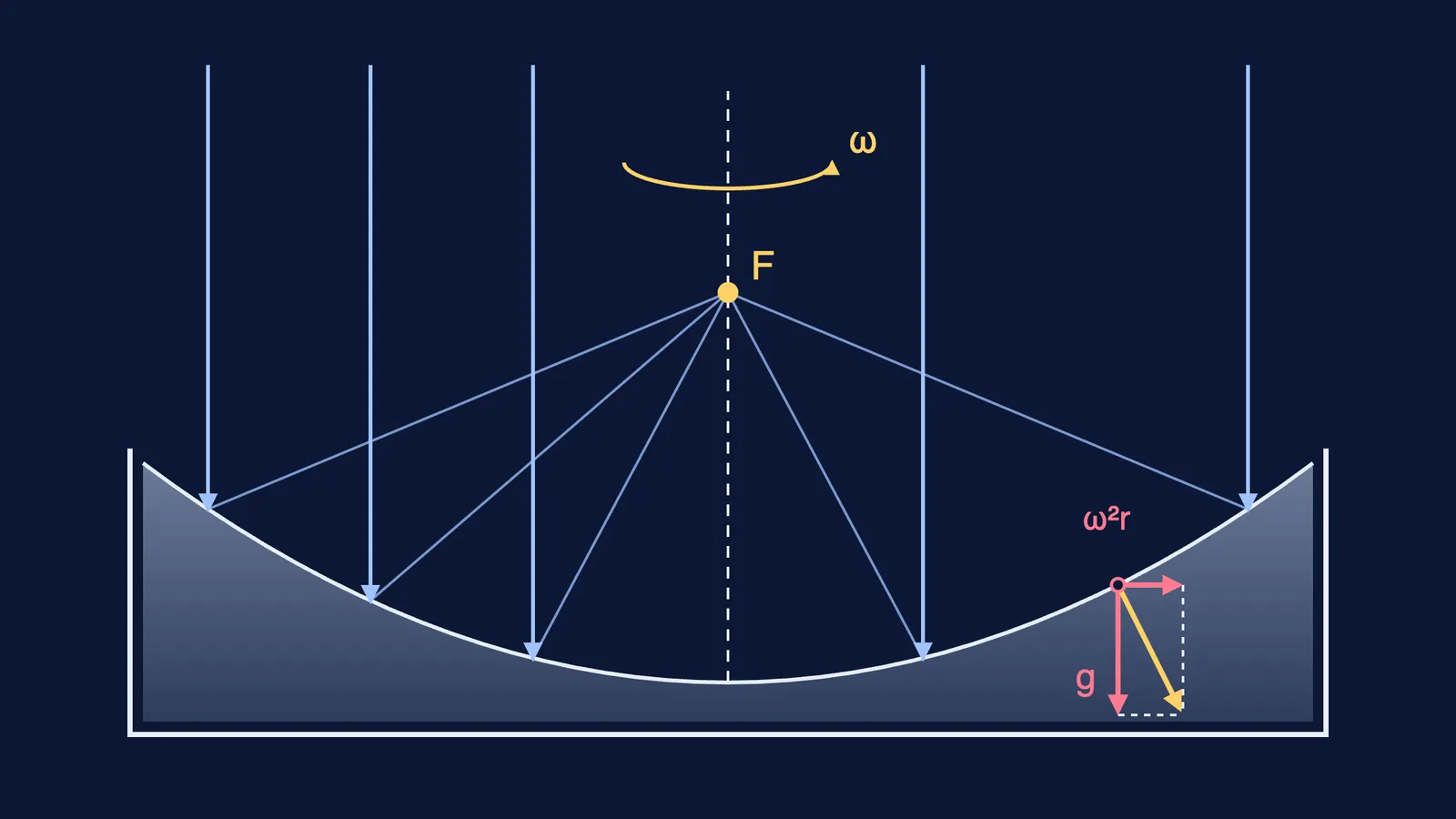
Why a parabola? Ride along with the spinning mirror and look at one small piece of the surface a distance r from the axis. It feels gravity g pulling down and a centrifugal acceleration ω²r pushing outward. The paper explains that a liquid always sets its surface perpendicular to the net acceleration it experiences.
So the slope of the surface at radius r is dz/dr = ω²r/g. Integrate and you get z = ω²r²/(2g), which is a parabola. Compare it with the standard form r² = 4fz and the focal length is f = g/(2ω²). A parabolic mirror sends every ray parallel to its axis to one focus, which is why the shape is worth spinning for.
Worked example: how fast must the ILMT spin?
Take the paper's focal length, f = 8 m, the mirror radius, r = 2 m, and g = 9.8 m/s².
From f = g/(2ω²), ω = √(g/2f) = √(9.8/16) ≈ 0.78 rad/s.
In turns per minute: 0.78 × 60 / 2π ≈ 7.5, so one turn takes about 8 s. That is close to the paper's rounded "about 8 turns per minute".
Rim height: z = r²/(4f) = 4/32 = 0.125 m. The mercury at the edge stands about 12.5 cm above the centre.
Sensitivity: f depends on 1/ω², so a 1% change in spin changes the focal length by about 2%. The paper sets a much tighter limit: rotation period variations below about one part in a million, to avoid transitory effects in the mercury.
The same equation solves the JEE classic of a beaker of water spun on a turntable. For the lens-based counterpart, see how to find the magnifying power and length of a Galilean telescope.
If the rotating frame is hard to picture, the Fermi Simulation Lab has interactive simulations for the ideas that are easier to see than to read. The Fermi Problem Library has worked problems with a step-by-step solver that explains the reasoning rather than printing an answer.
What can each Devasthal telescope do that the other cannot?
The 3.6 m DOT can be pointed and can track an object across the sky, then split its light with a spectrograph.
The 4 m ILMT watches one strip of sky, about 22 arcminutes wide, as it passes overhead each night, recording it with a CCD camera that uses time-delayed integration, per the project paper.
Because the ILMT sees the same strip again and again, changes stand out. The paper reports hundreds of transients and known asteroids identified, and more than 80 satellite and space debris streaks detected.
Telescopes are often strongest in combination; the Event Horizon Telescope's black hole image needed a planet-sized network of them.
Next time you solve a rotating-fluid question, remember there is a 4 m version of your answer on a hill near Nainital.