On this page
Here you will see why a concave eyepiece keeps the image upright, work out both formulas, and test them on Galileo's own telescope.
What is a Galilean telescope?
A Galilean telescope is a refracting telescope with a converging (convex) objective lens and a diverging (concave) eyepiece, and it gives an upright image (Wikipedia: Refracting telescope). The astronomical (Keplerian) telescope uses a convex eyepiece, and its image is inverted.
The objective has a long focal length, fo; the eyepiece a short one, fe. In normal adjustment the final image is at infinity.
Why does a Galilean telescope give an upright image?
Follow the light from the top of a distant water tank.
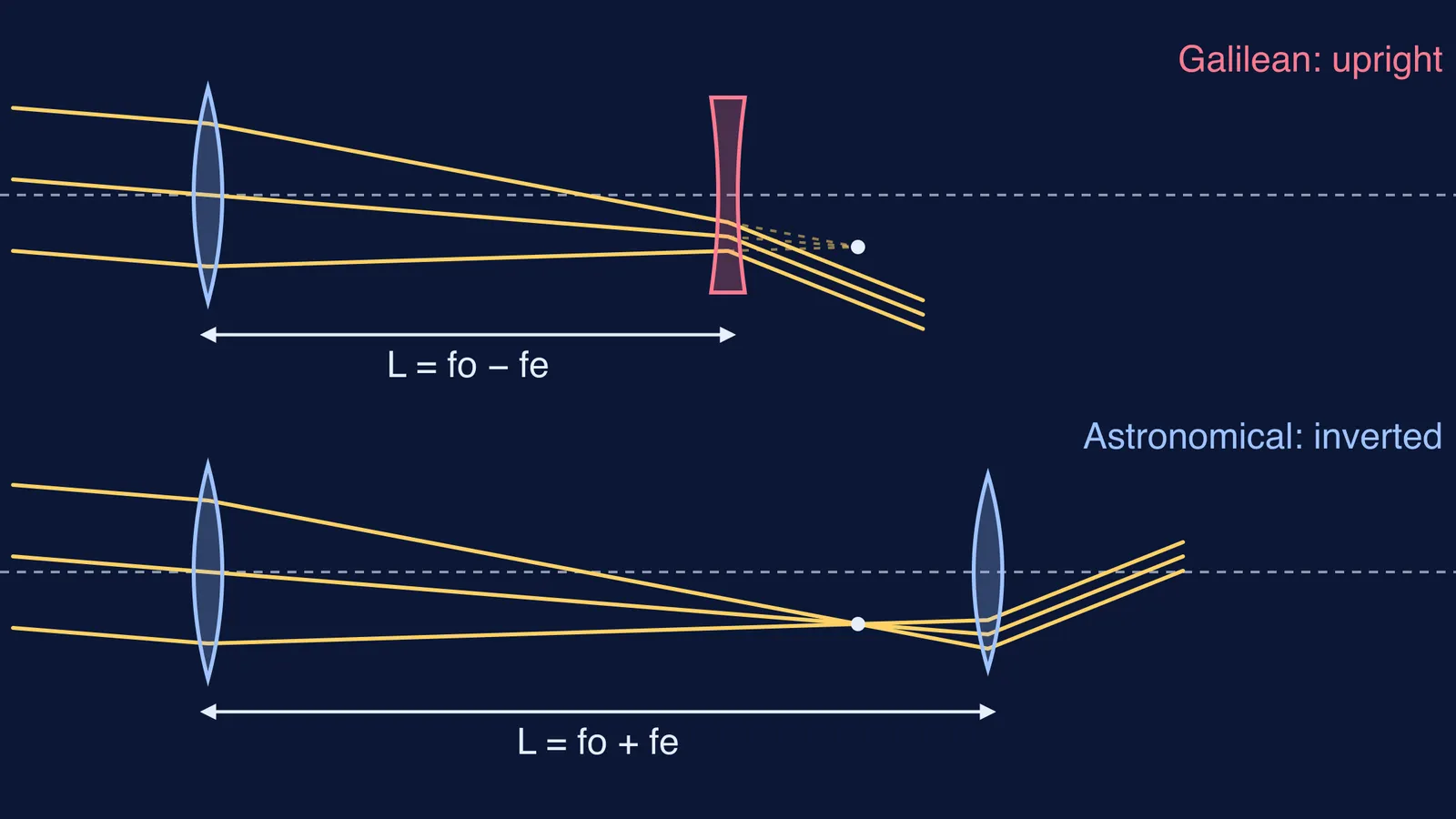
Parallel rays from the tank top pass through the convex objective. Alone, they would meet below the axis in the objective's focal plane, as the top of a real, inverted image.
The concave eyepiece sits fe before that point, so it catches the rays before they meet.
A diverging lens turns rays heading for a point in its focal plane into a parallel beam, tilted the same way as the incoming light. Your eye sees the tank top above the axis.
The rays never reach a focus, so no intermediate image forms and the final virtual image is upright (Wikipedia: Refracting telescope). In the astronomical telescope the rays do cross at the shared focus, forming a real inverted image that the convex eyepiece magnifies without turning back over. The diagram at the top shows both.
What is the magnifying power and length of a Galilean telescope?
In a Galilean telescope, the distance between the lenses equals the difference between the absolute values of their focal lengths, and the magnifying power is the ratio of the objective's focal length to the eyepiece's (Museo Galileo: Telescope). For the Keplerian telescope it gives the sum, with the same ratio.
In normal adjustment:
Galilean: M = fo/fe and L = fo − fe, image upright
Astronomical: M = fo/fe and L = fo + fe, image inverted
The lengths follow from where the eyepiece sits: the objective's image point is fo behind it, and a concave eyepiece stands fe in front of that point, a convex one fe beyond it.
With Cartesian signs a concave lens has a negative focal length, so L = fo + fe with a negative fe gives fo − |fe|. For M, use magnitudes. Magnifying power is a ratio of angles, not the image-size ratio v/u; our explainer on linear magnification vs magnifying power sets out the difference.
Do the formulas fit Galileo's own telescope?
Museo Galileo's catalogue lists Galileo's telescope (inventory 2428, late 1609 to early 1610) with an objective of focal length 980 mm, an eyepiece of focal length −47.5 mm, a magnification of 21 and a length of 927 mm (Museo Galileo catalogue). Check the formulas:
M = fo/fe = 980/47.5 ≈ 20.6, which rounds to the listed 21.
L = fo − fe = 980 − 47.5 = 932.5 mm, 5.5 mm more than the listed 927 mm.
An astronomical telescope with the same objective and a 47.5 mm convex eyepiece would need 980 + 47.5 = 1027.5 mm, about 10 cm longer for the same magnification.
Don't expect an exact match: 927 mm is the length of the whole instrument, not a measured lens separation, and the catalogue notes that the original eyepiece was lost and replaced in the nineteenth century. Then read how Galileo found Jupiter's moons, night by night.
Galilean vs astronomical telescope: what changes in a numerical?
Take objective 100 cm, eyepiece 5 cm, normal adjustment.
Galilean: M = 100/5 = 20, L = 100 − 5 = 95 cm, image upright.
Astronomical: M = 100/5 = 20, L = 100 + 5 = 105 cm, image inverted.
Same magnifying power; the lengths always differ by 2fe, here 10 cm. The cost is the view: Museo Galileo calls the Galilean design's field of view extremely narrow (Museo Galileo: Telescope), while the Keplerian design allows a much wider field of view and greater eye relief (Wikipedia: Refracting telescope).
Which mistakes cost marks in telescope questions?
Before the final answer, check:
Did you subtract fe for Galilean and add it for astronomical?
Is fo on top? If M comes out below 1, you flipped the ratio.
Are both focal lengths in the same unit?
Does the question say normal adjustment or final image at the near point? These formulas are for normal adjustment.
Did you state the orientation?
Our post on magnifying power of microscopes and telescopes, worked step by step covers the compound microscope too. If a numerical still goes wrong, the Fermi Problem Library has worked problems with a step-by-step solver that explains the reasoning rather than printing an answer. If the ray picture won't stick, the Fermi Simulation Lab has interactive simulations for ideas that are easier to see than to read.
Next time you see fo and fe in a question, look at the eyepiece first: concave means subtract, convex means add.