

On this page
On the evening of 7 January 1610, Galileo Galilei pointed a home-built telescope at Jupiter and noticed three small, bright points of light in a line beside it. He wrote down what he saw and kept coming back. Those notes changed astronomy, and they still show how to do good science: look, record, then look again.
How did Galileo discover the moons of Jupiter in 1610?
Galileo built his own telescopes from two lenses. By early 1610 he had one that, he wrote, showed objects “more than thirty times nearer” than the naked eye. That account is in his book *Sidereus Nuncius* (English translation by E. S. Carlos, Project Gutenberg).
On 7 January he saw “three little stars, small but very bright” near Jupiter, all in one straight line. He assumed they were ordinary fixed stars. The next night all three were west of the planet. That made no sense for fixed stars, so he first worried that Jupiter had moved differently from the astronomers' calculations and passed them by its own motion.
By 15 January he understood that he was looking at moons orbiting Jupiter (Astronomy magazine). *Sidereus Nuncius* came out in March 1610, and he named the moons the Medicean Stars after his patrons, the Medici family. Today they are Io, Europa, Ganymede and Callisto, known as the Galilean satellites (NASA).
What did Galileo's night-by-night notes show?
Here is the first week, from the Carlos translation:
7 January: two “stars” east of Jupiter, one west.
8 January: all three west of Jupiter, closer together and evenly spaced.
9 January: cloud. “I therefore waited for the next night with the most intense longing, but I was disappointed of my hope.”
10 January: only two, both east. He guessed the third was hidden by the planet.
11 January: he concluded “that there are three stars in the heavens moving about Jupiter, as Venus and Mercury round the Sun.”
13 January: “For the first time four satellites were in view.”
Notice the order of his reasoning. He first tested the boring explanation, that Jupiter itself had moved, and rejected it because such changes, he wrote, “could not by any means belong to Jupiter”. Only then did he accept the surprising one: the dots were moving, and they were going with Jupiter.
He kept observing until 2 March, noting the time of each sighting and the gaps between the moons in arcminutes (an arcminute is one-sixtieth of a degree). From those notes he worked out that the moons closest to Jupiter move fastest. He also estimated that the outermost moon takes about “half a month” to go round. NASA's fact sheet gives Callisto's period as 16.69 days and Io's as 1.77 days (NASA Jovian satellite fact sheet).
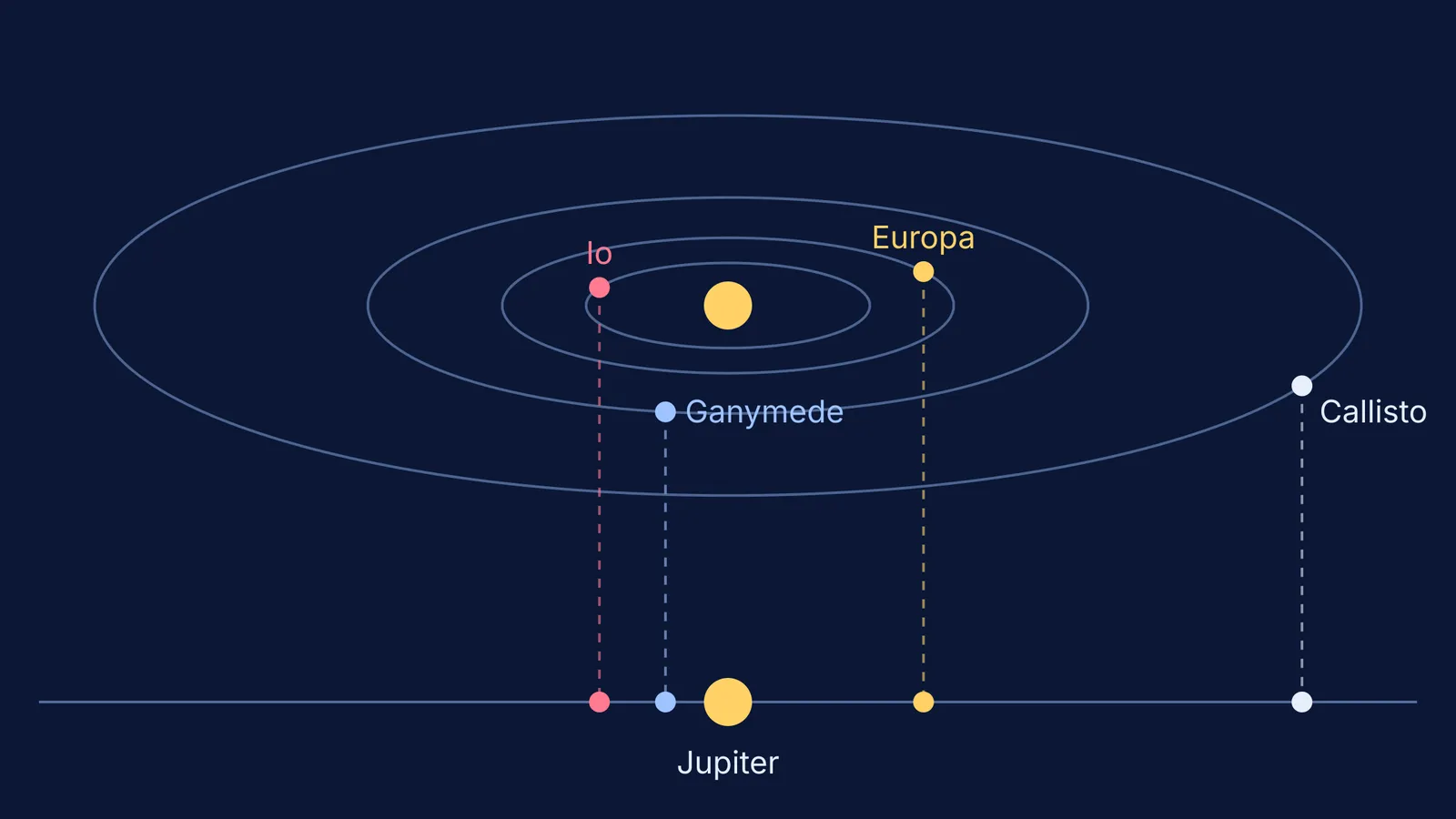
Why did the moons always appear in a line? They orbit almost in the plane of Jupiter's equator, which is tilted only about 3 degrees to Jupiter's orbit, according to a note in the Carlos translation. From Earth we see those orbits almost edge-on, so each circle looks like a dot sliding back and forth along a line.
Why did Jupiter's moons support Copernicus?
In the old Earth-centred model, everything in the sky circled Earth. Copernicus put the Sun at the centre instead (our post on Copernicus and heliocentrism). Critics asked how the Moon could keep circling an Earth that was itself moving round the Sun.
Galileo answered them directly in *Sidereus Nuncius*: “our sense of sight presents to us four satellites circling about Jupiter, like the Moon about the Earth, while the whole system travels over a mighty orbit about the Sun in the space of twelve years” (Carlos translation). So not everything orbits Earth, and a planet can travel with its moons. This did not prove the Sun-centred model by itself, but it was early evidence in favour of it (Astronomy magazine). Describing planetary orbits exactly took Johannes Kepler's mathematics (how Kepler's laws describe planetary orbits).
If the edge-on view is hard to picture, the Fermi Simulation Lab has interactive simulations for ideas that are easier to see than to read.
How can you observe like Galileo?
You can use his method on any repeated measurement: a pendulum in the physics lab, a plant on your windowsill, or your scores across mock tests. Try this five-evening Moon log:
Same time, same spot. Go out at the same time each evening and note it.
Record before you interpret. Sketch the Moon's shape and its position against a fixed landmark, such as a water tank or a tree.
Log the bad nights too. Write “cloudy” rather than skipping the date, just as Galileo did on 9 January.
Measure, don't describe. Count outstretched fists from the landmark instead of writing “a bit higher”.
Explain last. After five entries, write two possible explanations and say which one your data rules out.
For another careful record-keeper, read about Tycho Brahe and his observations. If your log raises a question you can't answer, look it up in the Fermi Concept Library, which has a lesson for each concept in physics, chemistry, biology, mathematics and computing.
Tonight, find Jupiter, write down the date, and start your own log.


