On this page
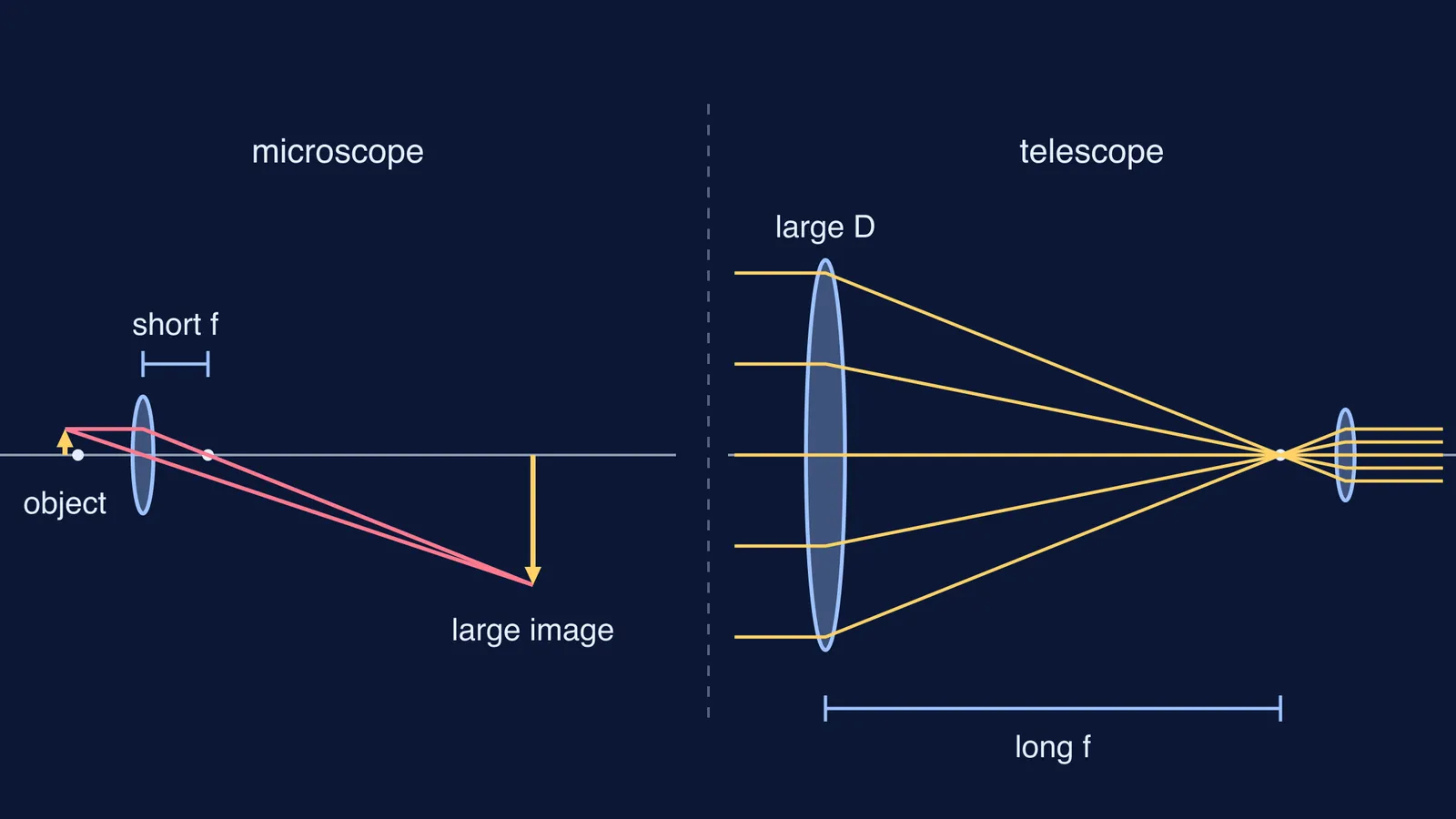
This is a standard "give reason" question in school ray optics. A microscope looks at something you can bring right up to the lens, so the lens should bend light sharply. A telescope looks at something you can never get closer to, so its objective has to be big and long instead.
Why does a microscope objective have a short focal length?
In a compound microscope, the object sits just beyond the focal point of the objective, which forms "a real, inverted image that is larger than the object", as OpenStax University Physics, Volume 3 puts it. The eyepiece then magnifies that image again.
In many microscopes, the distance between the objective's image-side focal point and the eyepiece's object-side focal point is standardised at 16 cm, called the tube length (OpenStax). When the tube length is much longer than the objective's focal length, the objective's magnification is about 16 cm divided by f_obj.
OpenStax gives the net magnification of a compound microscope as M = −(16 cm)(25 cm)/(f_obj × f_eye), with both focal lengths in centimetres and the final image at the 25 cm near point (OpenStax).
f_obj sits in the denominator, and the tube length is fixed, so a smaller focal length is the way to a bigger first image. That is why OpenStax describes the objective as "a convex lens of short focal length (i.e., high power)", with typical magnifications from 5× to 100× (OpenStax).
How much does a shorter focal length change the numbers?
Keep the eyepiece fixed at f_eye = 2.5 cm and use the OpenStax formula (OpenStax). The size of M is then 400/(2.5 × f_obj) = 160/f_obj, ignoring the minus sign that marks an inverted image.
f_obj = 1.6 cm (a 10× objective): M = 160/1.6 = 100×
f_obj = 0.4 cm (a 40× objective): M = 160/0.4 = 400×
f_obj = 0.16 cm (a 100× objective): M = 160/0.16 = 1000×
Cutting the objective's focal length to one tenth multiplied the magnification by ten. OpenStax's Example 2.11 skips the 16 cm shortcut and uses the thin-lens equation: an object 6.20 mm from a 6.00 mm objective, with a 50.0 mm eyepiece, gives a net magnification of −186 (OpenStax).
Magnification alone does not reveal detail. The smallest separation a microscope can resolve is x = 0.61λ/NA, where the numerical aperture NA = n sin α depends on the half-angle α of the cone of light the objective collects (OpenStax, circular apertures and resolution). A short-focus objective works close to the slide, so even a small lens can take in a wide cone and α can be large. With green light at 550 nm, NA = 0.25 gives x ≈ 1.3 µm, and NA = 0.95 gives x ≈ 0.35 µm. Our explainer on the resolving power of a microscope and a telescope goes further.
Why does a telescope need a large-aperture objective instead?
A telescope's angular magnification is M = −f_obj/f_eye, so you want "an objective with a long focal length and an eyepiece with a short focal length" (OpenStax). With f_obj = 100 cm and f_eye = 2.5 cm, M = 40×.
The bigger reason is that you cannot bring a star closer, only catch more of its light. Light-gathering power is proportional to the area of the aperture, so it grows as the diameter squared, D² (UC Berkeley astronomy lecture notes).
Diameter also sets sharpness. By the Rayleigh criterion, the smallest angle a circular aperture can resolve is θ = 1.22λ/D (OpenStax). For Hubble's 2.40 m mirror at 550 nm, OpenStax calculates θ = 2.80 × 10⁻⁷ rad.
Apply the same formula to two other telescopes that OpenStax mentions, still at 550 nm:
Yerkes, 40 inches (1.02 m): θ ≈ 6.6 × 10⁻⁷ rad
Hubble, 2.4 m: θ ≈ 2.8 × 10⁻⁷ rad
Keck, 10 m: θ ≈ 6.7 × 10⁻⁸ rad, with (10/2.4)² ≈ 17 times Hubble's light-collecting area
How do you write this answer in an exam?
Four steps for a "give reason" answer:
Write the magnification formula: M ≈ (L/f_obj)(25 cm/f_eye) for the microscope, M = f_obj/f_eye for the telescope.
Say where f_obj sits in the fraction, so short or long.
Add the aperture point: a wide light cone for the microscope (x = 0.61λ/NA), a large D for the telescope (light gathered ∝ D², θ = 1.22λ/D).
Finish with one number, such as "with a 2.5 cm eyepiece, f_obj from 1.6 cm to 0.16 cm takes M from 100× to 1000×".
A common slip is saying a telescope objective has a short focal length "to magnify more"; it is the other way round. Another is mixing up the two kinds of magnification, which our post on linear magnification vs magnifying power sorts out. For more practice, try magnifying power of microscopes and telescopes, worked step by step.
If the ray diagram won't stick, the Fermi Concept Library gives each physics concept its own lesson and its place in the map. For the numericals, the Fermi Problem Library has a step-by-step solver that explains the reasoning rather than printing an answer.