

On this page
If the amount of carbon dioxide in the air doubles, how much warmer does Earth get? The full answer needs climate models. But the first step, the warming you would get if nothing else in the climate changed, is a short calculation with the Stefan–Boltzmann law. It comes out at about 1 °C, and you can do it with a derivative and a logarithm.
How much energy does Earth radiate to space?
In balance, Earth sends out as much energy as it absorbs from the Sun. The sunlight arriving above the atmosphere is about 1,361 W/m² (Kopp and Lean, Geophysical Research Letters, 2011). We take a round albedo A = 0.30 as an illustrative value, meaning about 30% is reflected straight back.
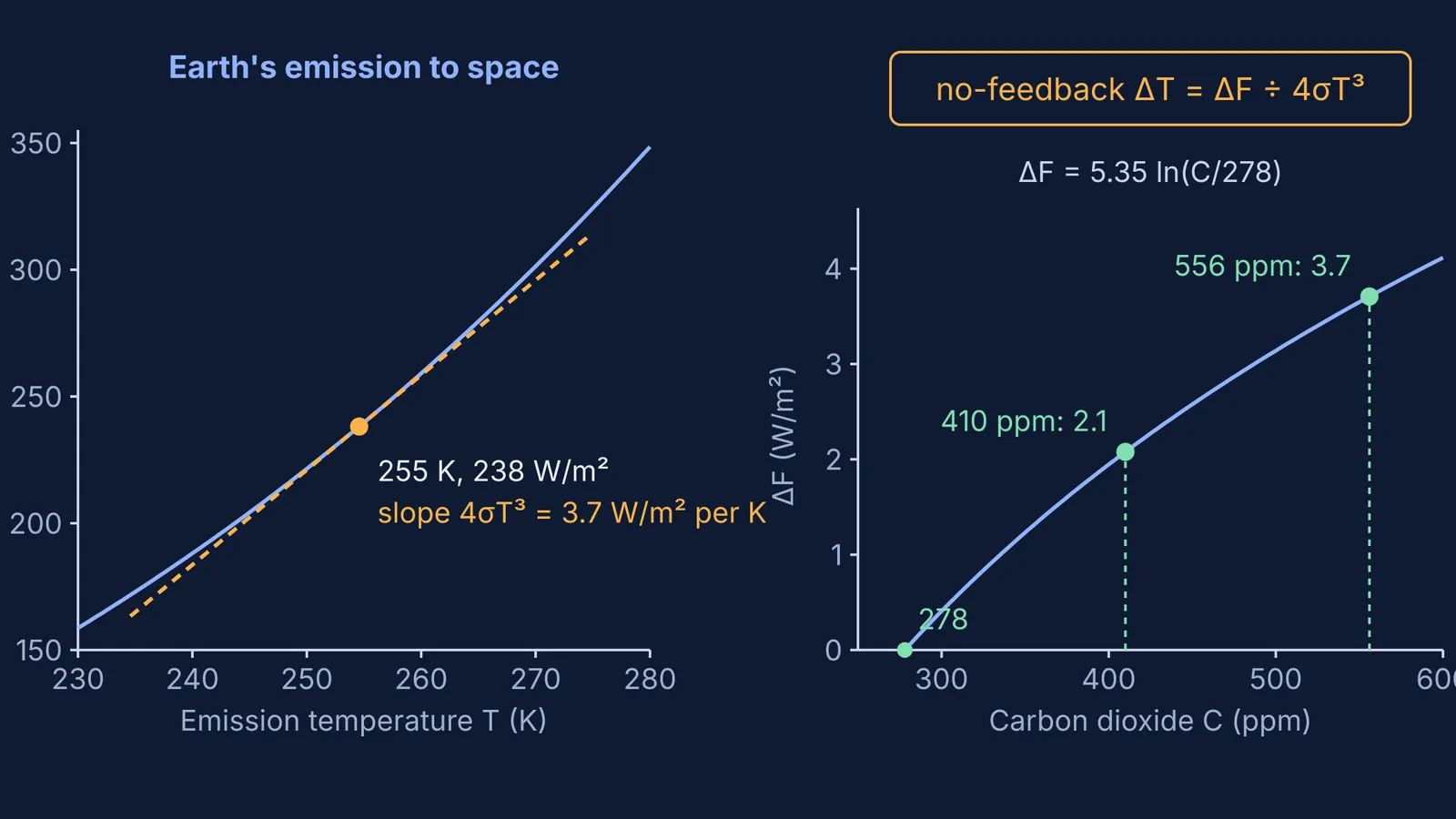
Averaged over the whole sphere, the absorbed power is S(1 − A)/4 = 1,361 × 0.70 / 4 = 238 W/m². Setting this equal to σT⁴ gives the emission temperature, Tₑ = 254.6 K. The setting up of that balance, and why the real surface is warmer at about 288 K, is worked through in estimating Earth's temperature from radiation balance. Here we only need its result and its slope.
How much extra does Earth radiate for each degree of warming?
This is the new step. If Earth warms by a small ΔT, the outgoing radiation rises by
ΔR = (dR/dT) × ΔT = 4σTₑ³ × ΔT
Insert numbers. 4 × 5.67 × 10⁻⁸ × (254.6)³ = 3.74 W/m² per K.
Check with a direct difference. σ(255.6)⁴ − σ(254.6)⁴ = 3.76 W/m², so the derivative is good for small changes.
Units. W m⁻² K⁻⁴ × K³ = W m⁻² K⁻¹, as required.
This restoring push is called the Planck response. Note that we used 255 K, not the 288 K surface temperature. Using 288 K gives 5.4 W/m² per K, which is wrong for this purpose, because the radiation that reaches space leaves, on average, from high up in the atmosphere.
The IPCC's Sixth Assessment Report (AR6) assesses the Planck response from full radiation calculations at 3.22 W/m² per °C, with a very likely range of 3.0 to 3.4 (IPCC AR6 WG1, Chapter 7, Section 7.4.2.1). It is a little smaller than our 3.74 because real Earth is not a single blackbody at one temperature. Our one-line model gets the size right, which is what we want from it.
How much extra energy does doubled CO₂ trap?
Adding CO₂ makes the air absorb more of the outgoing infrared, so less escapes until the planet warms. This reduction is the radiative forcing, ΔF. A widely used fit to detailed radiation calculations is
ΔF = 5.35 ln(C/C₀) W/m²
from Myhre and colleagues, Geophysical Research Letters, 1998. It is an empirical fit, not a law derived from first principles. The forcing grows with the logarithm because the centre of the CO₂ absorption band is already nearly saturated; extra CO₂ mostly widens the band at its edges.
For a doubling, ΔF = 5.35 × ln 2 = 3.71 W/m², about 1.6% of the 238 W/m² Earth radiates. AR6 uses updated formulae and gives 3.75 W/m² for the radiative forcing of a doubling. When it also includes the fast adjustments of the atmosphere, its assessed effective radiative forcing is 3.93 ± 0.47 W/m² (IPCC AR6 WG1, Chapter 7, Section 7.3.2).
How much warming is that before feedbacks?
Here is the full worked example. Warming stops when the extra outgoing radiation cancels the forcing: 4σTₑ³ × ΔT₀ = ΔF.
Doubling, simple model. ΔT₀ = 3.71 / 3.74 = 0.99 K.
Doubling, AR6 numbers. ΔT₀ = 3.93 / 3.22 = 1.22 K, using AR6's effective forcing and Planck response. AR6 writes this same relation as ΔTₚ = −ΔF/αₚ.
From 1750 to 2019. AR6 gives CO₂ rising from 278 ppm to 410 ppm. The fit gives ΔF = 5.35 ln(410/278) = 2.08 W/m², close to AR6's assessed 2.16 W/m² for CO₂ over that period. With the simple model, 2.08/3.74 = 0.56 K before feedbacks.
So the no-feedback warming for a doubling is about 1 °C, between 1.0 and 1.2 °C depending on which numbers you use. Notice that both forcing and response are a few W/m², a tiny change in a 238 W/m² flow.
Why is the real warming larger than 1 °C?
Because the climate does not stand still while it warms. AR6 describes several feedbacks. Warmer air holds more water vapour, itself a greenhouse gas. Melting snow and ice expose darker ground and sea that reflect less sunlight, the loop explained in why melting ice speeds warming. Clouds and the vertical temperature profile change too.
Taking all the evidence together, AR6 gives a central estimate of the equilibrium climate sensitivity, the long-term warming for a doubling of CO₂, of 3 °C. It is likely in the range 2.5 °C to 4 °C and very likely in the range 2 °C to 5 °C (IPCC AR6 WG1, Chapter 7, Section 7.5.5). AR6 notes that its 3 °C central estimate corresponds to a net feedback parameter of about −1.3 W/m² per °C, much weaker than the Planck response alone, which is why the final warming is roughly two to three times the no-feedback value.
These are long-term equilibrium figures for a doubling, not a forecast for any particular year. Earlier estimates make an interesting comparison: Svante Arrhenius's 1896 calculation gave a larger warming for a doubling, using far cruder data.
If you want to see how a small change in T changes σT⁴, the Simulation Lab has interactive simulations for ideas easier to see than read.
Quick checklist
Emission temperature: Tₑ = [S(1 − A)/4σ]^(1/4) = 255 K for S = 1,361 W/m², A = 0.30.
Planck response from the derivative: 4σTₑ³ = 3.7 W/m² per K; AR6 assesses 3.22 W/m² per °C.
CO₂ forcing fit: ΔF = 5.35 ln(C/C₀); a doubling gives 3.7 W/m². AR6's effective forcing is 3.93 ± 0.47 W/m².
No-feedback warming ΔT₀ = ΔF ÷ 4σTₑ³ is about 1 to 1.2 °C for a doubling.
Feedbacks raise this: AR6 central estimate 3 °C, likely 2.5 to 4 °C, very likely 2 to 5 °C.
Use 255 K, not 288 K, and quote IPCC ranges as ranges.


