On this page
Svante Arrhenius, a Swedish physicist and chemist, made a calculation that changed how we understand our planet. In 1896, he published a paper titled "On the Influence of Carbonic Acid in the Air upon the Temperature of the Ground" (Wikipedia). Long before digital computers existed, he used basic physical principles to estimate how changing the amount of carbon dioxide—which he called carbonic acid—would alter Earth's climate.
Why did Arrhenius calculate Earth's temperature in 1896?
Arrhenius was not initially trying to predict the future; he was trying to solve a mystery from the past. He wanted to understand the "riddle of the prehistoric ice ages" (American Institute of Physics). He hypothesised that variations in atmospheric gases, specifically carbon dioxide, might explain these radical climate shifts.
While water vapour was known to be a more abundant greenhouse gas, its levels fluctuated wildly from day to day. Carbon dioxide, on the other hand, was set over geological timescales by forces like volcanoes. Arrhenius reasoned that carbon dioxide acted as a regulator: a small change in carbon dioxide would alter the temperature slightly, which would then change the amount of water vapour the air could hold, amplifying the overall effect.
How did Arrhenius calculate the effect of doubling carbon dioxide?
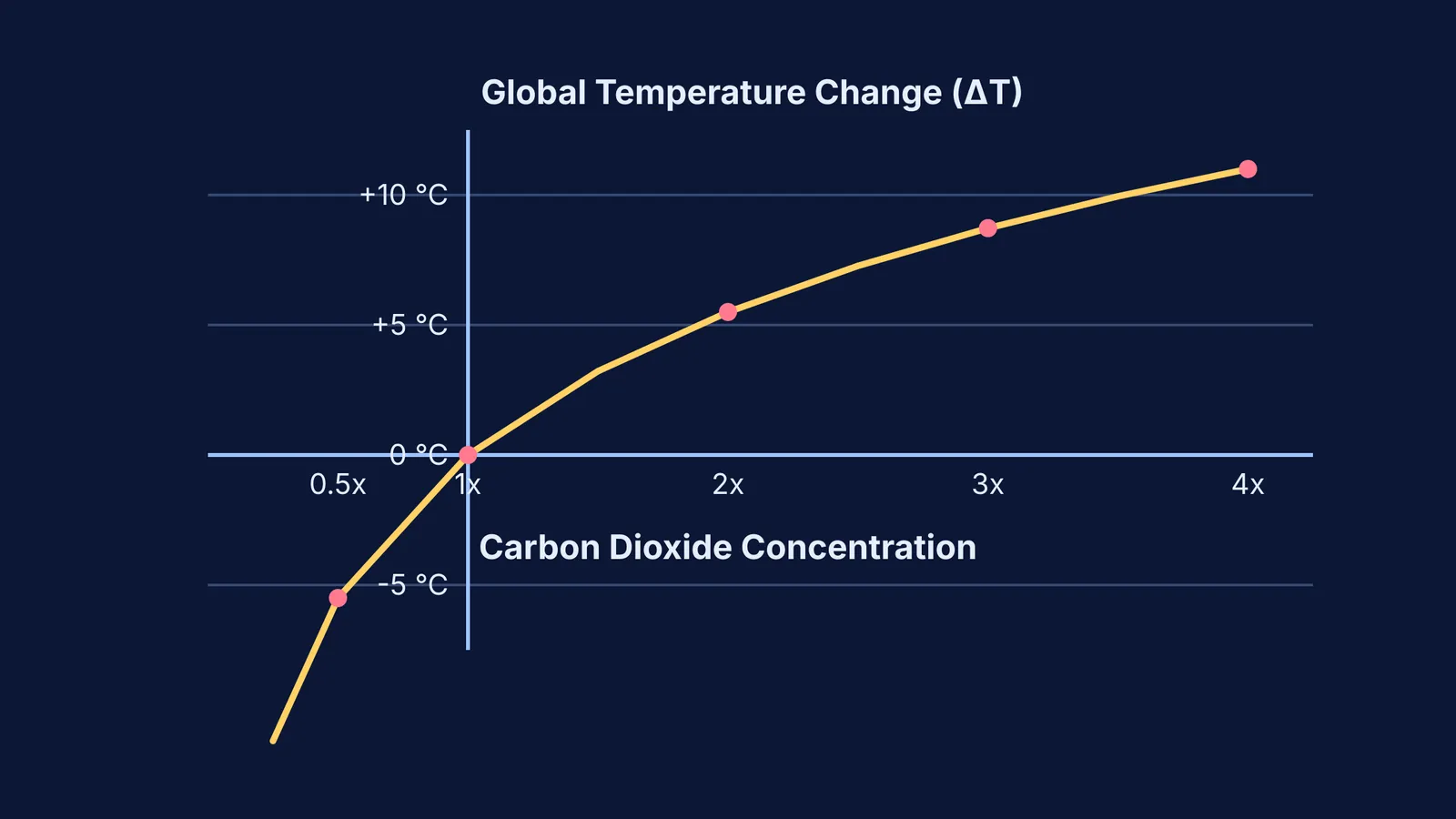
Arrhenius built on earlier discoveries about the greenhouse effect by scientists like Joseph Fourier and John Tyndall. He formulated a mathematical rule: if the quantity of carbon dioxide increases in a geometric progression, the temperature will increase in an arithmetic progression.
Through laborious numerical computations done entirely by hand, using infrared observations of the moon by Samuel Pierpont Langley and Frank Washington Very, he arrived at specific estimates. He calculated that doubling the carbon dioxide in the atmosphere would raise the Earth's average temperature by 5 to 6 °C (American Institute of Physics). Conversely, he estimated that cutting the atmospheric carbon dioxide in half would lower the temperature by 4 to 5 °C, which he believed was enough to trigger an ice age. He also predicted that the warming would be stronger near the poles, estimating an 8 to 9 °C rise in the Arctic if carbon dioxide levels increased by 2.5 to 3 times (Wikipedia).
When you tackle a complex calculation yourself, the Fermi Problem Library has worked problems with a step-by-step solver that explains the reasoning rather than just printing an answer, helping you break the work down just as Arrhenius broke down the Earth's energy budget into manageable equations.
Did Arrhenius know about global warming from burning coal?
Yes, Arrhenius was the first to predict that human-caused emissions from burning fossil fuels could cause global warming. However, his timeframe was vastly different from what we know today.
In 1896, based on the industrial rates of his time, he estimated it would take roughly 3,000 years for human industry to double the carbon dioxide level (American Institute of Physics). (He later revised this to "within a few centuries" in 1908 as coal burning accelerated). Interestingly, as a resident of chilly Sweden, he did not view this as a crisis. He actually believed that a warmer climate would be beneficial, potentially preventing future ice ages and producing better crop yields.
His peers were initially sceptical. In 1900, Knut Ångström argued that carbon dioxide absorption was already "saturated," meaning adding more gas would not trap any more heat. Ångström based this on laboratory measurements where passing infrared radiation through a tube of carbon dioxide showed little change when the gas amount was reduced (American Institute of Physics). Others assumed the oceans would safely absorb all excess human emissions, as they held fifty times more carbon than the atmosphere (American Institute of Physics). It took decades of further research, including the discovery of new ocean buffering mechanisms and more precise measurements, to prove Arrhenius's fundamental intuition correct.
How can you tackle complex physics problems like Arrhenius?
Arrhenius succeeded because he did not just memorise formulas; he built a model from the ground up. This is a crucial lesson for anyone studying science today, as why memorising physics formulas fails is a common stumbling block in exams.
If you are facing a multi-step physics problem, use this four-step framework inspired by his approach:
Identify the core variables: Arrhenius isolated carbon dioxide as the primary independent variable, treating water vapour as a dependent feedback loop. Write down exactly what you are changing and what depends on it.
Set up the boundary conditions: Before calculating intermediate values, look at the extremes. What happens if the value doubles? What if it halves?
Use first principles: Do not look for a single shortcut equation. Build the solution using fundamental laws of energy and thermodynamics. If you are struggling with this, practicing learning physics from first principles will build your intuition.
Test the limits: Arrhenius checked his model against the extremes of the Ice Ages. When you finish a calculation, always ask if the final number makes physical sense in the real world.
By structuring your thinking methodically—how to solve physics problems step by step—you can handle calculations that at first seem impossible to solve.