

On this page
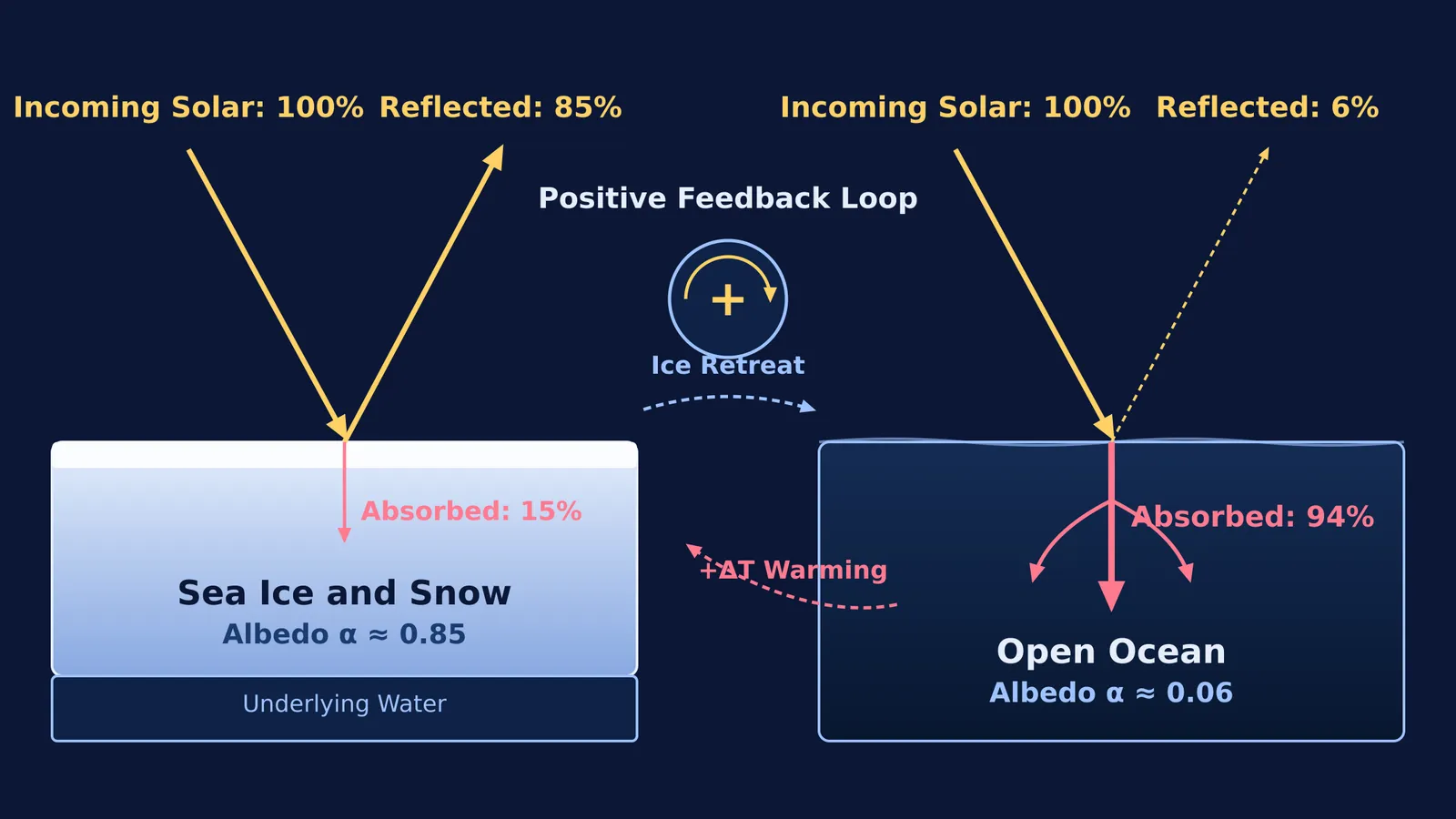
When polar ice melts into open ocean water, the planet replaces a bright mirror with a dark heat collector. In physics, this transition is governed by albedo, the ratio of reflected solar radiation to incoming solar radiation. According to the National Snow and Ice Data Center, fresh snow reflects 80% to 90% of incoming sunlight, and bare sea ice reflects 50% to 70%. In sharp contrast, open ocean reflects only about 6% of solar radiation, absorbing the remaining 94% as thermal energy (NSIDC).
What is the ice-albedo feedback loop?
This reflectivity gap turns melting into a self-reinforcing positive feedback loop. When rising temperatures melt sea ice, dark water replaces white ice. The exposed ocean absorbs far more solar radiation instead of reflecting it back to space. That absorbed heat warms the upper ocean, melting adjacent ice and exposing more dark water. Climate pioneer Syukuro Manabe and early computer climate models demonstrated that coupling this albedo shift with radiative transfer was essential to model polar climate changes accurately.
Why does melting ice accelerate polar warming so rapidly?
Satellite instruments show that this darkening is already altering Earth's energy balance. In the Proceedings of the National Academy of Sciences, Kristina Pistone, Ian Eisenman, and V. Ramanathan found that Arctic planetary albedo dropped from 0.52 to 0.48 between 1979 and 2011. This darkening added 6.4 ± 0.9 W/m² of radiative heating to the Arctic Ocean region, equal to 25% of the direct greenhouse heating from global carbon dioxide over those 30 years (PNAS).
In summer, continuous polar sunlight magnifies this effect. In Communications Earth & Environment, Mika Rantanen and colleagues reported that the Arctic warmed 3.8 times faster than the global average between 1979 and 2021. The ocean stores absorbed heat through summer, delaying autumn freeze-up and thinning winter ice before the next melt season.
How can students predict and test the feedback loop?
For students studying thermodynamics in CBSE Class 11 physics, feedback loops can be challenging because standard exercises assume static equilibrium. Research by Matthew Kearney and colleagues in Research in Science Education shows that Predict-Observe-Explain (POE) tasks build deeper physical intuition by requiring learners to commit to a prediction before seeing the outcome.
You can test this feedback loop through a structured three-step sequence:
Predict: Calculate how absorbed solar flux changes when surface albedo drops from 0.85 to 0.06 under constant sunlight.
Observe: Track water temperature and evaluate whether thermal radiation via Stefan's law and black-body radiation can radiate heat away fast enough.
Explain: Determine how ocean heat storage delays autumn freezing and amplifies annual warming.
Research on simulations versus static diagrams in science learning confirms that adjusting parameters interactively helps students correct misconceptions more effectively than reading static pages. When exploring how changing reflectivity alters thermal energy flow, the Fermi Simulation Lab provides interactive simulations for the ideas that are easier to see than to read.
How much extra solar heat does melting ice add?
A quick calculation reveals why this feedback loop accelerates warming so quickly. According to NASA Earth Observatory, Earth receives an average solar irradiance of roughly 340 W/m². In polar summer, incident solar flux S reaching the surface is approximately 300 W/m². The absorbed power per square metre is Q_abs = (1 − α) × S, where α is albedo.
Using representative NSIDC albedo values, compare the two surfaces under 300 W/m² of polar sunlight:
Snow-covered ice (α = 0.85): Absorbed heat flux is Q_ice = (1 − 0.85) × 300 W/m² = 45 W/m², while 255 W/m² reflects away.
Open ocean (α = 0.06): Absorbed heat flux is Q_ocean = (1 − 0.06) × 300 W/m² = 282 W/m², while only 18 W/m² reflects away.
The net increase in absorbed power is ΔQ = 282 W/m² − 45 W/m² = 237 W/m²—a 6.3-fold jump in absorbed energy. Over a single 24-hour polar day (86,400 seconds), each square metre absorbs an additional 2.05 × 10⁷ joules. Given ice's latent heat of fusion (L_f = 3.34 × 10⁵ J/kg), this extra daily heat can melt roughly 61 kilograms of surrounding ice per square metre. For practice with heat transfer equations, the Fermi Problem Library has worked problems with a step-by-step solver that explains the reasoning rather than printing an answer.


