

On this page
Every list of neutral oxides starts with carbon monoxide. NCERT puts CO beside NO and N₂O, and our post on what neutral oxides are and why CO, NO and N₂O count as neutral explains the classification and the low-oxidation-state reason behind it. That is the right exam answer. But one reaction surprises most students when they first meet it: sodium formate, a bulk industrial chemical, is made by passing carbon monoxide into hot sodium hydroxide.
What does NCERT say about CO as a neutral oxide?
NCERT Class 11 sorts oxides into acidic, basic, amphoteric and neutral, and gives CO, NO and N₂O as the neutral ones: they show neither acidic nor basic properties. At room temperature that is exactly what you see: bubble CO through water or dilute NaOH and the pH does not move.
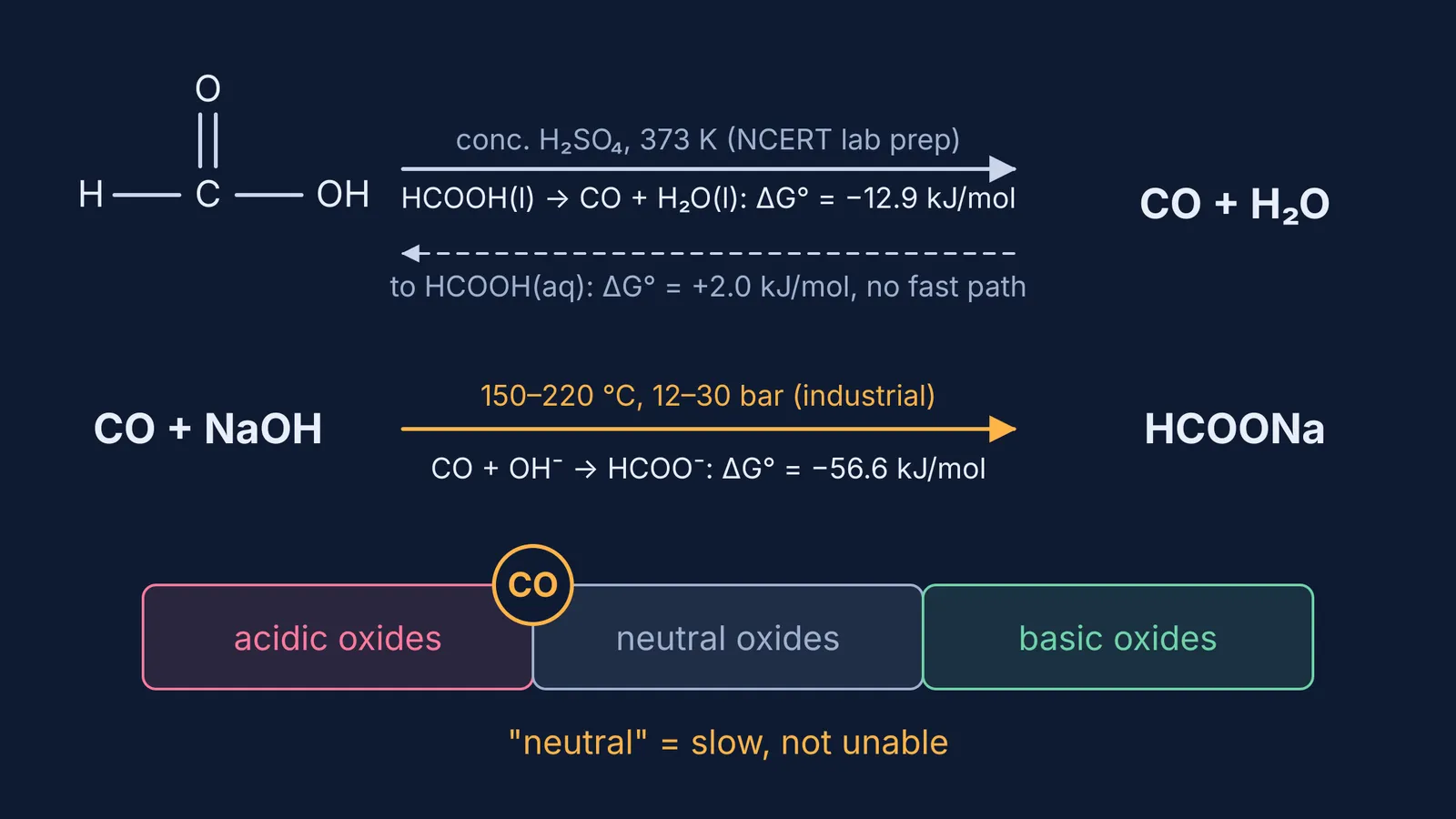
The same textbook, in the p-block chapter, makes CO in the lab by dehydrating formic acid with concentrated sulphuric acid at 373 K:
HCOOH → CO + H₂O
Read that equation backwards. Formic acid minus one water is CO. By the same "acid minus water" rule used in matching each acidic oxide to its parent acid, CO is the formal anhydride of formic acid, just as CO₂ is the anhydride of carbonic acid. Carbon is +2 in both CO and HCOOH, so going from one to the other is not a redox reaction.
Does carbon monoxide react with sodium hydroxide?
Yes, if you heat it under pressure. Hydroxide adds to the carbon of CO and gives formate:
CO + NaOH → HCOONa
In ionic form this is CO + OH⁻ → HCOO⁻. Check the balance: 1 C, 2 O, 1 H and 1 Na on each side, and the charge is zero on both sides of the full equation (−1 on both sides of the ionic one).
This is an industrial process, not a curiosity. A Mitsubishi Gas Chemical patent for continuous production of pure sodium formate reacts aqueous NaOH with CO at about 150–220 °C and 12–30 kg/cm², roughly 12–29 bar (US 3,928,435). A later patent describes the aqueous route with the same 150–220 °C and 12–30 kg/cm² window and notes that it still needs a residence time of about 30 minutes; its own method adds methanol and runs at 80–120 °C and 10–40 bar (US 4,237,318).
So a "neutral" oxide is absorbed by a base to give a salt, which is what an acidic oxide does. It is just very slow to do it.
Is the reaction of CO with alkali thermodynamically favourable?
Work it out from standard Gibbs energies of formation. All values below are at 298 K from one source, the NBS tables (Wagman et al., J. Phys. Chem. Ref. Data 11, Suppl. 2, 1982), with standard states of 1 bar for gases and 1 mol/kg for dissolved species. In kJ/mol:
CO(g): −137.2
OH⁻(aq): −157.2
HCOO⁻(aq): −351.0
H₂O(l): −237.1
HCOOH(aq), the undissociated acid: −372.3
HCOOH(l): −361.4
A quick check that the numbers hang together: HCOOH(aq) → HCOO⁻(aq) + H⁺(aq) has ΔG° = −351.0 + 372.3 = +21.3 kJ/mol, which corresponds to pKa ≈ 3.73. Formic acid's measured pKa is about 3.75.
Worked example: three reactions, one table
(a) CO with hydroxide.
Write the reaction: CO(g) + OH⁻(aq) → HCOO⁻(aq).
ΔG° = ΣΔfG°(products) − ΣΔfG°(reactants) = −351.0 − (−137.2 − 157.2) = −56.6 kJ/mol.
K = e^(−ΔG°/RT) = e^(56,600 / (8.314 × 298)) = e^22.8 ≈ 8 × 10⁹.
Far to the right, yet CO and NaOH solution at 25 °C sit together unchanged.
(b) CO with water.
Write the reaction: CO(g) + H₂O(l) → HCOOH(aq).
ΔG° = −372.3 − (−137.2 − 237.1) = +2.0 kJ/mol.
K = e^(−2000 / (8.314 × 298)) ≈ 0.45.
This is almost balanced. If equilibrium were ever reached under 1 bar of CO, the water would hold roughly 0.45 mol/kg of formic acid, a clearly acidic solution. In practice CO and water stay neutral on any ordinary time scale, because the reaction has no fast path.
(c) The NCERT lab preparation.
Write the reaction: HCOOH(l) → CO(g) + H₂O(l).
ΔG° = (−137.2 − 237.1) − (−361.4) = −12.9 kJ/mol.
K = e^(12,900 / (8.314 × 298)) ≈ 190.
Pure formic acid is thermodynamically unstable with respect to CO and water. It survives in a bottle because the decomposition is slow. Concentrated H₂SO₄ speeds it up and soaks up the water, so the reaction runs to completion at 373 K.
(d) A factory-scale number. To make 1.00 kg of HCOONa (68.0 g/mol) you need 1000 / 68.0 = 14.7 mol of CO, which is 0.41 kg, or 14.7 × 22.7 ≈ 334 L at 273 K and 1 bar, plus 14.7 mol (0.59 kg) of NaOH.
If CO + OH⁻ is so favourable, why is CO called neutral?
Because "neutral" describes what an oxide does under ordinary conditions, and that is a question of rate. For hydroxide to add, it has to attach to the carbon of a strong C≡O triple bond and turn it into the C=O and C–O bonds of formate. That step has a high activation barrier, so at 25 °C it is far too slow to see. Heat speeds it up, and a high CO pressure raises the amount of CO dissolved in the liquid (Henry's law). Together they make it fast enough for a plant.
The low oxidation state explanation in the neutral oxides post is a useful guide to which oxides react slowly with water and alkali. The ΔG° numbers show that it is a guide to speed, not a statement that the reaction is impossible. The same split between "downhill" and "fast" explains why ozone and NO are thermodynamically unstable but long-lived.
One related case, kept short: N₂O is the formal anhydride of hyponitrous acid, since H₂N₂O₂ → N₂O + H₂O. But N₂O does not give the acid back with water, so in practice it too behaves as neutral.
CO is a toxic gas with no smell. None of this is a home or school-lab experiment.
What should you write in a board, JEE or NEET answer?
Classify CO as a neutral oxide. That is the NCERT answer and the answer key's. Do not call CO an acidic oxide.
If asked why it is neutral, say it does not react with water, acids or alkalis under ordinary conditions, and give the low oxidation state of carbon (+2). Adding "under ordinary conditions" is accurate and costs nothing.
If a question gives CO + NaOH at high temperature and pressure, the product is sodium formate: CO + NaOH → HCOONa.
In a thermodynamics question, a negative ΔG° tells you a reaction is favourable, not that it is fast.
If ΔG° to K conversions still trip you up, the Fermi Problem Library has worked problems with a step-by-step solver that explains the reasoning at each step.
Quick checklist
CO is the formal anhydride of formic acid: HCOOH → CO + H₂O.
CO + OH⁻ → HCOO⁻ has ΔG° ≈ −56.6 kJ/mol, K ≈ 8 × 10⁹, but needs about 150–220 °C and 12–30 bar to go at a useful rate.
CO + H₂O → HCOOH(aq) has ΔG° ≈ +2.0 kJ/mol, and no fast path.
"Neutral" means slow under ordinary conditions, not unable.
In exams, CO stays a neutral oxide.


