

On this page
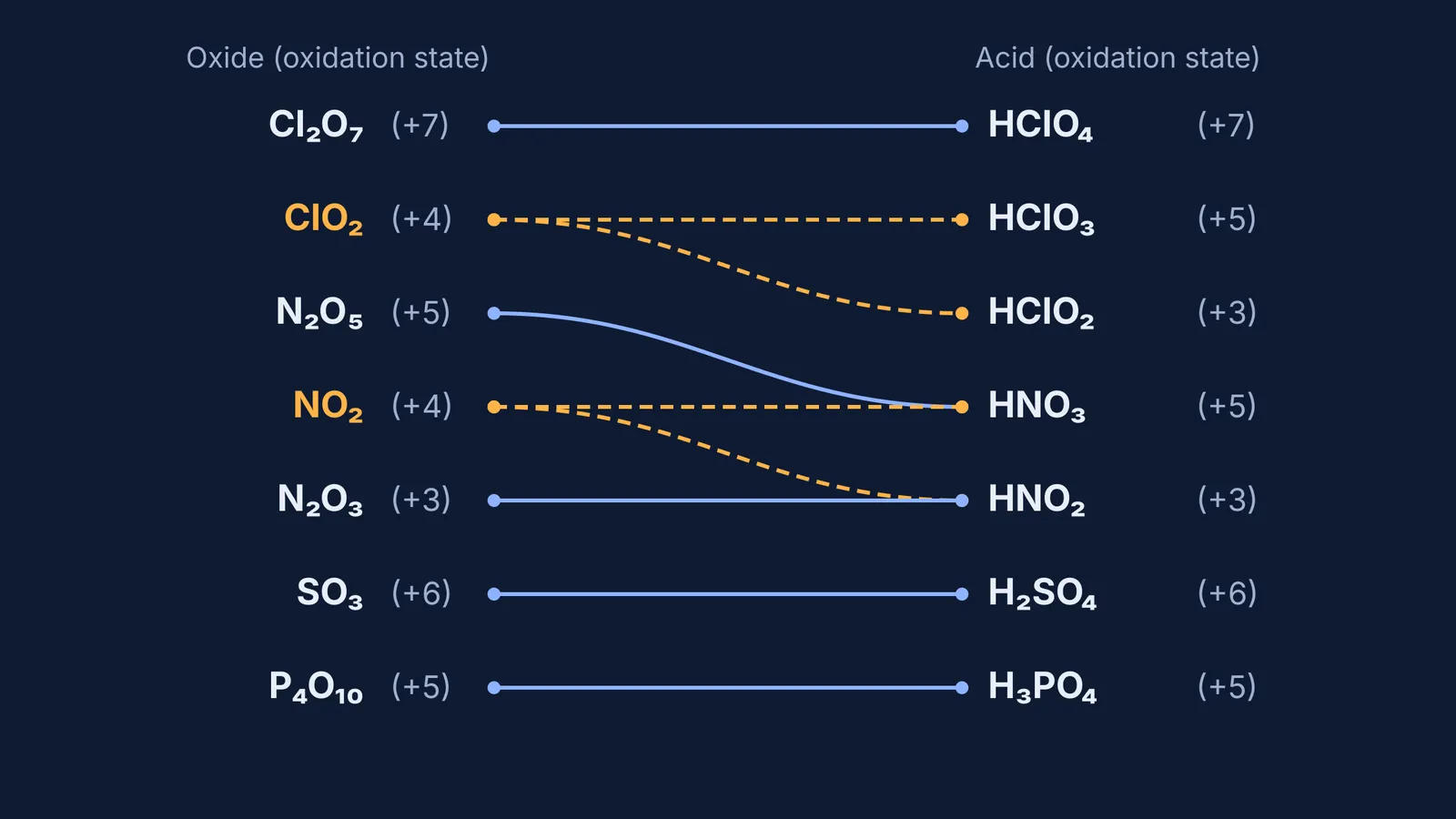
Every acidic oxide has a parent acid. Take the acid, remove water, and keep the oxidation state of the central atom the same: what is left is the oxide, called the acid anhydride. Most pairs match one to one, such as N₂O₅ with HNO₃. A few oxides, like NO₂ and ClO₂, sit at an oxidation state with no stable acid of their own, so water or alkali splits them into two acids at once. Those mixed anhydrides are where JEE and NEET questions set their traps.
What is an acid anhydride in inorganic chemistry?
An acid anhydride is a non-metal (or high-oxidation-state metal) oxide that reacts with water to give an oxoacid, and that can be made, at least on paper, by taking water out of that acid. "Anhydride" means "without water".
Which oxides are acidic in the first place, and how that changes across a period, is covered in the nature of oxides across Period 3. This post takes the next step: for each acidic oxide, which acid exactly?
The one rule that does all the work: the oxidation state of the central atom does not change when an anhydride reacts with water. Water adds H and O as H₂O, which is neither oxidised nor reduced. So an oxide with nitrogen at +5 can only give the nitrogen acid at +5.
How do you find the anhydride of an acid?
Remove water from the acid until no hydrogen is left (or until the formula cannot lose more H₂O). For a monoprotic acid you need two molecules:
2HClO₄ − H₂O = Cl₂O₇ (Cl stays +7)
2HNO₃ − H₂O = N₂O₅ (N stays +5)
2HNO₂ − H₂O = N₂O₃ (N stays +3)
2HOCl − H₂O = Cl₂O (Cl stays +1)
2HMnO₄ − H₂O = Mn₂O₇ (Mn stays +7)
For a diprotic acid, one water goes:
H₂SO₄ − H₂O = SO₃ (S stays +6)
H₂SO₃ − H₂O = SO₂ (S stays +4)
H₂CrO₄ − H₂O = CrO₃ (Cr stays +6)
H₂CO₃ − H₂O = CO₂ (C stays +4)
For phosphorus, the real molecules are the cage oxides P₄O₁₀ and P₄O₆, so write the reaction forwards:
P₄O₁₀ + 6H₂O → 4H₃PO₄ (P stays +5)
P₄O₆ + 6H₂O → 4H₃PO₃ (P stays +3)
H₃PO₃ is diprotic because one H is bonded directly to P. That changes its basicity, not its anhydride.
Mn₂O₇ and CrO₃ are acidic even though Mn and Cr are metals: at +7 and +6 the metal behaves like a non-metal centre. Their low oxides, MnO and CrO, are basic.
What is a mixed anhydride, and why do NO₂ and ClO₂ count as one?
Nitrogen in NO₂ is +4. Look for a nitrogen oxoacid at +4 and you will not find a stable one: HNO₂ is +3 and HNO₃ is +5. Water cannot make a +4 acid that does not exist, so NO₂ disproportionates. Half the nitrogen goes up to +5 and half comes down to +3:
2NO₂ + H₂O → HNO₂ + HNO₃
Check it: 2 N, 5 O and 2 H on each side. Oxidation states: +4 → +3 and +4 → +5, one electron each way, so the change balances.
Because NO₂ gives two acids, it is called a mixed anhydride of HNO₂ and HNO₃. In alkali you get both salts:
2NO₂ + 2NaOH → NaNO₂ + NaNO₃ + H₂O
In warm water the HNO₂ itself breaks down further, and the overall result is 3NO₂ + H₂O → 2HNO₃ + NO. Both equations are correct; they describe different conditions.
Chlorine dioxide behaves the same way. Cl in ClO₂ is +4, and there is no stable chlorine oxoacid at +4 (HClO₂ is +3, HClO₃ is +5). In alkali:
2ClO₂ + 2OH⁻ → ClO₂⁻ + ClO₃⁻ + H₂O
Check: 2 Cl, 6 O, 2 H and a charge of −2 on each side. So ClO₂ is a mixed anhydride of chlorous and chloric acid. In plain water the picture is messier, because ClO₂ dissolves mostly unchanged and decomposes in light, which is why the alkaline equation is the one to learn. The shape and odd electron of ClO₂ are covered in structures of SO₂, SO₃, ClO₂ and Cl₂O₇.
As an aside, Cl₂O₆ (average +6) fits the same pattern: Cl₂O₆ + 2OH⁻ → ClO₃⁻ + ClO₄⁻ + H₂O.
Note that "mixed anhydride" also has an organic meaning, such as ethanoic propanoic anhydride, made from two different carboxylic acids. That is a naming topic, covered in naming symmetric and mixed acid anhydrides. The inorganic idea is different: one oxide, two acids, through disproportionation.
Worked example: find the anhydride of HNO₂, then explain NO₂
Question. (a) Write the anhydride of nitrous acid. (b) Explain why NO₂ cannot be the anhydride of a single acid.
Step 1: find the oxidation state in the acid. In HNO₂, H is +1 and each O is −2. So N + 1 − 4 = 0, giving N = +3.
Step 2: remove water while keeping that oxidation state. HNO₂ has one H, so take two molecules: 2HNO₂ = H₂N₂O₄. Removing H₂O leaves N₂O₃.
Step 3: check the oxidation state in the oxide. In N₂O₃, 2N − 6 = 0, so N = +3. It matches.
Step 4: write the forward reaction. N₂O₃ + H₂O → 2HNO₂. Atoms: 2 N, 4 O, 2 H on each side.
Step 5: find nitrogen's oxidation state in NO₂. N − 4 = 0, so N = +4.
Step 6: look for the parent acid. No stable nitrogen oxoacid has N at +4. The neighbours are HNO₂ (+3) and HNO₃ (+5).
Step 7: conclude. Since water cannot change the total oxidation state, NO₂ must split into one acid above +4 and one below: 2NO₂ + H₂O → HNO₂ + HNO₃. NO₂ is therefore a mixed anhydride, not the anhydride of a single acid.
A useful cross-check: N₂O₃ can be seen as NO + NO₂ combined, and it is in fact made that way at low temperature. Average oxidation state (+2 + +4)/2 = +3, which matches HNO₂.
Which oxides do JEE and NEET ask about most?
Most questions draw on a short list. Learn it with the oxidation state attached:
Cl₂O (+1) → HOCl; Cl₂O₇ (+7) → HClO₄
ClO₂ (+4) → chlorite + chlorate (mixed)
N₂O₃ (+3) → HNO₂; N₂O₅ (+5) → HNO₃
NO₂ (+4) → HNO₂ + HNO₃ (mixed)
SO₂ (+4) → H₂SO₃; SO₃ (+6) → H₂SO₄
P₄O₆ (+3) → H₃PO₃; P₄O₁₀ (+5) → H₃PO₄
CO₂ (+4) → H₂CO₃
CrO₃ (+6) → H₂CrO₄; Mn₂O₇ (+7) → HMnO₄
If you want to practise turning formulas into oxidation states quickly, the Fermi Problem Library has a step-by-step solver that explains the reasoning at each line, which helps when a question mixes anhydrides with redox.
Quick checklist
Anhydride = acid minus water, with the same oxidation state.
Monoprotic acid: take two molecules and remove one H₂O.
If no stable acid exists at the oxide's oxidation state, expect disproportionation into two acids.
NO₂ and ClO₂ (both +4) are the standard mixed anhydrides.
CO, NO and N₂O are neutral, not anhydrides.
Balance atoms, then check the oxidation-state changes cancel.


