

On this page
When you move across Period 3 of the periodic table, the elements change from reactive metals to reactive non-metals. Their oxides follow a similar dramatic shift, transforming from strongly basic to strongly acidic.
Understanding why this happens is a classic test of how well you grasp the connection between atomic properties and chemical behaviour.
Why do the oxides change their nature?
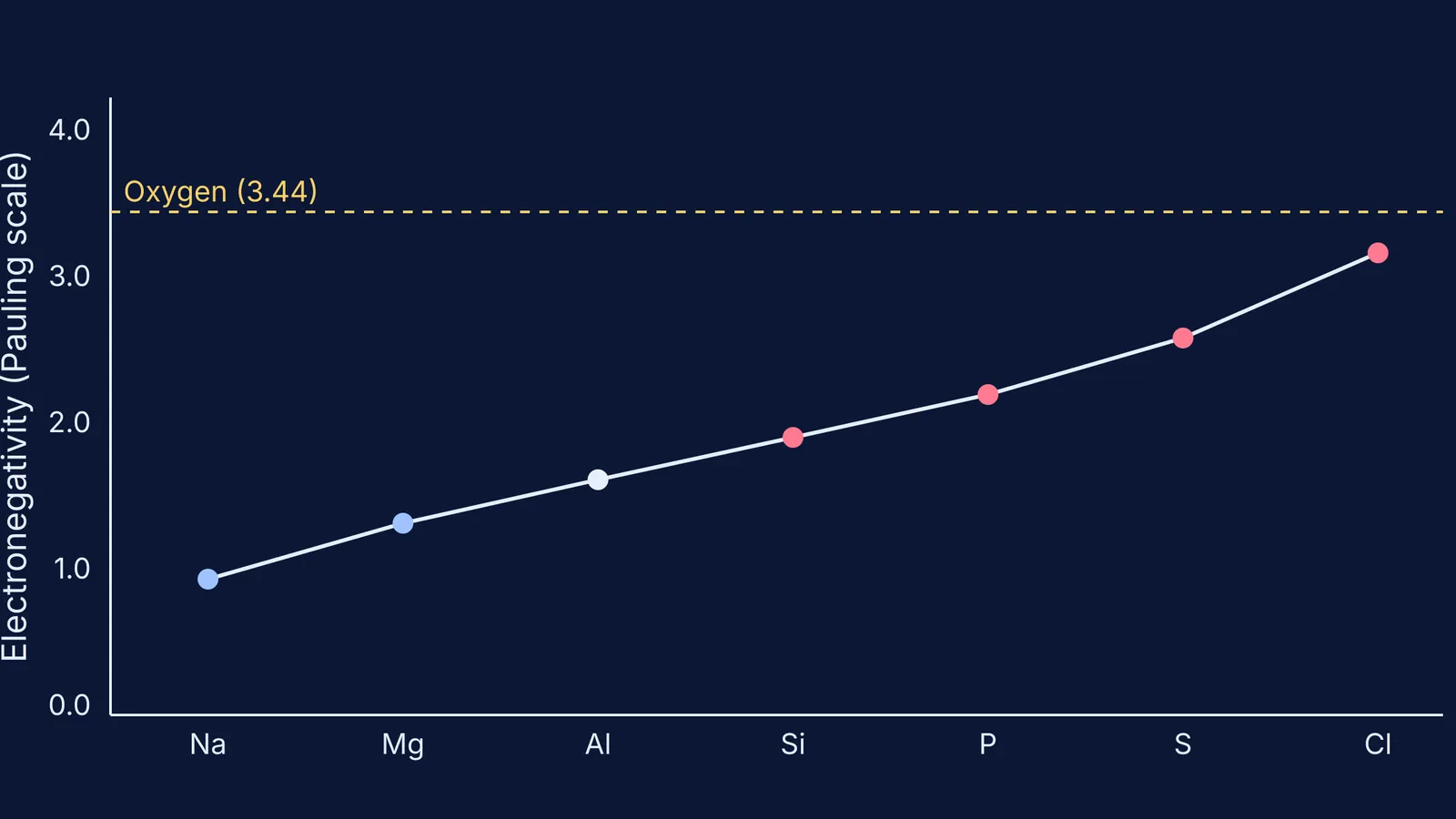
The chemical nature of an oxide is driven by the difference in electronegativity between the element and oxygen. According to the Pauling scale, oxygen has an electronegativity of 3.44 (Wikipedia).
As you move from left to right across Period 3, the electronegativity of the elements steadily increases: sodium (0.93), magnesium (1.31), aluminium (1.61), silicon (1.90), phosphorus (2.19), sulfur (2.58), and chlorine (3.16).
This means the electronegativity gap between the element and oxygen shrinks. A large gap creates an ionic bond, while a small gap creates a covalent bond. That shift in bonding is what changes the oxide from basic to acidic. If you find these atomic trends hard to picture, the Fermi Concept Library maps out electronegativity and bonding so you can trace the logic step by step.
Which oxides are basic?
Sodium oxide (Na₂O) and magnesium oxide (MgO) are basic. Because sodium and magnesium have low electronegativities, the difference between them and oxygen is large (2.51 and 2.13, respectively) (Wikipedia).
This large gap means the bonds are purely ionic. These compounds exist as giant ionic lattices containing the oxide ion (O²⁻). The oxide ion is a strong base. When sodium oxide dissolves in water, the oxide ions react completely with water molecules to form hydroxide ions (OH⁻), creating a strongly alkaline solution of sodium hydroxide. Magnesium oxide does the same, though it is less soluble, forming a weaker alkaline solution.
Why is aluminium oxide amphoteric?
Aluminium has a higher electronegativity (1.61) (Wikipedia), so the difference with oxygen drops to 1.83. This is the turning point in Period 3.
While aluminium oxide (Al₂O₃) is still primarily ionic, the aluminium ion is small and highly charged. This allows it to pull the oxygen's electrons towards itself, giving the bond significant covalent character. Because it sits on this borderline, Al₂O₃ is amphoteric. It does not dissolve in water, but it will react with both strong acids (acting as a base) and strong bases (acting as an acid) to form salts.
Which oxides are acidic?
From silicon onwards, the elements are non-metals with high electronegativities. The gap with oxygen is small, meaning the bonds are covalent. The oxides are silicon dioxide (SiO₂), phosphorus(V) oxide (P₄O₁₀), sulfur trioxide (SO₃), and dichlorine heptoxide (Cl₂O₇).
Because these oxides share electrons rather than forming oxide ions, they behave entirely differently in water. The central atoms are highly positively polarised and attract the oxygen atom of a water molecule, eventually releasing H⁺ ions into the solution. For instance, phosphorus(V) oxide reacts vigorously with water to produce phosphoric acid. Sulfur trioxide reacts violently with water to form sulfuric acid, and dichlorine heptoxide forms perchloric acid, which is one of the strongest known mineral acids (Wikipedia).
Silicon dioxide is the exception only in solubility. Its giant covalent structure means that strong silicon-oxygen bonds must be broken for it to dissolve, making it insoluble in water. However, it still behaves as a weak acid by reacting with hot, concentrated bases like sodium hydroxide to form sodium silicate. You can explore how these acids behave in solutions by reading about conjugate acid-base pairs or the pH of very dilute acids.
How can you predict an oxide's nature?
If you are facing an unknown oxide in an exam, use this simple framework:
Find its position: Elements on the far left form basic oxides. Elements on the right form acidic oxides.
Check the electronegativity gap: A large gap with oxygen means it is ionic and basic. A small gap means it is covalent and acidic.
Look for the borderline: Elements with intermediate gaps (like aluminium) often form amphoteric oxides.
Test the water reaction: If the oxide releases OH⁻ in water, it is a base. If it forms an oxyacid and releases H⁺, it is an acid.


