

On this page
In chemistry, oxides are binary compounds formed when oxygen bonds with another element. Because oxygen is highly electronegative, it readily reacts with almost everything on the periodic table. However, the resulting compounds behave very differently when they are dissolved in water or exposed to acids and alkalis.
Most metal oxides are basic, and most non-metal oxides are acidic. But a small handful of non-metal oxides break this fundamental rule. They are entirely unreactive towards both acids and bases, earning them the name "neutral oxides".
What are neutral oxides?
According to the NCERT Class 11 Chemistry textbook on the classification of elements, neutral oxides are compounds that show neither basic nor acidic properties (NCERT, Chapter 3). They do not react with acids to form salts, they do not react with bases, and they do not alter the pH of pure water. If you were to bubble a neutral oxide gas through a solution containing universal indicator, the liquid would remain perfectly green.
To understand where they fit, it helps to look at the four main categories of oxides and their chemical behaviour:
Acidic oxides: Typically formed by non-metals (such as carbon dioxide, CO₂, or sulphur dioxide, SO₂). They dissolve in water to form acids. For example, CO₂ dissolves to form carbonic acid. They readily react with bases to form salts and water.
Basic oxides: Typically formed by metals on the far left side of the periodic table (such as sodium oxide, Na₂O, or calcium oxide, CaO). They dissolve in water to form alkaline solutions, and they neutralise acids to form salts.
Amphoteric oxides: Formed by metals and metalloids near the centre of the periodic table (such as aluminium oxide, Al₂O₃, or zinc oxide, ZnO). These unique compounds can behave as either an acid or a base, meaning they can react with both to form salts.
Neutral oxides: Formed by a few specific non-metals. They sit completely outside the acid-base spectrum and react with neither.
What are the examples of neutral oxides: CO, N2O and NO?
If you are asked to identify a neutral oxide in a chemistry exam, the answer is almost always one of these three classic examples:
Carbon monoxide (CO): While carbon dioxide is famously acidic, carbon monoxide is strictly neutral. It does not react with water, acids or alkalis at room temperature.
Nitrous oxide (N₂O): Commonly known as laughing gas. Despite being an oxide of nitrogen, it does not form an acid in water and remains neutral.
Nitric oxide (NO): A colourless gas that plays a crucial role in human biology as a signalling molecule. Like nitrous oxide, it does not exhibit acidic or basic chemistry.
Water (H₂O) is also technically a neutral oxide of hydrogen. However, because water itself is the solvent we use to define the pH scale, it is usually treated as a separate baseline. (For more on how water's self-ionisation shifts with heat, see why neutral pH is not always 7).
Why are some non-metal oxides neutral?
If non-metals typically form acidic oxides, why do CO, N₂O and NO buck the trend? The answer lies in their oxidation states.
The acidity of a non-metal oxide is directly linked to the oxidation state (or formal positive charge) of its central atom. A higher oxidation state means the central atom pulls more strongly on the electrons in its bonds, making the molecule highly electrophilic. When a strongly electrophilic oxide dissolves in water, it pulls the oxygen away from the H₂O molecules, forcing the release of hydrogen ions (H⁺) and thereby creating an acidic solution.
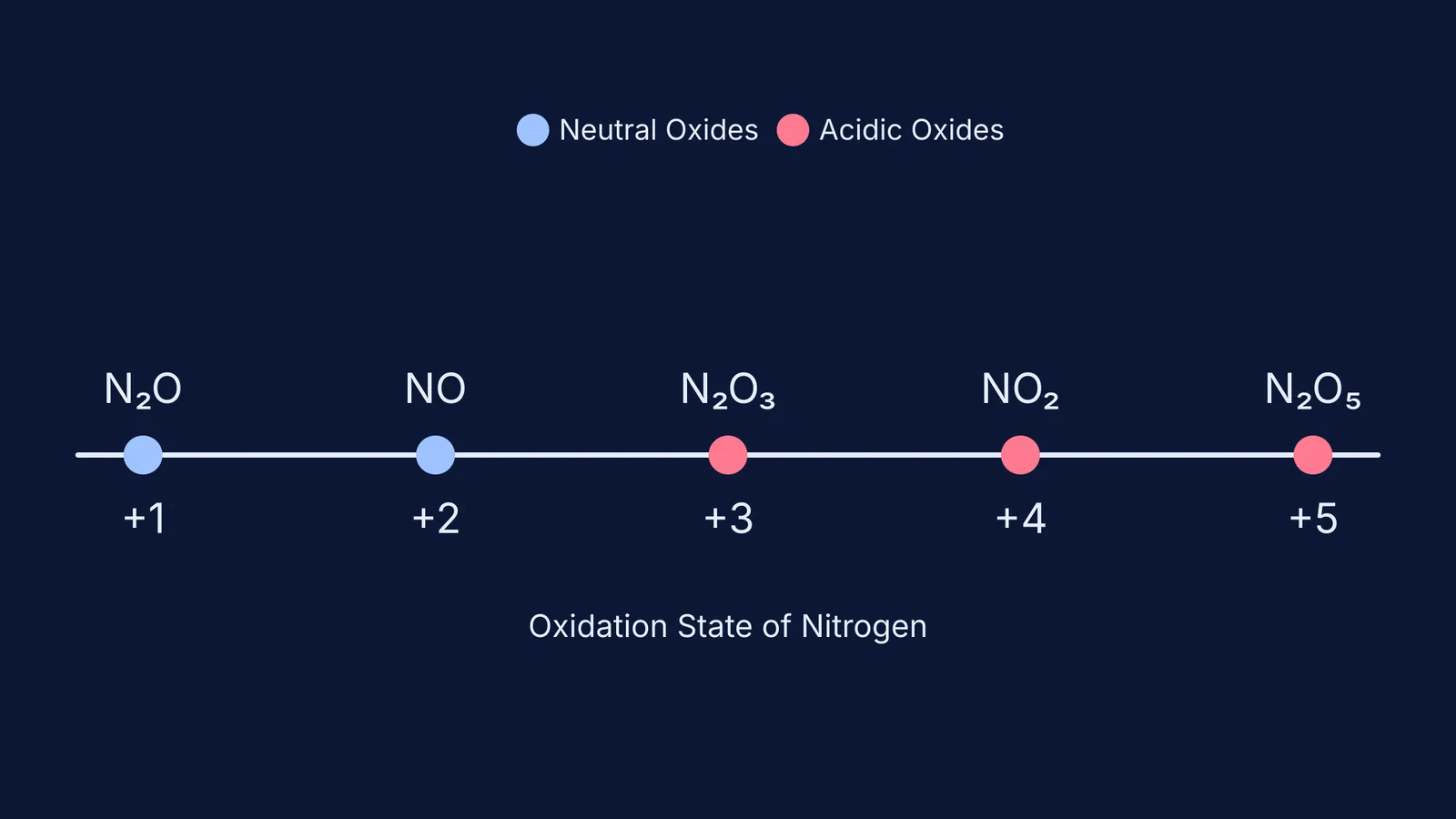
Neutral oxides feature non-metals in low oxidation states:
Carbon in CO is in a +2 state (compared to the acidic CO₂ at +4).
Nitrogen in N₂O is in a +1 state.
Nitrogen in NO is in a +2 state.
Because these central atoms carry a very low positive charge, they lack the intense electron-pulling strength required to strip water molecules apart. Consequently, they cannot generate H⁺ ions, and they cannot act as acids.
You can see this trend perfectly by tracking nitrogen. As the oxidation state of nitrogen increases from +1 (N₂O) and +2 (NO) up through +3 (N₂O₃), +4 (NO₂) and +5 (N₂O₅), its oxides transition completely from unreactive neutral gases to strongly acidic compounds.
Mapping out chemical trends across the periodic table can be daunting. If you have gaps in your understanding of how these rules connect, the Fermi Concept Library holds a lesson for every concept in chemistry, placing ideas like oxidation states and periodic properties in their exact place on the map.


