

On this page
The acid rain equation you learn, 2SO₂ + O₂ + 2H₂O → 2H₂SO₄, is balanced, as the Taj Mahal acid rain post shows. It does not say where the reaction happens, how fast it goes or which oxidant does the work. Much of the sulphate in rain and haze is made inside cloud and fog drops, in three steps you already know from Class 12: Henry's law, weak-acid ionisation and rate laws. Put them together and you find that hydrogen peroxide, not ozone, does most of the work in acidic drops.
How does SO₂ get into a cloud drop?
SO₂ dissolves by Henry's law: [SO₂·H₂O] = K_H × p(SO₂), with K_H ≈ 1.23 M atm⁻¹ at 298 K (published values run from about 1.2 to 1.3; see the Henry's law compilation for SO₂).
The dissolved gas is a weak diprotic acid:
SO₂·H₂O ⇌ HSO₃⁻ + H⁺, with pKa₁ ≈ 1.9 (Ka₁ ≈ 1.3 × 10⁻²)
HSO₃⁻ ⇌ SO₃²⁻ + H⁺, with pKa₂ ≈ 7.2 (Ka₂ ≈ 6.6 × 10⁻⁸)
Together these are called S(IV), sulphur in the +4 state. How the three forms share out with pH is worked through in the potassium bisulphite preservative project, so it is not repeated here. The new point is this: every time dissolved SO₂ ionises, more gas can dissolve to replace it. The total S(IV) in the drop follows an effective Henry's constant:
H* = K_H (1 + Ka₁/[H⁺] + Ka₁Ka₂/[H⁺]²)
At pH 5, Ka₁/[H⁺] = 1300, so the drop holds about 1300 times more sulphur than Henry's law alone predicts. Each pH unit lower cuts that by about ten.
Which oxidants turn dissolved SO₂ into sulphate?
Two oxidants dissolve into the same drop and compete.
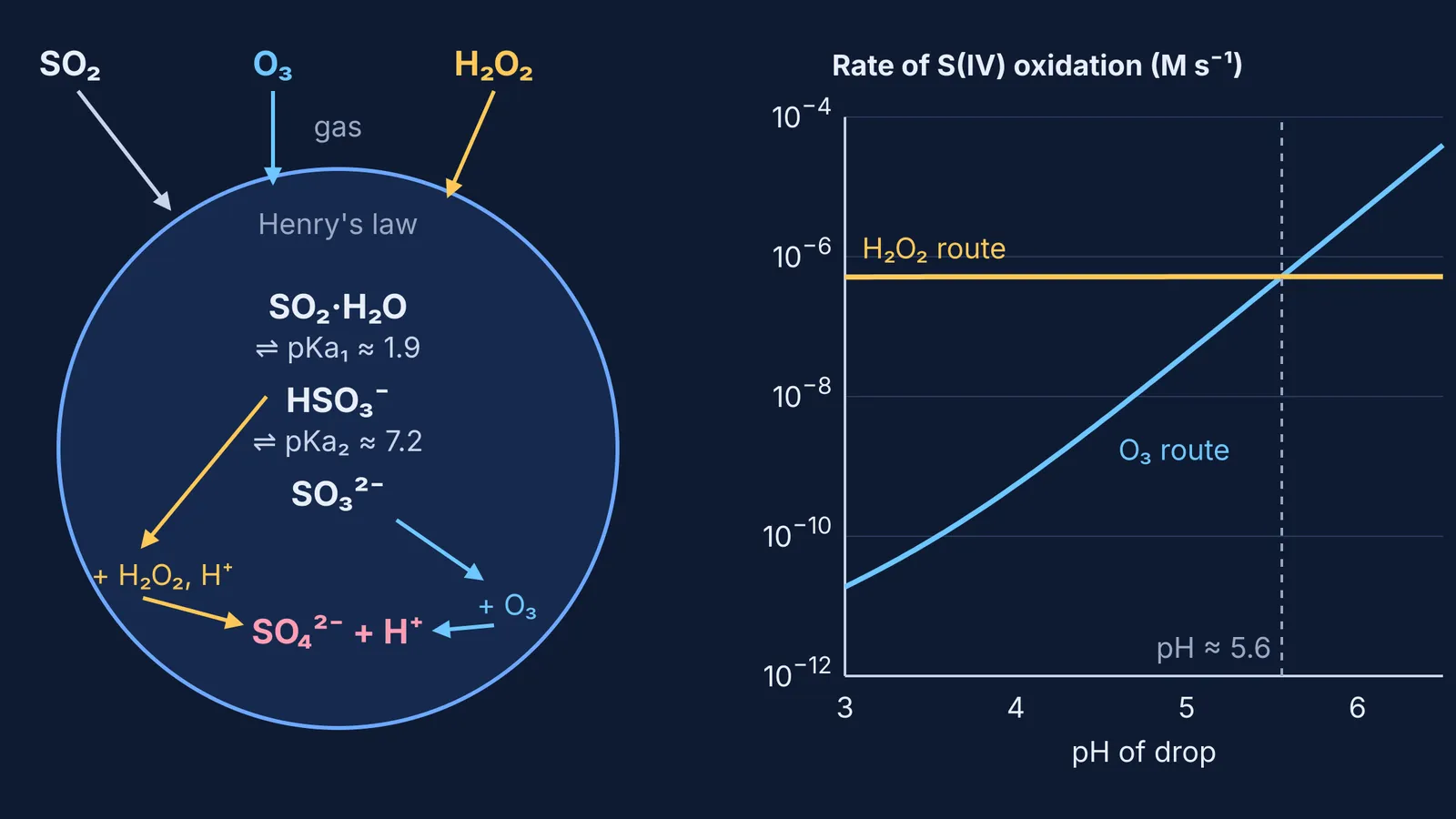
Ozone reacts with all three S(IV) forms, but at very different speeds. Hoffmann (1986)90147-2) recommends rate constants of about 2.4 × 10⁴ (SO₂·H₂O), 3.7 × 10⁵ (HSO₃⁻) and 1.5 × 10⁹ M⁻¹ s⁻¹ (SO₃²⁻) at 298 K. Sulphite is about 4000 times more reactive than bisulphite:
SO₃²⁻ + O₃ → SO₄²⁻ + O₂
Hydrogen peroxide reacts with bisulphite in an acid-catalysed step:
HSO₃⁻ + H₂O₂ → SO₄²⁻ + H⁺ + H₂O
Its standard rate law, used in atmospheric models, is rate = k[H⁺][HSO₃⁻][H₂O₂]/(1 + K[H⁺]), with k = 7.45 × 10⁷ M⁻² s⁻¹ and K = 13 M⁻¹ (Hung, Hsu and Hoffmann, 2018). Both equations balance: count S, O and H, then check the charge (−2 on each side for the first, −1 for the second).
Why does the ozone route switch itself off as the drop gets acidic?
Ozone depends mainly on SO₃²⁻. Between pH 4 and 6, total S(IV) falls tenfold per pH unit, and the share of it that is SO₃²⁻ also falls tenfold. So the ozone rate drops about 100 times for each pH unit.
Now notice what the reaction makes: H⁺. Every sulphate made by ozone acidifies the drop, which slows the next one. The ozone route shuts itself down.
Why doesn't the H₂O₂ route care about pH?
Substitute the speciation into the H₂O₂ rate law. In acidic drops, [HSO₃⁻] ≈ Ka₁K_H p(SO₂)/[H⁺]. Then:
rate = k × [H⁺] × (Ka₁K_H p(SO₂)/[H⁺]) × [H₂O₂] / (1 + K[H⁺])
The two [H⁺] terms cancel. As long as K[H⁺] is much less than 1 (pH above about 2), the rate barely changes with pH. Less S(IV) dissolves in acid, but each HSO₃⁻ reacts faster, and the two effects balance exactly.
Worked example: which oxidant wins, and how much sulphate?
Take illustrative air at 298 K with 5 ppb SO₂, 50 ppb O₃ and 1 ppb H₂O₂ (1 ppb = 10⁻⁹ atm at 1 atm). Use K_H(O₃) ≈ 1.0 × 10⁻² and K_H(H₂O₂) ≈ 8.7 × 10⁴ M atm⁻¹ from the Henry's law compilation. Assume the drop is in Henry's-law equilibrium with the air and ignore how fast gas can diffuse in.
(a) Dissolved S(IV) at pH 5.
H* = 1.23 × (1 + 1300 + 8.6) ≈ 1610 M atm⁻¹.
S(IV) = 1610 × 5 × 10⁻⁹ ≈ 8.1 × 10⁻⁶ M, almost all of it HSO₃⁻ (8.0 × 10⁻⁶ M).
SO₃²⁻ = HSO₃⁻ × Ka₂/[H⁺] = 8.0 × 10⁻⁶ × 6.6 × 10⁻³ ≈ 5.3 × 10⁻⁸ M.
At pH 4, H* ≈ 161 M atm⁻¹, so S(IV) ≈ 8.1 × 10⁻⁷ M: ten times less.
(b) Compare the two rates.
Dissolved O₃ = 1.0 × 10⁻² × 50 × 10⁻⁹ = 5.0 × 10⁻¹⁰ M. Dissolved H₂O₂ = 8.7 × 10⁴ × 10⁻⁹ = 8.7 × 10⁻⁵ M.
Ozone at pH 5: (3.7 × 10⁵ × 8.0 × 10⁻⁶ + 1.5 × 10⁹ × 5.3 × 10⁻⁸) × 5.0 × 10⁻¹⁰ ≈ 4.1 × 10⁻⁸ M s⁻¹.
H₂O₂ at pH 5: 7.45 × 10⁷ × 10⁻⁵ × 8.0 × 10⁻⁶ × 8.7 × 10⁻⁵ ≈ 5.2 × 10⁻⁷ M s⁻¹. That is about 13 times the ozone rate.
At pH 4, ozone falls to about 5.4 × 10⁻¹⁰ M s⁻¹, while H₂O₂ stays at 5.2 × 10⁻⁷ M s⁻¹, nearly 1000 times faster.
The two rates are equal near pH 5.6. Above that, ozone wins.
At 5.2 × 10⁻⁷ M s⁻¹, the dissolved H₂O₂ would be used up in about 170 s if it were not resupplied from the air. So the peroxide route runs in minutes.
(c) Limiting reagent. SO₂ + H₂O₂ → H₂SO₄ is 1 : 1. One ppb of H₂O₂ can convert only 1 ppb of the 5 ppb SO₂, giving 1 ppb of sulphate. Cut SO₂ by 20%, to 4 ppb, and the peroxide route still makes the same 1 ppb. H₂O₂ is the limiting reagent, so sulphate does not fall in step with SO₂.
Why doesn't cutting SO₂ always cut sulphate in proportion?
Part (c) is the answer while H₂O₂ is scarcer than SO₂. The leftover SO₂ is not safe either. If the drop stays less acidic, ozone can oxidise it. Ammonia does exactly that: it neutralises the acid and keeps the pH up, reopening the ozone route. That is one reason sulphate and ammonium travel together in North India's winter haze, alongside the nitrate described in how cold air turns NH₃ and HNO₃ into PM2.5.
SO₂ is also oxidised in clear air, by OH radicals, but much more slowly than in cloud where clouds are present.
If you want to rework these numbers until each step feels natural, the Fermi Problem Library has a step-by-step solver that explains the reasoning at each line.
Quick checklist
SO₂ dissolves by Henry's law (K_H ≈ 1.23 M atm⁻¹), then ionises; H* = K_H(1 + Ka₁/[H⁺] + Ka₁Ka₂/[H⁺]²).
Ozone attacks mainly SO₃²⁻; its rate falls about 100-fold per pH unit, and it makes the acid that stops it.
H₂O₂ attacks HSO₃⁻ with H⁺ catalysis; the [H⁺] terms cancel, so its rate barely depends on pH.
For 5 ppb SO₂, 50 ppb O₃ and 1 ppb H₂O₂, the rates cross near pH 5.6.
SO₂ + H₂O₂ is 1 : 1, so scarce H₂O₂ caps sulphate; ammonia reopens the ozone route.


