

On this page
The CBSE Class 12 project list includes "Study of the effect of potassium bisulphite as a food preservative under various conditions (temperature, concentration and time)". To do it well you need three pieces of chemistry: which form of sulphite actually stops microbes, why the acidity of the food matters so much, and how to measure what is left after storage. Our post on how sodium benzoate, sorbic acid and BHT keep food fresh covers the other common preservatives. This one is only about sulphite.
What is potassium bisulphite, and is it the same as KMS?
Potassium bisulphite is KHSO₃, also called potassium hydrogen sulphite. Potassium metabisulphite, K₂S₂O₅, sold as "KMS" for home pickles and squashes, is a different compound. Project reports often mix them up.
In water, metabisulphite turns into bisulphite:
S₂O₅²⁻ + H₂O → 2HSO₃⁻
So both deliver the same ion. They differ in how much SO₂ each gram can supply:
KHSO₃ (about 120.2 g mol⁻¹) carries one SO₂ (64.1 g mol⁻¹) per formula unit, so it is about 53.3% SO₂ by mass.
K₂S₂O₅ (about 222.3 g mol⁻¹) releases two SO₂ per formula unit, so it is about 57.6% SO₂ by mass.
Write down which salt you used, and express every dose as mg of SO₂ per litre.
How does sulphite preserve food?
In acidic food, bisulphite picks up a proton:
HSO₃⁻ + H⁺ ⇌ SO₂·H₂O
Textbooks write the product as H₂SO₃, sulphurous acid, but almost none of it exists as H₂SO₃ molecules. It is dissolved SO₂. This neutral molecule is the form that acts on microbes. An uncharged molecule crosses a cell membrane far more easily than an ion, the same idea that explains why benzoate needs acidic food.
Sulphite does a second job as well. It is a reducing agent, the property you meet in the SO₂ tests with acidified KMnO₄ and dichromate. When fruit is cut, enzymes oxidise its phenols to coloured quinones, and the fruit darkens. Sulphite reduces the quinones back and slows the enzyme, so the colour of the squash holds. It also slows the slower browning of sugars during storage.
Why does bisulphite work in acidic squash but not in neutral food?
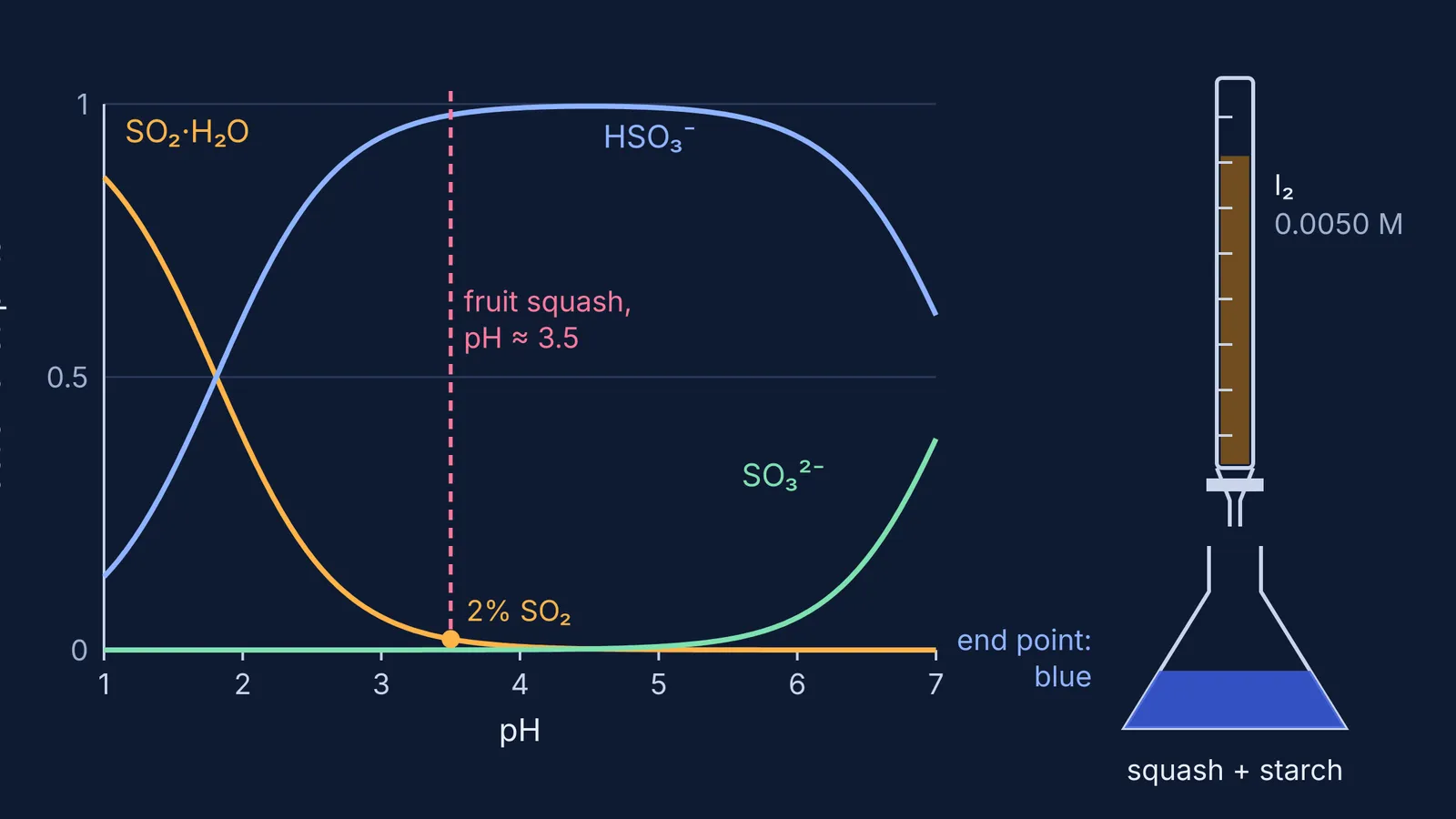
Treat dissolved SO₂ as a diprotic acid with pKa₁ ≈ 1.8 and pKa₂ ≈ 7.2. Tables differ a little (about 1.8 to 1.9 and 7.0 to 7.2), so treat answers as approximate. Below about pH 5, the amount of SO₃²⁻ is negligible, so the fraction present as molecular SO₂ is:
fraction of SO₂·H₂O = 1 / (1 + 10^(pH − pKa₁))
Worked example 1: a squash at pH 3.5, with pKa₁ = 1.81
pH − pKa₁ = 3.5 − 1.81 = 1.69.
10^1.69 ≈ 49.
Fraction = 1 / (1 + 49) = 0.020, so about 2.0% is molecular SO₂ and about 98% is HSO₃⁻.
Check the second step: SO₃²⁻ / HSO₃⁻ = 10^(3.5 − 7.2) ≈ 2 × 10⁻⁴. Ignoring it was safe.
Now repeat at pH 6.0: 10^(6.0 − 1.81) ≈ 1.5 × 10⁴, so the fraction is about 0.006%, roughly 300 times smaller than at pH 3.5.
So if you add bisulphite equal to 100 mg of SO₂ per litre, a squash at pH 3.5 holds about 2 mg L⁻¹ as molecular SO₂, and a near-neutral food holds almost none. That is why sulphite is used mainly in acidic products such as squashes, fruit pulps and wine, and why measuring the pH of every sample belongs in your project.
What happens to sulphite during storage?
Your project varies time and temperature because sulphite is used up. There are three main losses.
Air oxidation. 2HSO₃⁻ + O₂ → 2SO₄²⁻ + 2H⁺. Sulphate has no preservative action, so a jar opened often loses its protection faster.
Binding. Bisulphite adds to the C=O group of carbonyl compounds in the food, such as acetaldehyde and keto acids. This is the same reaction as the sodium bisulphite addition test for aldehydes and ketones. Bound sulphite is "bound SO₂"; only the free part protects the food.
Escape as gas. SO₂ is volatile. Warming an open sample drives some of it off, and heat also speeds up the oxidation.
A simple design uses one juice or squash with doses of 0, 50, 100 and 200 mg SO₂ per litre, stored in a refrigerator, at room temperature and in a warm place. Record days to visible mould, gas or a sour smell, note colour changes, and titrate the free SO₂ on day 0 and at fixed intervals. For a 100 mg L⁻¹ dose from KHSO₃, you need 100 / 0.533 ≈ 188 mg of the salt per litre. These numbers are a starting point, not a standard method.
How do you measure SO₂ in a squash by iodine titration?
Iodine oxidises SO₂ quantitatively:
SO₂ + I₂ + 2H₂O → H₂SO₄ + 2HI
Titrating the sample directly with standard iodine is an iodimetric titration; the difference from iodometric methods is explained in iodometric vs iodimetric titration. Add starch and a little dilute H₂SO₄ to the sample. As long as SO₂ remains, iodine is used up at once. The first drop of excess iodine turns the starch blue, and that is the end point.
Two practical warnings. Titrate quickly, because SO₂ is lost to air while the flask stands. And any other reducing agent, especially vitamin C in fruit juice, also uses up iodine and will be counted as SO₂, so run an unsulphited sample of the same juice as a blank and subtract its titre.
Worked example 2 (illustrative numbers)
A 25.0 mL sample of squash needs 4.4 mL of 0.0050 M I₂ to reach the blue end point. Find the free SO₂ in mg L⁻¹.
Moles of I₂ = 4.4 × 10⁻³ L × 0.0050 mol L⁻¹ = 2.2 × 10⁻⁵ mol.
The equation is 1 : 1, so moles of SO₂ = 2.2 × 10⁻⁵ mol.
Mass of SO₂ = 2.2 × 10⁻⁵ × 64.07 g mol⁻¹ = 1.41 × 10⁻³ g = 1.41 mg.
Concentration = 1.41 mg / 0.0250 L ≈ 56 mg L⁻¹.
At pH 3.5, about 2% of that is molecular SO₂: about 1.1 mg L⁻¹.
If you want to practise more titration calculations like this, the Fermi Problem Library has a step-by-step solver that explains the reasoning at each stage.
Is sulphite safe to eat?
Sulphites are permitted food additives in many countries, with limits that depend on the food. If your project quotes a legal limit, take it from the current regulations and cite them. The European Food Safety Authority's 2022 follow-up opinion on sulphur dioxide and sulphites notes that reactions to these additives in people are most often respiratory, particularly in people with asthma, and that sulphite destroys thiamine (vitamin B1) in stored food and drink. Anyone with asthma or a known sensitivity should check labels and ask a doctor.
Quick checklist
KHSO₃ (about 53% SO₂) and K₂S₂O₅, KMS (about 58% SO₂), are different salts; report doses as mg SO₂ per litre.
The active form is molecular SO₂, made when HSO₃⁻ picks up H⁺.
Use pKa₁ ≈ 1.8: about 2% is active at pH 3.5, almost none at pH 6.
Sulphite is lost by air oxidation, binding to carbonyl compounds and escape as gas.
Free SO₂: titrate with standard I₂ to a blue starch end point; 1 mol I₂ = 1 mol SO₂.
Run a blank to correct for vitamin C and other reductants.


