

On this page
In short In aqueous solutions, sulphur dioxide (SO₂) acts as a reducing agent by oxidising to sulphate. When passed through acidified potassium permanganate, it reduces manganese from +7 to +2, decolourising the purple solution. In the dichromate test, it reduces chromium from +6 to +3, turning the orange solution green.
Sulphur dioxide is a colourless gas with a pungent smell, famously known as the odour of burnt matches. It is often encountered industrially as a key intermediate in the Contact process for sulphuric acid. In the laboratory, differentiating it from other acidic gases (like carbon dioxide) requires relying on its chemical reactivity. Because CO₂ is already fully oxidised, a clear method to identify SO₂ is by testing its reducing nature. Two common analytical tests for this use acidified potassium permanganate and acidified potassium dichromate.
How does sulphur dioxide act as a reducing agent?
In aqueous solutions, sulphur dioxide dissolves to form sulphurous acid (H₂SO₃). This acid readily gives up electrons to oxidise into sulphate ions (SO₄²⁻). During this process, the oxidation state of the central sulphur atom increases from +4 to +6.
This electron-donating behaviour makes it a strong reducing agent. Because the sulphur atom has a lone pair of electrons in its +4 state and is not at its maximum oxidation state (which is +6 for Group 16 elements), it is highly motivated to lose those electrons in the presence of an electron acceptor. This allows it to easily reduce strong oxidising agents that contain transition metals.
Why does sulphur dioxide decolourise acidified KMnO4?
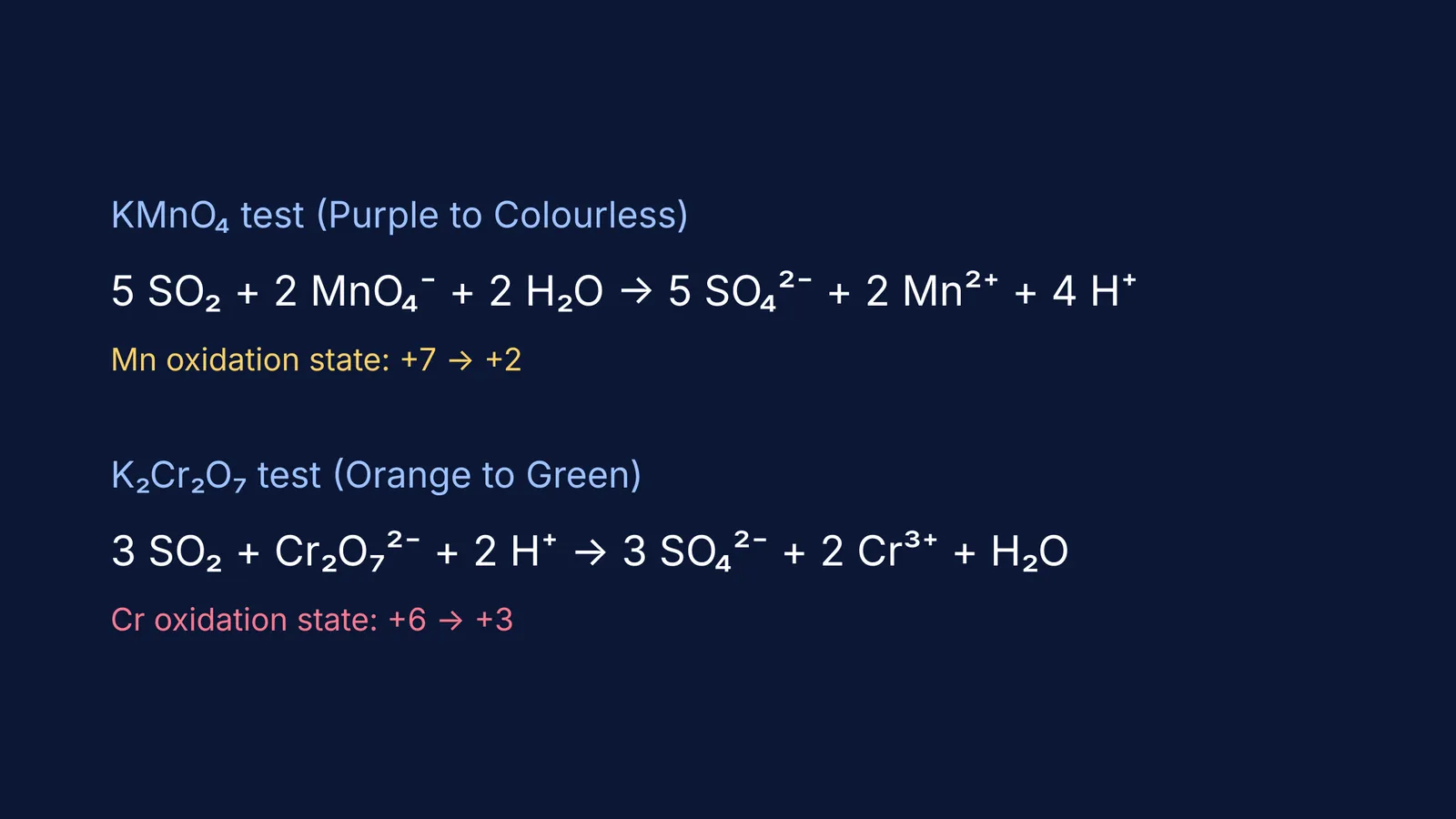
When sulphur dioxide gas is passed through a solution of acidified potassium permanganate, the intense purple colour of the MnO₄⁻ ion fades rapidly.
The chemistry driving this observation is a classic redox reaction. The manganese(VII) center within the permanganate ion gains 5 electrons and drops down to a +2 oxidation state. This leaves a nearly colourless (or very faintly pink) aqueous solution of manganese(II) sulfate_sulfate).
The balanced ionic equation for this reaction is: 5 SO₂ + 2 MnO₄⁻ + 2 H₂O → 5 SO₄²⁻ + 2 Mn²⁺ + 4 H⁺
This rapid decolourisation serves as a primary qualitative test for SO₂. Because permanganate is self-indicating, you do not need to add any external indicators to see the reaction reach completion. If you find yourself struggling to track these oxidation states across different reactions, the Fermi Concept Library maps out every concept in physics, chemistry, biology, mathematics and computing, each with its own lesson and its place in the map.
Why does sulphur dioxide turn acidified dichromate green?
The second standard test involves passing SO₂ through a solution or filter paper soaked in acidified potassium dichromate (K₂Cr₂O₇). Filter paper is often used because it can be held directly over a test tube where the gas is evolving, making it a safer and quicker qualitative check.
Potassium dichromate is an inorganic compound that dissolves in water to release bright orange Cr₂O₇²⁻ ions, containing hexavalent chromium (Cr(VI)). As the gas contacts the paper or solution, the sulphur dioxide reduces the chromium from this +6 oxidation state down to the +3 state. This electron transfer forms chromium(III) sulfate_sulfate), which produces a distinct green colour in aqueous solutions.
The balanced ionic equation for this reaction is: 3 SO₂ + Cr₂O₇²⁻ + 2 H⁺ → 3 SO₄²⁻ + 2 Cr³⁺ + H₂O
Learning these characteristic E° values of 3d metals and their colours is heavily tested in the inorganic chemistry sections of JEE Main and NEET-UG. If you keep dropping marks when balancing these complex equations, you can practise them in the Fermi Problem Library, where you will find worked problems with a step-by-step solver that explains the reasoning rather than printing an answer.
A framework for redox colour changes
It is easy to mix up what turns green and what turns colourless under exam pressure, especially when studying multiple gases. Use this simple checklist when evaluating a reducing agent like SO₂:
Identify the oxidising agent's starting colour: Permanganate is always intensely purple; dichromate is always bright orange.
Note the final state of the metal: Mn²⁺ is colourless or very pale pink; Cr³⁺ is green.
Confirm the reducing agent's product: SO₂ always oxidises to sulphate (SO₄²⁻). You can recall the average bond order from resonance in the sulphate ion to help draw its final molecular structure in the exam.
Check the medium: Both of these tests require an acidic medium (usually dilute sulphuric acid) to provide the H⁺ ions necessary for the reduction half-reactions to proceed efficiently.


