On this page
The Taj Mahal is the textbook example of acid rain for a reason: it is made of marble, and marble is mostly calcium carbonate, CaCO3. The US Geological Survey explains that limestone and marble are predominantly made of the mineral calcite, which dissolves easily in acid. Here are the balanced equations and a worked number.
Why is normal rain already acidic?
Normal rain has a pH of about 5.6, because carbon dioxide dissolves in it and forms weak carbonic acid, according to the US Environmental Protection Agency.
CO2 + H2O ⇌ H2CO3
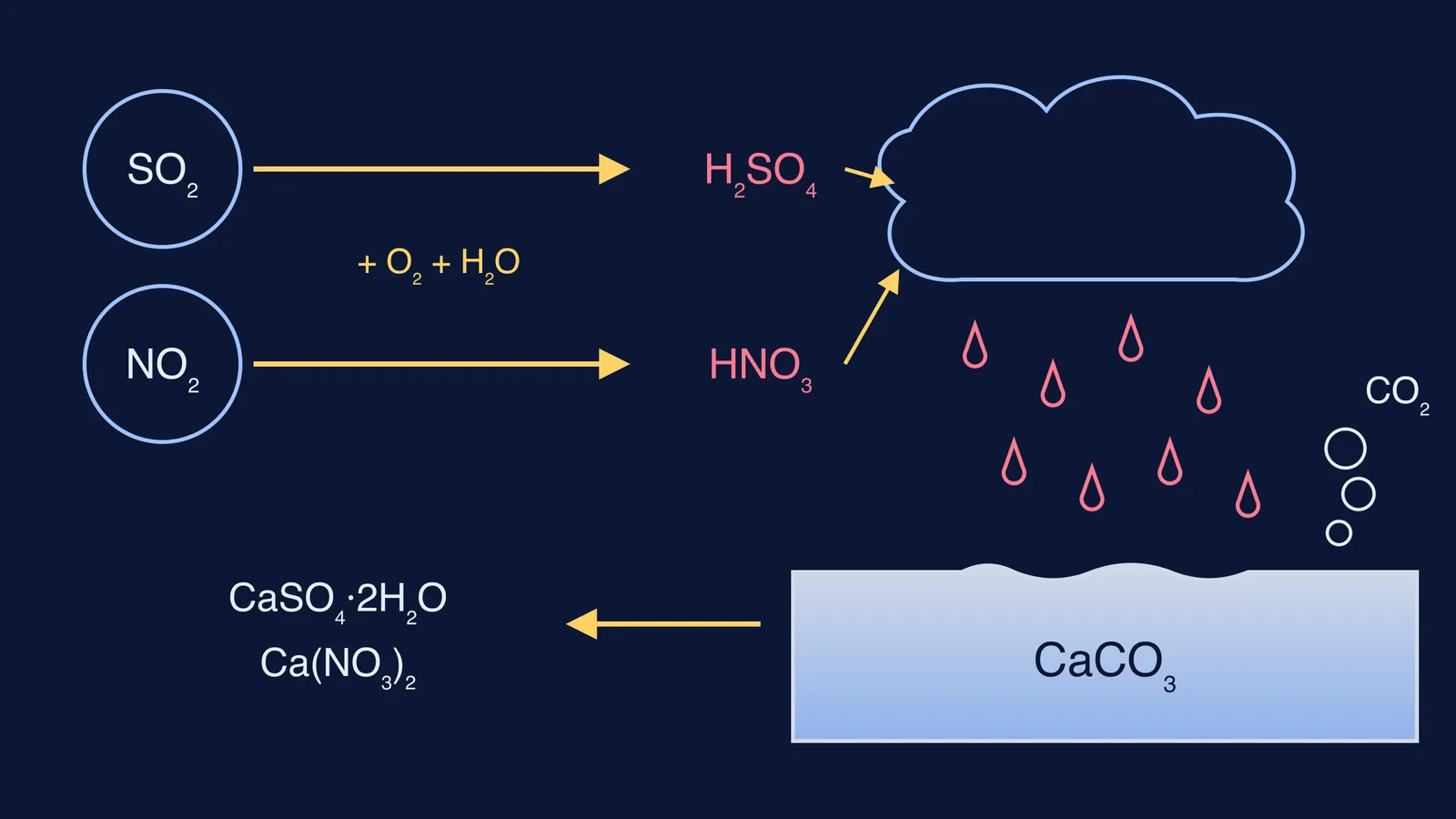
So "acidic" alone is not the test. Rain counts as acid rain when stronger acids, sulphuric and nitric, push its pH below that natural level. The EPA describes how SO2 and NOx react with water, oxygen and other chemicals to form sulfuric and nitric acids.
What are the acid rain reactions for SO2 and NO2?
Sulphur dioxide to sulphuric acid: 2SO2 + O2 + 2H2O → 2H2SO4
Nitrogen dioxide to nitric acid: 4NO2 + O2 + 2H2O → 4HNO3
Check the first one atom by atom: 2 S on each side; oxygen 4 + 2 + 2 = 8 on the left and 2 × 4 = 8 on the right; hydrogen 4 on each side. For the second: 4 N each side; oxygen 8 + 2 + 2 = 12 on the left and 4 × 3 = 12 on the right; hydrogen 4 each side.
Burning sulphur-containing fuels gives SO2; hot engines and furnaces give nitrogen oxides. Our post on what a catalytic converter does to car exhaust shows the other end of that story.
How does acid rain damage marble?
The acid attacks the carbonate. With sulphuric acid:
CaCO3 + H2SO4 → CaSO4 + H2O + CO2
With nitric acid:
CaCO3 + 2HNO3 → Ca(NO3)2 + H2O + CO2
Both give off carbon dioxide gas, which is why marble chips fizz in acid. Calcium nitrate is very soluble and washes away. Calcium sulphate takes up water and forms gypsum, CaSO4·2H2O. The USGS notes that the gypsum crystals grow into a network of thin blades that traps particles of dirt, resulting in a dark crust on the stone's surface. The EPA lists the visible result as loss of detail on stone and metal statues, monuments and tombstones.
What did India's Supreme Court order to protect the Taj Mahal?
In M.C. Mehta vs Union of India, decided on 30 December 1996, the Supreme Court of India's judgment sets out the petitioner's case in plain chemistry: "The sulphurdioxide emitted by the Mathura Refinery and the industries when combined with Oxygen - with the aid of moisture - in the atmosphere forms sulphuric acid called 'Acid rain' which has a corroding effect on the gleaming white marble." That sentence is the first equation above, written in words. The court then ordered 292 listed industries in Agra to change over to natural gas as an industrial fuel; the rest had to stop burning coke or coal in the Taj Trapezium Zone or relocate.
Acid is not the main cause of the Taj's discoloration, though. A study in Environmental Science and Technology by Bergin and colleagues sampled airborne particles at the Taj over one year and found that deposited dust, and black and brown carbon from burning fossil fuels and biomass, are responsible for the surface discoloration. Acid dissolves the stone; soot and dust stain it.
Worked example: how much marble can one litre of rain dissolve?
Compare normal rain, at a pH of about 5.6 according to the EPA, with polluted rain at pH 4.2. That second number is not invented: the USGS reports that rainfall in the Washington area has an average pH of 4.2 to 4.4, more than 10 times as acid as unpolluted rain.
The ionic equation is CaCO3 + 2H+ → Ca2+ + H2O + CO2, so one mole of marble needs two moles of H+. Count only the free H+ the rain carries, and assume all of it reacts.
Rain at pH 5.6: [H+] = 10^-5.6 = 2.5 × 10^-6 mol/L. Marble dissolved = 1.26 × 10^-6 mol × 100 g/mol = 0.13 mg per litre.
Rain at pH 4.2: [H+] = 10^-4.2 = 6.3 × 10^-5 mol/L. Marble dissolved = 3.2 × 10^-5 mol × 100 g/mol = 3.2 mg per litre.
Ratio: 10^(5.6 - 4.2) = 10^1.4, about 25 times more.
A drop of 1.4 pH units sounds small, but pH is a log scale. For more practice, see our step-by-step method for the volume of HCl needed to dissolve marble or zinc, and why powdered calcium carbonate reacts faster than marble chips.
If a balancing or mole step keeps going wrong, the Fermi Problem Library has a step-by-step solver that explains the reasoning rather than printing an answer, so you can see exactly which line slipped.