

On this page
When a question asks for the volume of hydrochloric acid needed to dissolve 5 g of marble, it is really three small questions chained together. How many moles of solid do you have? How many moles of acid does the equation say that needs? What volume of this acid holds that many moles? Get each link right and the answer drops out. The middle step is the easiest one to skip.
What are the three steps to find the volume of acid?
Molarity is the number of moles of solute in exactly 1 litre of solution (OpenStax Chemistry 2e). So once you know how many moles of acid you need, the volume is just moles divided by molarity.
Moles of solid = mass ÷ molar mass.
Moles of acid = moles of solid × (acid coefficient ÷ solid coefficient), read from the balanced equation.
Volume of acid in litres = moles of acid ÷ molarity. Multiply by 1000 for mL.
For marble, the reaction is CaCO3 + 2HCl → CaCl2 + CO2 + H2O, as written in a Royal Society of Chemistry practical on marble chips and acid. For zinc, it is Zn + 2HCl → ZnCl2 + H2 (LibreTexts stoichiometry review). Both have the same 1 : 2 ratio of solid to acid, which is why one method covers both. If the ratio step feels shaky, our guide to reading mole ratios straight off a balanced equation walks through it.
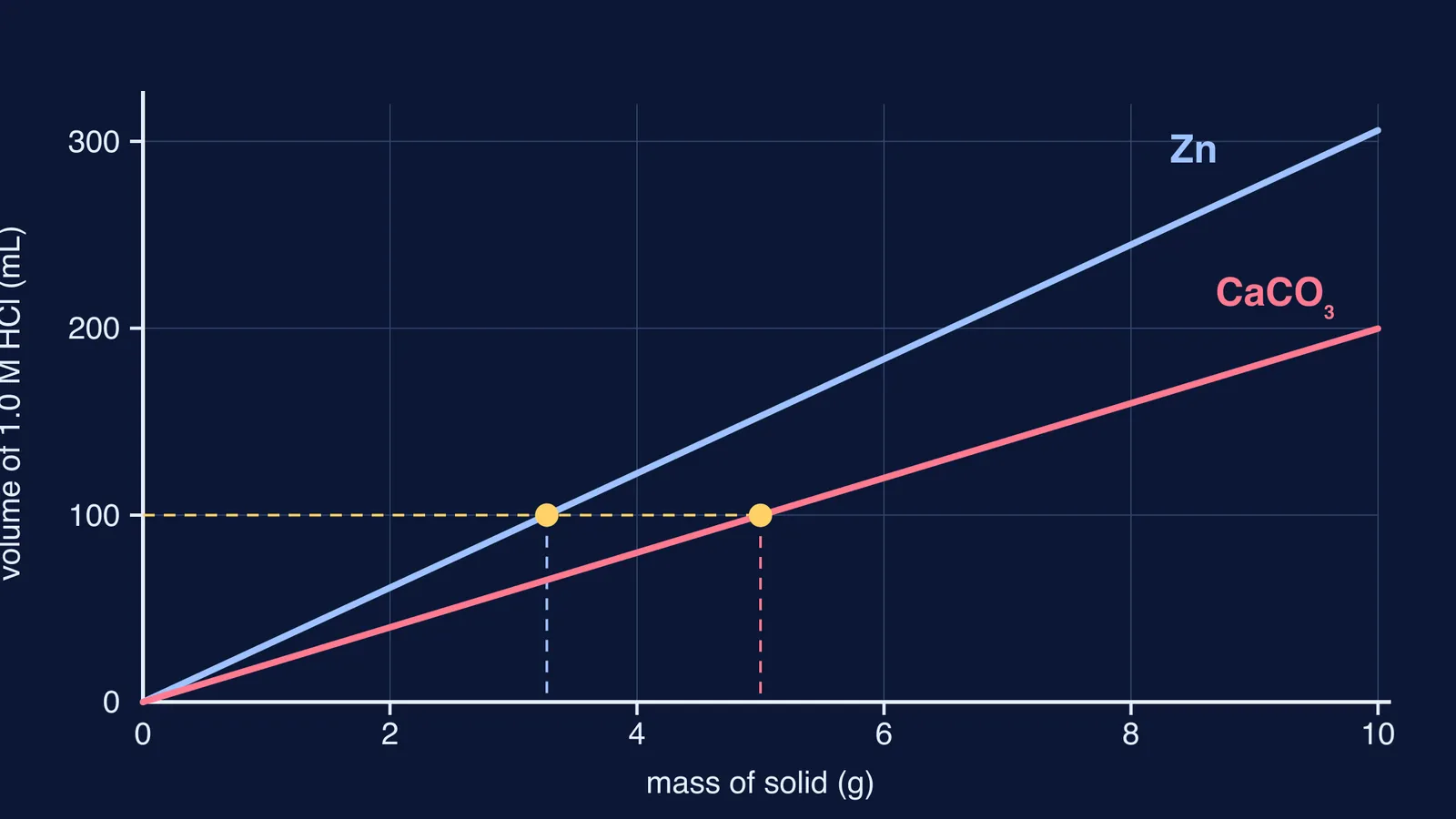
How much 1.0 M HCl dissolves 5.00 g of marble?
Treat marble as pure calcium carbonate unless the question gives a purity. The molar mass of CaCO3 is 100.09 g/mol (PubChem).
Moles of CaCO3 = 5.00 ÷ 100.09 = 0.04996 mol.
Moles of HCl = 2 × 0.04996 = 0.0999 mol.
Volume = 0.0999 ÷ 1.0 = 0.0999 L, or about 100 mL.
The RSC practical uses hydrochloric acid at 1 mol dm⁻³, which is the same as 1.0 M, so the acid in this example is a concentration used in school labs. If the question asks for the mass of HCl instead, multiply the moles by its molar mass of 36.46 g/mol (PubChem): 0.0999 × 36.46 = 3.64 g.
How much 2.0 M HCl dissolves 3.27 g of zinc?
The standard atomic weight of zinc is 65.38 (CIAAW).
Moles of Zn = 3.27 ÷ 65.38 = 0.0500 mol.
Moles of HCl = 2 × 0.0500 = 0.100 mol.
Volume = 0.100 ÷ 2.0 = 0.0500 L, or 50.0 mL.
Doubling the molarity halved the volume. That is a quick sense check: stronger acid, smaller volume, same number of moles.
What if there is too much acid, or not enough?
Exam questions often give both amounts and ask what remains. Compare the moles of acid you have with the moles of acid the solid needs. The molar masses below are the same ones used above, from PubChem and CIAAW.
Excess acid: all the solid dissolves. Take 5.00 g of marble with 150 mL of 1.0 M HCl. Acid available = 0.150 L × 1.0 M = 0.150 mol. Acid needed = 0.0999 mol. All the marble dissolves, and 0.150 − 0.0999 = 0.050 mol of HCl stays unreacted in the solution.
Too little acid: solid is left over. Take 3.27 g of zinc with 30.0 mL of 2.0 M HCl. Acid available = 0.0300 L × 2.0 M = 0.0600 mol. That reacts with only 0.0600 ÷ 2 = 0.0300 mol of zinc, which is 0.0300 × 65.38 = 1.96 g. Leftover zinc = 3.27 − 1.96 = 1.31 g. Here the acid is the limiting reagent, and the question is really asking for the excess solid.
The same compare-then-subtract logic appears in our post on finding the mass of excess reagent left over.
How do you check your answer before moving on?
Units: g ÷ g/mol gives mol, and mol ÷ mol/L gives L. If your units do not cancel to litres, a step is missing.
Ratio: for CaCO3 or Zn with HCl, the moles of acid must be exactly double the moles of solid.
Size: compare with the worked examples above. An answer in litres for a few grams of solid is a red flag.
Purity: if the question gives the marble's purity, multiply the mass by that fraction before step 1.
Concentrated acid: if you are given a bottle label (density and mass percent) instead of molarity, convert first. Our walkthrough of the molarity of concentrated acid from its label shows how.
If a step keeps going wrong, the Fermi Problem Library has worked problems with a step-by-step solver that explains the reasoning rather than printing an answer, so you can see which link in the chain broke. If moles themselves still feel fuzzy, the Fermi Concept Library gives every chemistry concept its own lesson.
Try it now: work out the volume of 0.50 M HCl that dissolves 2.00 g of marble, then check your answer with the three steps above.


