

On this page
A balanced chemical equation is a recipe written in moles. Once you see that, most stoichiometry questions in Class 11, the boards, JEE Main and NEET-UG come down to the same three moves.
What do the coefficients in a balanced equation mean?
The numbers placed in front of formulas are called stoichiometric coefficients, and they give the number of molecules, and equally the number of moles, taking part in the reaction. That is how the NCERT Class 11 chemistry textbook puts it in Unit 1, section 1.10 (NCERT, Some Basic Concepts of Chemistry), using the combustion of methane:
CH4 + 2O2 → CO2 + 2H2O
Read it as: one mole of methane reacts with two moles of oxygen to give one mole of carbon dioxide and two moles of water. The SI defines one mole as exactly 6.022 140 76 × 10^23 elementary entities (BIPM, the mole). Multiply both sides of "1 molecule to 2 molecules" by that number and you get "1 mole to 2 moles".
A coefficient multiplies the whole formula, while a subscript is part of the formula itself. NCERT reminds you that subscripts cannot be changed to balance an equation (NCERT, Unit 1). If 2H2O versus H2O still feels slippery, our post on what 2H, H2 and 2H2 each mean sorts it out.
Why is a mole ratio not a mass ratio?
Different molecules have different masses. The same NCERT section spells out the methane reaction in grams: 16 g of CH4 reacts with 2 × 32 g of O2 to give 44 g of CO2 and 2 × 18 g of H2O (NCERT, section 1.10). The mole ratio of methane to oxygen is 1 : 2, but the mass ratio is 16 : 64, which is 1 : 4.
What does stay equal is total mass. Add the grams on each side: 16 + 64 = 80 on the left, 44 + 36 = 80 on the right. Mass is conserved; moles of substance need not be. Here 3 moles of reactants become 3 moles of products, but in propane combustion 6 moles become 7.
How do you read any mole ratio off the equation?
Check that the equation is balanced: count each element on both sides.
Circle the two substances the question links: the one you know and the one you want.
Write the ratio as wanted coefficient over known coefficient.
Multiply the moles you know by that fraction.
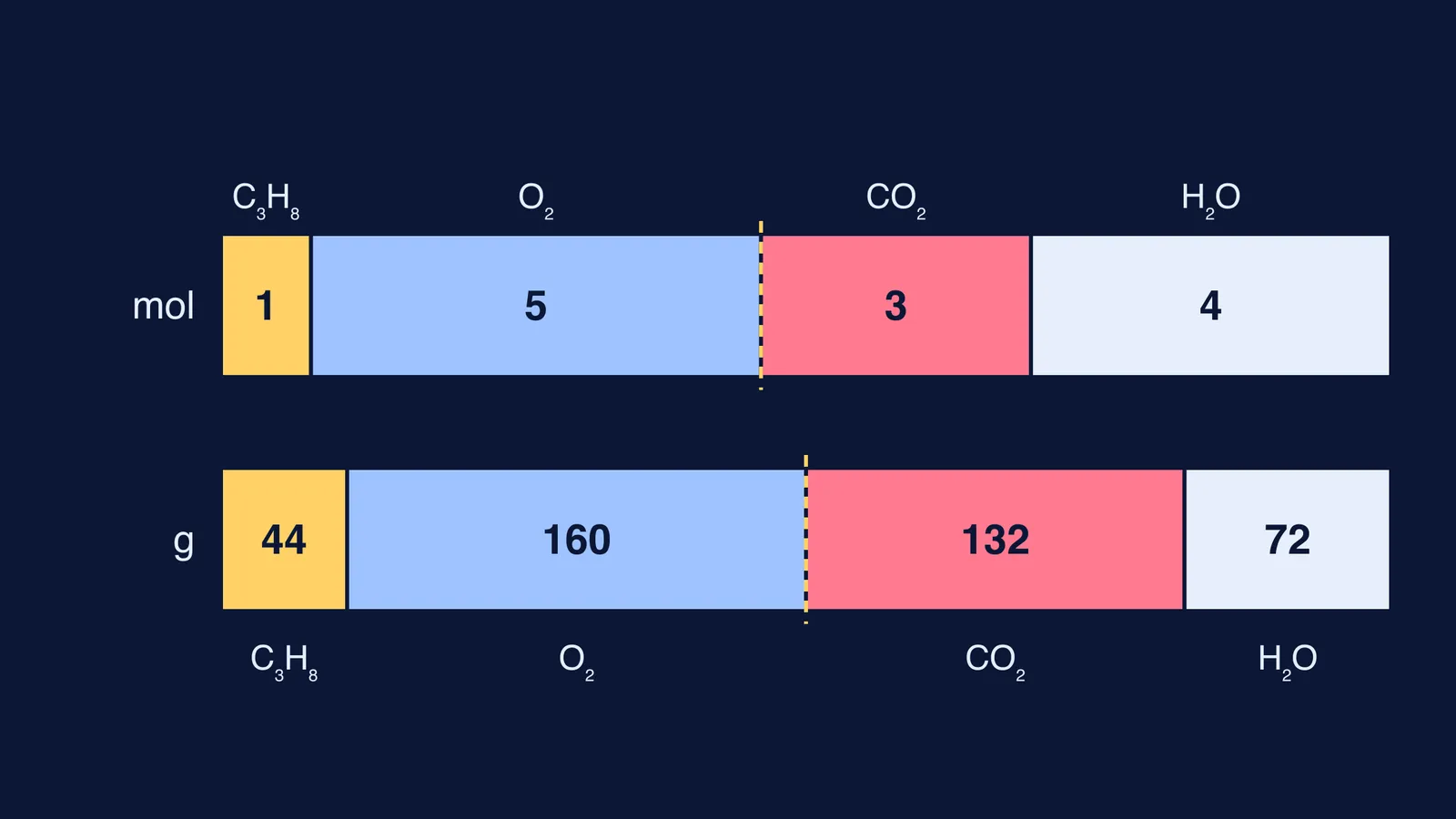
Take propane, balanced step by step in NCERT's own worked box: C3H8 + 5O2 → 3CO2 + 4H2O (NCERT, Unit 1). Without any calculation you can read off ratios such as:
O2 to C3H8: 5/1
CO2 to C3H8: 3/1
H2O to O2: 4/5
Keep it "wanted over known" so the known substance cancels.
Worked example: how much CO2 does 11 g of propane make?
Use molar masses C = 12, H = 1, O = 16 g/mol, so C3H8 = 44, O2 = 32, CO2 = 44 and H2O = 18 g/mol.
Grams to moles: 11 g ÷ 44 g/mol = 0.25 mol of propane.
Mole ratio: 0.25 mol × (3 mol CO2 / 1 mol C3H8) = 0.75 mol of CO2.
Moles to grams: 0.75 mol × 44 g/mol = 33 g of CO2.
The same 0.25 mol gives the rest: oxygen needed is 0.25 × 5 = 1.25 mol, or 40 g, and water formed is 0.25 × 4 = 1 mol, or 18 g. Check the mass balance: 11 + 40 = 51 g in, 33 + 18 = 51 g out.
Now the trap. Treating coefficients as masses ("1 to 3, so 11 g gives 33 g") works here only by luck, because propane and CO2 both weigh 44 g/mol. Try it for water: "1 to 4, so 44 g" instead of the correct 18 g. For more drills, see mass-to-mass stoichiometry in three steps.
What mistakes do students make with mole ratios?
In a study by Michael Sanger at Middle Tennessee State University, 156 first-semester general chemistry students wrote a balanced equation from a particle drawing and then used it in a stoichiometry calculation (Sanger, Journal of Chemical Education, 2005). Among the 46 students whose equations still contained leftover, unreacted particles, 64% used an incorrect ratio taken straight from their equation, and only 23% used the correct reacting ratio (summary of the study).
The lesson: a coefficient is a reacting ratio, not a count of what is in the flask. When one reactant is in excess, the ratio tells you how much of it is used, not how much you started with. That is the idea behind limiting reagent problems.
A quick self-check before you submit any answer:
Did I convert grams to moles before using the ratio?
Is my fraction wanted over known?
Do the masses on each side add up?
If one of these keeps tripping you up, the Fermi Problem Library has worked problems with a step-by-step solver that explains the reasoning rather than printing an answer. If the mole itself feels shaky, start with the Fermi Concept Library.


