

On this page
Balancing chemical equations is one of the first major hurdles students face in chemistry. You are handed a puzzle of letters and numbers, and you have to make both sides equal. But before you can balance the equation, you need to speak the language.
A 2024 study published in the *Journal of General Education and Humanities* found that 79.3% of surveyed students struggle to understand atomicity. The root of this confusion is almost always the failure to distinguish between a coefficient and a subscript.
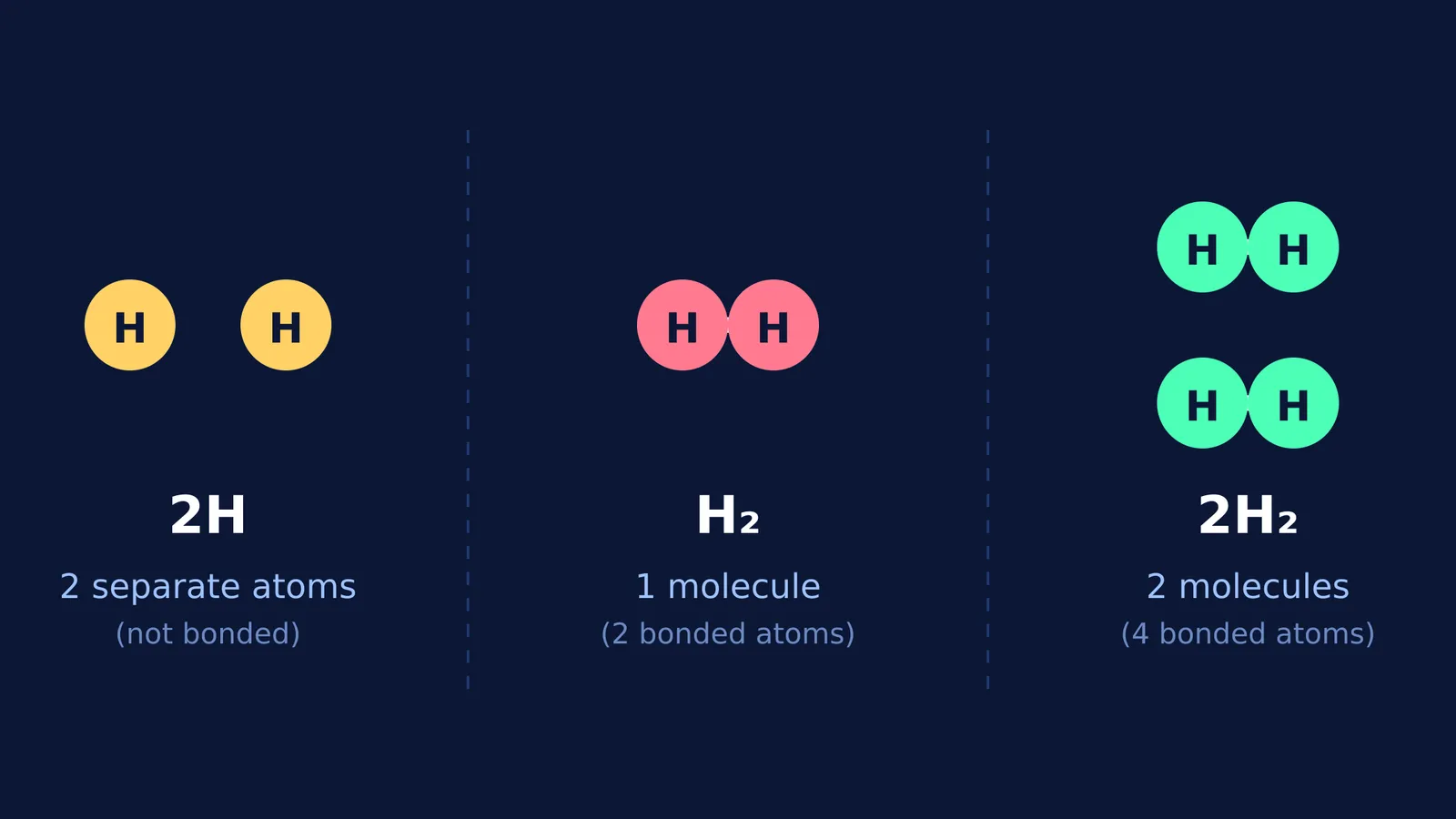
What is the difference between 2H, H₂ and 2H₂?
Here is what the numbers mean using hydrogen as an example:
2H (Two separate atoms): The "2" in front is a coefficient. It tells you there are two independent hydrogen atoms floating around. They are not bonded to each other.
H₂ (One molecule): The small "2" at the bottom right is a subscript. It tells you that two hydrogen atoms are chemically bonded together to make one single molecule of hydrogen gas.
2H₂ (Two molecules): This has both. The coefficient "2" means you have two separate molecules, and the subscript "2" means each molecule is made of two bonded atoms. You have four hydrogen atoms in total.
Can you change a subscript to balance an equation?
No, you can never change a subscript to balance an equation.
When you change a coefficient, you change the *amount* of the substance. If you need more oxygen to balance a reaction, you can write 2H₂O to show two water molecules instead of one.
When you change a subscript, you change the *identity* of the substance entirely. Changing H₂O (water) to H₂O₂ (hydrogen peroxide) gives you a completely different chemical that behaves differently. According to research in the *Journal of Chemical Education* (Sanger, 2005), college students often change subscripts instead of coefficients to balance equations.
Balancing an equation is not just a math game; it is a way to prove the Law of Conservation of Mass on paper. This law states that atoms are neither created nor destroyed in a chemical reaction—they only rearrange themselves into new combinations. When you change a coefficient, you are correctly showing that you need more molecules to provide the right number of atoms.
For more on what equations can and cannot tell you, read our guide on What a Balanced Chemical Equation Gives and Its Limitations.
How to count atoms in a formula like 3H₂SO₄?
When formulas get complex, counting atoms feels like a math puzzle. The rule is simple: multiply the coefficient by the subscript for each element.
Let's break down three units of sulfuric acid, written as 3H₂SO₄. Sulfuric acid is a strong acid used in everything from car batteries to fertilizers, and its formula is a perfect practice ground for counting atoms.
Hydrogen (H): The coefficient in front of the entire molecule is 3, and the subscript for hydrogen is 2. (3 × 2 = 6 hydrogen atoms).
Sulfur (S): The coefficient is 3. Sulfur has no visible subscript next to it, which means its subscript is an invisible 1. (3 × 1 = 3 sulfur atoms).
Oxygen (O): The coefficient is 3, and the subscript is 4. (3 × 4 = 12 oxygen atoms).
In total, 3H₂SO₄ contains 21 atoms (6 + 3 + 12).
What happens when a formula has parentheses?
Ionic compounds often involve polyatomic ions (groups of atoms that stick together). When these molecules need more than one of that group, we use parentheses. Counting atoms here adds one extra step.
Take the example of two units of magnesium nitrate: 2Mg(NO₃)₂.
Magnesium (Mg): The coefficient is 2. The subscript on Mg is 1. (2 × 1 = 2 magnesium atoms).
Nitrogen (N): The coefficient is 2. Inside the parentheses, the subscript is 1. Outside the parentheses, the subscript is 2. You must multiply the inside subscript by the outside subscript, and then by the coefficient. (2 × 1 × 2 = 4 nitrogen atoms).
Oxygen (O): The coefficient is 2. The inside subscript is 3, and the outside subscript is 2. (2 × 3 × 2 = 12 oxygen atoms).
This gives a total of 18 atoms for 2Mg(NO₃)₂.
If you are struggling to picture why molecules form in specific ratios before you start counting them, the Fermi Concept Library holds every concept in physics, chemistry, biology, mathematics and computing, each with its own lesson and its place in the map. You can also brush up on the basics with our guide on How to write chemical formulas using valency in Class 9.


