

On this page
Most textbook solutions stop at the limiting reagent and the product. Exam questions often ask one more thing: how much of the other reactant is left? That takes three more lines, plus one to check yourself.
What is the excess reagent?
NCERT's Class 11 chemistry textbook says the reactant that gets consumed first "limits the amount of product formed and is, therefore, called the limiting reagent" (NCERT, Some Basic Concepts of Chemistry, section 1.10.1). The excess reagent is the other reactant: there is more of it than the balanced equation needs, so some is left when the reaction stops.
The leftover mass is one subtraction: mass of excess reagent left = mass you started with − mass that reacted.
How do you find the mass of excess reagent left after a reaction?
Write the balanced equation.
Convert each reactant's mass to moles.
Divide each mole value by its coefficient in the equation. The smallest result is the limiting reagent.
Multiply the limiting reagent's moles by (coefficient of excess ÷ coefficient of limiting). This is the moles of excess reagent used.
Convert the moles used to grams with the molar mass.
Subtract that from the starting mass of the excess reagent.
Check: mass of products + mass left over = total mass of reactants you started with.
Step 7 works because of the law of conservation of mass, the same law that makes a balanced equation carry the same number of atoms of each element on both sides (NCERT, same chapter).
Worked example: how much nitrogen is left in NCERT's ammonia problem?
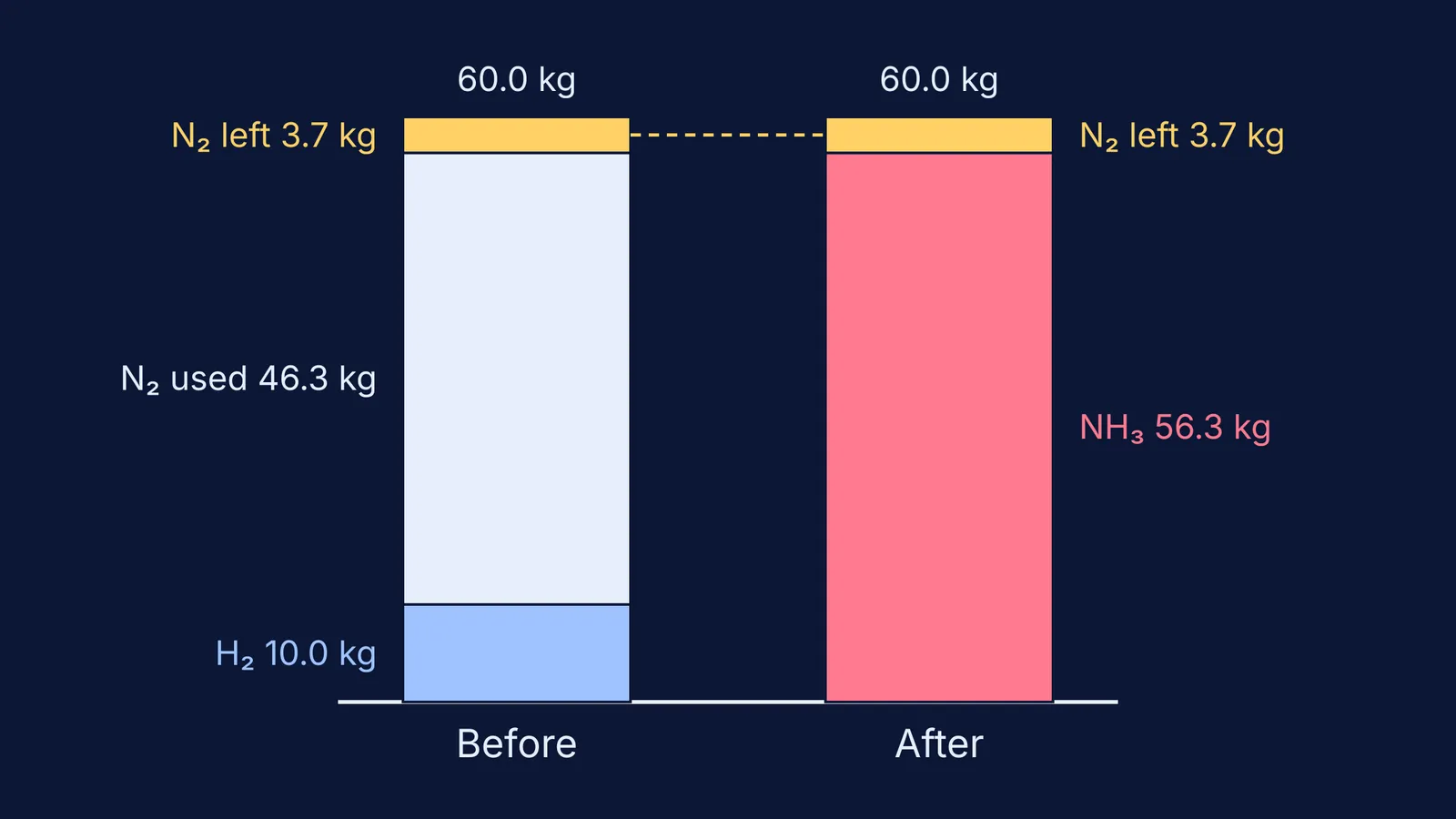
NCERT Problem 1.5 mixes 50.0 kg of N₂ with 10.0 kg of H₂ to make ammonia, N₂ + 3H₂ → 2NH₃, and shows that dihydrogen is the limiting reagent (NCERT Class 11 Chemistry, chapter 1). It stops there, so here is the missing step. We use the IUPAC abridged atomic weights H = 1.0080 and N = 14.007 (CIAAW abridged atomic weights), which give H₂ = 2.016 g/mol and N₂ = 28.014 g/mol.
Moles of H₂ = 10,000 g ÷ 2.016 g/mol = 4,960.3 mol.
Moles of N₂ = 50,000 g ÷ 28.014 g/mol = 1,784.8 mol.
Divide by coefficients: H₂ gives 4,960.3 ÷ 3 = 1,653.4; N₂ gives 1,784.8 ÷ 1 = 1,784.8. H₂ has the smaller value, so it is limiting.
N₂ used = 4,960.3 mol H₂ × (1 mol N₂ ÷ 3 mol H₂) = 1,653.4 mol N₂.
Mass of N₂ used = 1,653.4 mol × 28.014 g/mol = 46,319 g, or 46.3 kg.
N₂ left = 50.0 kg − 46.3 kg = 3.7 kg.
Check: ammonia formed = 46.3 kg of N₂ + 10.0 kg of H₂ = 56.3 kg, and 56.3 kg + 3.7 kg = 60.0 kg, exactly what went in.
NCERT's own ammonia answer is 56.1 kg because it rounds to 3.30 × 10³ mol and 17.0 g/mol partway through. That is why you keep extra digits until the last line: early rounding can make your mass check miss and send you hunting for an error that isn't there.
What mistakes cost marks on excess reagent questions?
Using the excess reagent to find the product. The product and the "amount used" both come from the limiting reagent.
Flipping the mole ratio. Write it with units (mol N₂ per mol H₂) so the units cancel the right way.
Comparing raw moles without dividing by coefficients. In the example, H₂ has more moles than N₂ and is still the limiting reagent.
Skipping the mass check, which catches many arithmetic slips.
A quick sense check: the balanced equation fixes a mass ratio. With the CIAAW molar masses above, N₂ : H₂ = 28.014 : 6.048, about 4.63 : 1. You were given 5 : 1, more nitrogen than needed, so nitrogen is in excess before you calculate anything.
If your number keeps differing and you can't see why, the Fermi Problem Library has worked problems with a step-by-step solver that explains the reasoning rather than printing an answer, so you can find the line where you went wrong.
Can you try one on your own?
Use Mg = 24.305 and O = 15.999 from the CIAAW table, so O₂ = 31.998 g/mol. Try all seven steps before reading the answer.
If moles themselves still feel shaky, the Fermi Concept Library covers every concept in chemistry, each with its own lesson and its place in the map. For the step before this, see limiting reagent and percentage yield problems, step by step. Or watch the leftover change in the limiting reagent simulation that predicts product and leftovers. If your lab yield comes out low, read why actual yield is less than theoretical yield.


