

On this page
When you calculate the outcome of a chemical reaction on paper, stoichiometry gives you a definitive number. If you balance the equation, identify the limiting reactant, and convert moles into grams, you calculate what chemists define as theoretical yield. Yet in a laboratory, the mass of pure product you isolate onto a watch glass is almost never equal to that prediction.
Understanding why actual yield is less than theoretical yield is an essential skill in chemistry. Whether you are balancing reactions for CBSE and JEE examinations or synthesizing compounds in a school laboratory, tracking missing mass transforms stoichiometry from abstract arithmetic into tangible science.
What is the difference between actual yield and theoretical yield?
The distinction between theoretical and actual yield begins with how each quantity is established:
Theoretical yield is the maximum quantity of product that can form from a given amount of reactants, calculated strictly from the stoichiometry of a balanced equation (OpenStax Chemistry 2e Section 4.4). It assumes that the reaction proceeds to 100% completion, that no side reactions occur, and that every milligram of product is recovered.
Actual yield is the amount of product physically isolated, purified, and weighed at the conclusion of an experiment (IUPAC Compendium of Chemical Terminology).
Chemists compare these two values using percent yield:
Percent Yield = (Actual Yield / Theoretical Yield) × 100%
In chemical education research, Chandrasegaran et al. (2009) observed that students frequently stumble when deducing limiting reagents, often confusing starting mass ratios with stoichiometric mole ratios. As outlined in NCERT Class 11 Chemistry, the limiting reactant is the substance that is completely consumed first, setting the boundary for theoretical yield. When working through complex reactions, the Fermi Problem Library offers worked problems with a step-by-step solver that explains the reasoning rather than printing an answer.
Why is actual yield almost always less than theoretical yield?
An actual yield below 100% does not mean an experiment failed. Instead, it reflects real physical and chemical limits identified in OpenStax Chemistry 2e Section 4.4:
Incomplete reactions and equilibrium: Many reactions are reversible. As products accumulate, the reverse reaction accelerates until dynamic equilibrium is reached, leaving unreacted starting materials.
Competing side reactions: Reactants often follow alternative reaction pathways, forming unintended byproducts and consuming starting material.
Separation and filtration losses: During crystallization, some product remains dissolved in the solvent due to temperature-dependent solubility, while more gets trapped inside filter paper pores.
Mechanical transfer losses: Minute amounts of material adhere to the walls of beakers, stirring rods, and funnels during each physical manipulation.
Impurities in starting reagents: Commercial reactants are seldom 100% pure. If a starting material contains 5% inert impurities, the active reagent mass is lower than measured on the balance.
How do you predict and test each source of yield loss?
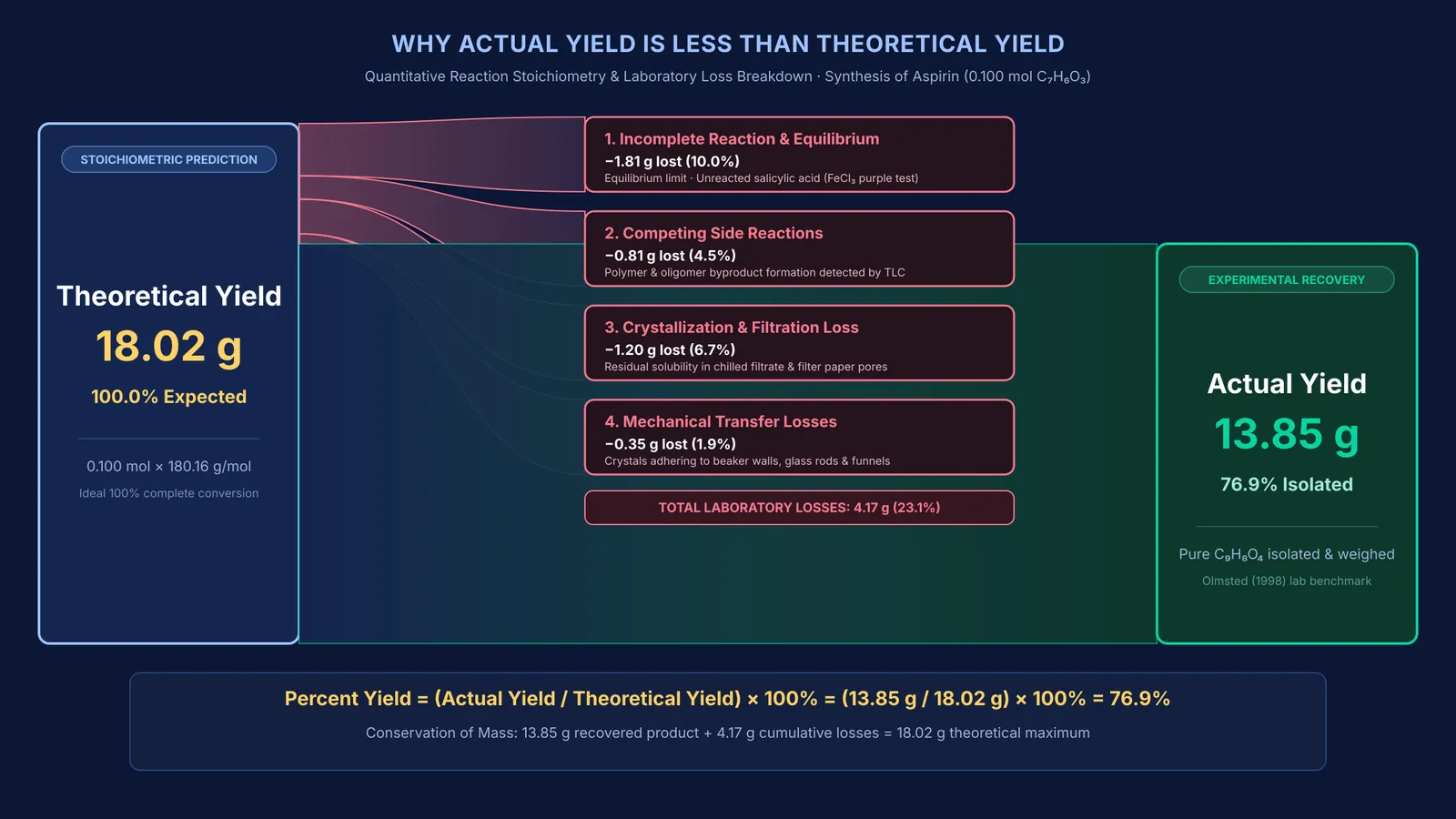
To understand how losses accumulate, consider the synthesis of aspirin (acetylsalicylic acid, molar mass 180.16 g/mol) from salicylic acid (molar mass 138.12 g/mol) and excess acetic anhydride, a standard benchmark analyzed by Olmsted (1998).
Starting with 13.81 g (0.100 mol) of salicylic acid, which reacts in a 1:1 molar ratio, the theoretical yield is:
Theoretical Yield = 0.100 mol × 180.16 g/mol = 18.02 g
Rather than treating the gap between prediction and recovery as mystery loss, you can test each loss mechanism:
Testing incomplete reaction: If 10.0% of the salicylic acid remains unreacted due to equilibrium limits, 1.81 g of potential product is lost. Testing the reaction mixture with iron(III) chloride solution produces a purple color from free phenolic groups, confirming unreacted reactant.
Testing side reactions: Prolonged heating causes salicylic acid to form polymer byproducts, consuming 4.5% of the substrate (0.81 g product loss). Thin-layer chromatography (TLC) separates these byproducts from aspirin.
Testing crystallization solubility: Chilling the mixture leaves 1.20 g dissolved in the cold filtrate. Evaporating a measured sample of the filtrate confirms this dissolved mass.
Testing mechanical transfer: Scraping crystals leaves 0.35 g adhering to flask walls and filter paper. Taring glassware before and after transfer quantifies this mechanical loss.
Subtracting these tested losses reveals the final recovered product:
Actual Yield = 18.02 g - 1.81 g - 0.81 g - 1.20 g - 0.35 g = 13.85 g
Percent Yield = (13.85 g / 18.02 g) × 100% = 76.9%
How do interactive simulations and step-by-step models help master reaction yield?
Stoichiometry becomes much clearer when students move beyond rote formulas to dynamic exploration. In a meta-analysis across 225 STEM studies, Freeman et al. (2014) found that active learning increases student examination performance by 6% and reduces course failure rates compared to passive lecturing. In addition, research by Wieman, Adams, & Perkins (2008) demonstrated that interactive simulations allow students to construct accurate mental models of molecular interactions and limiting constraints.
Rather than memorizing abstract rules, students can test reaction mixtures, adjust initial reactant quantities, observe equilibrium limits, and visualize byproduct formation dynamically at the Fermi Simulation Lab. To build strong conceptual foundations across stoichiometry, equilibrium, and reaction mechanisms, learners can explore the Fermi Concept Library, which covers every concept in physics, chemistry, biology, mathematics and computing, each with its own lesson and its place in the map.


