

On this page
Every winter, PM2.5 readings across North India climb. The inversion lid explains why pollution stays near the ground, as covered in why smog is worse in North India in winter. It does not explain why part of the winter haze is a salt that barely exists on a warm afternoon. That salt is ammonium nitrate, NH₄NO₃. It forms from two gases when the air cools and goes back to gas when it warms, and you can work out how much forms with Class 11 equilibrium.
Where do ammonia and nitric acid in the air come from?
Ammonia, NH₃, comes mostly from farming: nitrogen fertilisers such as urea, and animal waste. Nitric acid, HNO₃, is made in the air from nitrogen oxides (NOx) released by vehicles, power plants and burning. In daylight, NO₂ reacts with the hydroxyl radical: NO₂ + OH → HNO₃.
Neither gas counts as PM2.5. The salt they make does. In a source study for the Delhi Pollution Control Committee, IIT Kanpur's 2016 report%20in%20Delhi.pdf) found that secondary particles (nitrate, sulphate and ammonium together) made up about 28% of winter PM2.5, and estimated their source share at about 30% of PM2.5 in winter against about 15% in summer. Not all of that is nitrate, but the winter jump is the effect this post explains.
Why is Kp just p(NH₃) × p(HNO₃)?
Write the equilibrium in the dissociation direction:
NH₄NO₃(s) ⇌ NH₃(g) + HNO₃(g)
The solid has activity 1, so it drops out of the expression, exactly as in heterogeneous equilibria with solids:
Kp = p(NH₃) × p(HNO₃)
Now use Q. If the product of the two partial pressures in the air is less than Kp, no solid can form, and any particles present evaporate. If the product is more than Kp, gas condenses into solid until the product falls back to Kp. In air it is handy to measure pressure in ppb: at 1 atm, 1 ppb is 10⁻⁹ atm, so 1 ppb² is 10⁻¹⁸ atm².
Worked example: when does nitrate turn into particles?
(a) Kp at 25 °C. Standard ΔfG° values from the NBS tables: NH₄NO₃(s) −183.9, NH₃(g) −16.5, HNO₃(g) −74.7 kJ/mol.
ΔG° = (−16.5) + (−74.7) − (−183.9) = +92.7 kJ/mol.
ln Kp = −ΔG°/RT = −92,700 ÷ (8.314 × 298.15) = −37.40.
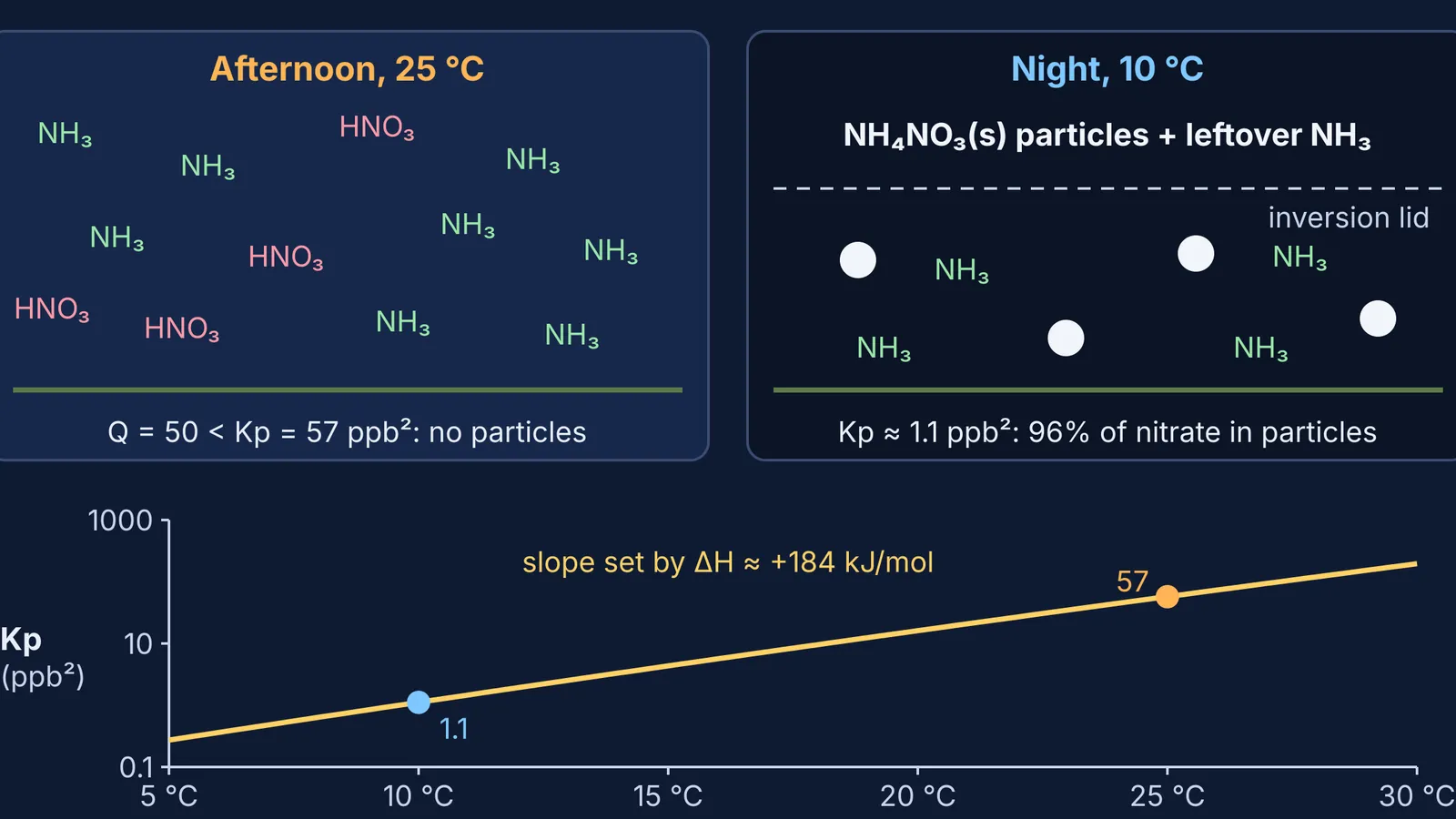
Kp ≈ 5.7 × 10⁻¹⁷ atm², which is about 57 ppb².
Atmospheric models usually use a fitted expression (Mozurkewich, 1993) instead, which gives a somewhat smaller value at 25 °C. Data sets differ by up to about a factor of two, but all show the same steep fall with temperature. We use the NBS value throughout.
(b) Cool the air. Take illustrative air with 10 ppb NH₃ and 5 ppb total nitric acid.
At 25 °C, Q = 10 × 5 = 50 ppb². Q is less than 57, so no NH₄NO₃ forms. All the nitrate is gas.
The dissociation is endothermic. From ΔfH° values (NH₄NO₃(s) −365.6, NH₃(g) −46.1, HNO₃(g) −135.1 kJ/mol), ΔH° ≈ +184 kJ/mol.
Use the van 't Hoff equation for 10 °C (283.15 K), taking ΔH° as constant: ln(K₂/K₁) = −(184,400 ÷ 8.314) × (1/283.15 − 1/298.15) = −3.94.
K₂ = 57 × e^(−3.94) ≈ 1.1 ppb².
Now Q = 50 is far above 1.1, so solid forms. Let x ppb of each gas condense: (10 − x)(5 − x) = 1.1, so x² − 15x + 48.9 = 0.
x = [15 − √(225 − 195.6)] ÷ 2 = (15 − 5.43) ÷ 2 ≈ 4.8 ppb.
So 4.8 of the 5 ppb of nitric acid, about 96%, is now in particles. The same sum at 20 °C (K ≈ 16) gives about 55% in particles, and at 15 °C (K ≈ 4.3) about 85%. A 15 °C drop from afternoon to night moves almost all the nitrate from gas to particle.
The 10 and 5 ppb are round numbers for the example, not typical Delhi values. At Delhi airport in winter 2017–18, Pawar and colleagues (2023) measured a mean NH₃ of about 28 µg/m³, roughly 40 ppb. With that much ammonia, Q can exceed Kp even on a mild afternoon, and the supply of nitric acid limits how much nitrate forms. The same study found chloride was the largest measured anion, because NH₃ + HCl ⇌ NH₄Cl(s) follows the same logic.
How many µg/m³ of PM2.5 is that?
(c) Convert ppb to mass.
Molar volume at 283.15 K and 1 atm: 0.08206 × 283.15 ≈ 23.24 L/mol, so 1 m³ (1000 L) holds about 43.0 mol of air.
1 ppb of that is 4.30 × 10⁻⁸ mol. Multiply by the molar mass of NH₄NO₃, 80.04 g/mol: 3.44 × 10⁻⁶ g, or about 3.4 µg/m³.
4.8 ppb × 3.44 ≈ 16.5 µg/m³.
Under the CPCB AQI breakpoints, 0–30 µg/m³ of PM2.5 over 24 hours counts as "Good". This one salt, formed overnight from gases that were not counted as PM2.5 that afternoon, is more than half of that band. To practise more Q-versus-K problems like this, the Fermi Problem Library has a step-by-step solver that explains the reasoning.
Why does sulphate not go back to gas?
SO₂ is oxidised in the air to sulphuric acid, H₂SO₄, which has almost no vapour pressure. It takes ammonia firmly: 2NH₃ + H₂SO₄ → (NH₄)₂SO₄. There is no gas-phase equilibrium to reverse, so warming does not break it up. Ammonia is used by sulphate first. Only the ammonia left over can pair with nitric acid, which is why nitrate is the part of the haze that swings with temperature.
What changes in fog and humid air?
The Kp above applies to dry, solid NH₄NO₃. Above its deliquescence humidity, about 62% relative humidity at 25 °C, the particle soaks up water and becomes a droplet of solution. Then the equilibrium is between the gases and dissolved ions, and the effective constant is lower, so even more nitrate stays in the particles. Foggy winter nights in the Indo-Gangetic Plain push the same way as cold ones.
The practical point follows from Q. Cutting either ammonia or NOx lowers the product p(NH₃) × p(HNO₃), and that cuts this part of the PM, which is why ammonia now features in Indian clean-air discussions.
Quick checklist
NH₄NO₃(s) ⇌ NH₃(g) + HNO₃(g), with Kp = p(NH₃) × p(HNO₃).
From NBS ΔfG° data, Kp ≈ 57 ppb² at 25 °C; fitted values used in models are somewhat lower.
ΔH° ≈ +184 kJ/mol, so Kp falls about fifty-fold from 25 °C to 10 °C.
Q > Kp means particles form; solve (a − x)(b − x) = Kp.
1 ppb of NH₄NO₃ at 10 °C is about 3.4 µg/m³.
Sulphate holds ammonia first and does not evaporate; nitrate uses the leftover ammonia.
Humid air and fog push even more nitrate into particles.


