

On this page
A room that feels right in a jacket feels cold in a half-sleeve shirt. Engineers who design air conditioning, and scientists who test clothing, put a number on that difference. The unit is the clo, and once you see that it is just a thermal resistance, the comfortable room temperature for any outfit drops out of the same rule you use for heat flowing through rods in series.
What does 1 clo mean?
The clo measures how well clothing resists the flow of heat from your skin to the room. One clo is a thermal resistance of 0.155 m² K/W, roughly the insulation of a typical business suit. This value is the one used in ISO 9920, as documented in the pythermalcomfort clothing notes from the University of California, Berkeley's Center for the Built Environment, a package described in a peer-reviewed SoftwareX paper.
Notice the unit. Thermal resistance for a slab is usually R = L/(kA) in K/W. Clothing is described per square metre of body surface, so its resistance is in m² K/W. Divide a temperature difference by it and you get a heat flux, in W/m².
The ASHRAE Standard 55 clothing table (Addendum h to the 2010 edition) gives typical values:
Trousers and a short-sleeve shirt: 0.57 clo.
Trousers and a long-sleeve shirt: 0.61 clo.
The same with a suit jacket: 0.96 clo.
Why does clothing work like resistors in series?
Heat from your skin has to cross two layers before it reaches the room:
The clothing itself, including the air trapped between fibres and between layers. Its resistance is I_cl.
The thin layer of still air clinging to the outside of your clothes (or your bare skin). Its resistance is I_a.
The same heat flows through both, one after the other, so the resistances add, just as for thermal resistance of rods in series. There is one twist. Clothes make you bigger: the outer surface of a clothed person is larger than the skin. The outer air layer is spread over this larger area, so its resistance per square metre of skin is smaller. The ratio of clothed area to skin area is the clothing area factor f_cl. The total resistance is
R = I_cl + I_a/f_cl
The same Berkeley notes, following ISO 9920, give I_a = 0.7 clo = 0.109 m² K/W for still air (about 0.1 m/s), and f_cl = 1 + 0.28 × I_cl, with I_cl in clo, for ensembles between about 0.2 and 1.7 clo. The heat flux is then
q = (T_skin − T_room)/R
which is Ohm's law with temperature difference in place of voltage.
Worked example: what room temperature suits each outfit?
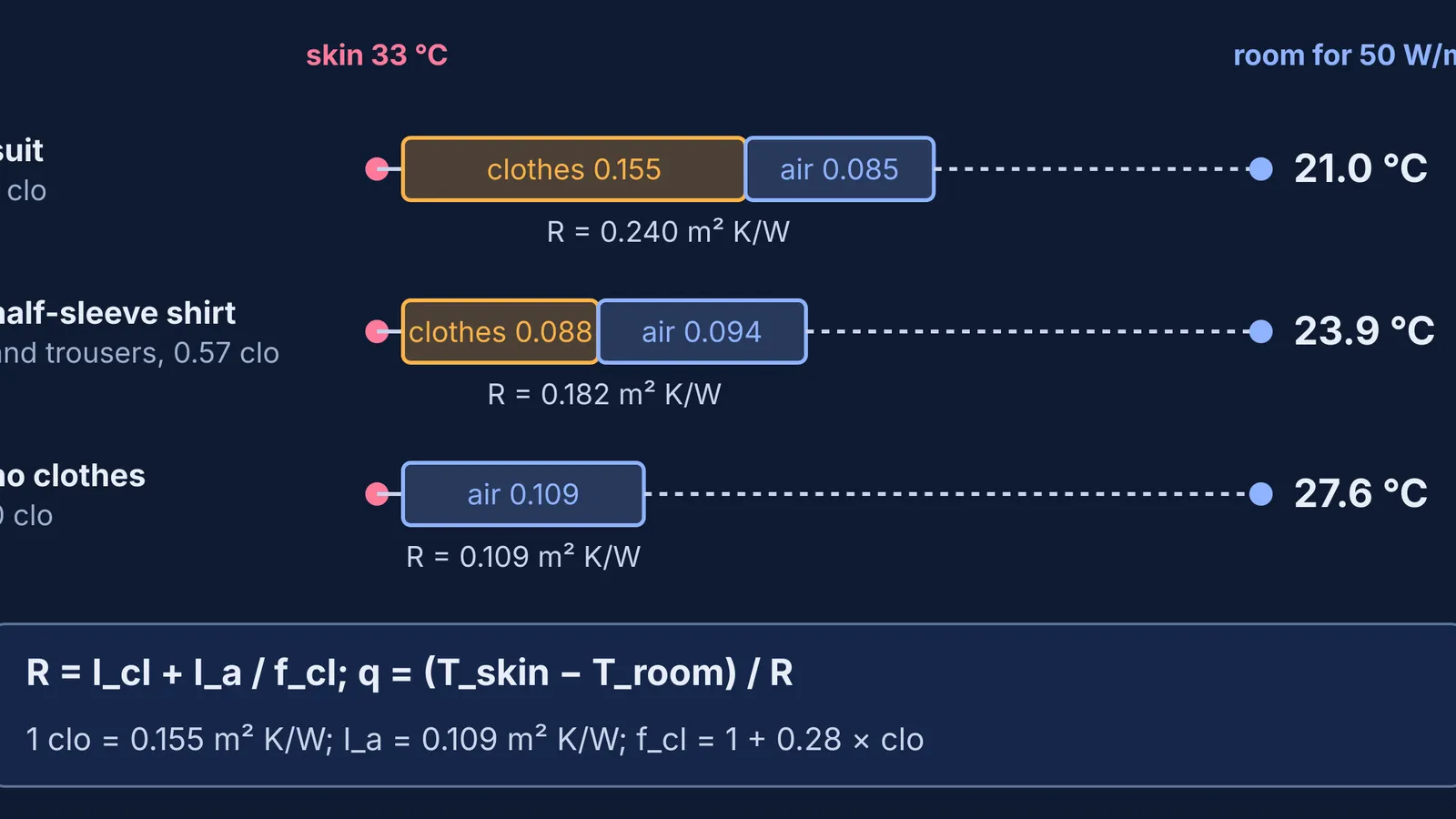
Assume a person sitting quietly with a mean skin temperature of 33 °C who needs to shed 50 W/m² as dry heat (by conduction, convection and radiation) to feel neutral. Both numbers are illustrative round values chosen for the sum; real values vary with the person and the activity. Find the room temperature that makes q = 50 W/m² for three outfits.
Outfit A: 1 clo (about a suit).
I_cl = 1 × 0.155 = 0.155 m² K/W.
f_cl = 1 + 0.28 × 1 = 1.28.
I_a/f_cl = 0.109/1.28 = 0.085 m² K/W.
R = 0.155 + 0.085 = 0.240 m² K/W.
T_skin − T_room = qR = 50 × 0.240 = 12.0 K, so T_room = 33 − 12.0 = 21.0 °C.
Outfit B: 0.57 clo (trousers and half-sleeve shirt).
I_cl = 0.57 × 0.155 = 0.088 m² K/W.
f_cl = 1 + 0.28 × 0.57 = 1.16, so I_a/f_cl = 0.109/1.16 = 0.094 m² K/W.
R = 0.088 + 0.094 = 0.182 m² K/W.
qR = 50 × 0.182 = 9.1 K, so T_room = 33 − 9.1 = 23.9 °C.
Outfit C: no clothes.
I_cl = 0, f_cl = 1, so R = I_a = 0.109 m² K/W.
qR = 50 × 0.109 = 5.45 K, so T_room = 33 − 5.45 = 27.6 °C (27.55 before rounding).
Check the units: (W/m²) × (m² K/W) = K. Good.
From 1 clo to 0.57 clo, the comfortable temperature rose by 2.9 K, about 6.7 K per clo. The ASHRAE 55 addendum linked above gives a rule of thumb of about 6 °C per clo for near-sedentary work, so this simple model lands close to the standard.
Why does the still air layer matter so much?
For light summer clothing, the air layer is the larger of the two resistances. In outfit B it is 0.094 against 0.088 for the clothes. That is why moving air cools you so quickly: a fan or a breeze thins the still air layer and lowers I_a, so the total R falls even though your clothes have not changed. The same Berkeley notes give ISO 9920's corrections that reduce I_a as air speed and walking speed rise.
Wet clothing works the other way round from what you want. Water conducts heat far better than the trapped air it replaces, so I_cl drops sharply. This is also why woollen clothes keep you warm: the fibres hold a lot of still air, and still air is a poor conductor.
What does this simple model leave out?
Radiation. I_a lumps convection and radiation together, so "room temperature" here really means a temperature that averages air and wall temperatures. A room with cold walls feels cooler than its air temperature suggests.
Sweat and breath. The body also loses heat by evaporation from skin and lungs. The 50 W/m² is only the dry part, which is less than the total heat the body produces.
The body adjusts. Skin temperature is not fixed. When you are cold, blood flow to the skin falls and, if that is not enough, you shiver to produce more heat.
Full comfort models. Standards such as ISO 7730 and ASHRAE 55 use more detailed models that include humidity, air speed and activity.
For more series and parallel heat-flow problems, the Fermi Problem Library has a step-by-step solver that explains the reasoning. If thermal resistance itself still feels slippery, start in the Concept Library.
Quick checklist
1 clo = 0.155 m² K/W, about a business suit.
Clothing and the outer still-air layer are resistances in series: R = I_cl + I_a/f_cl.
Heat flux q = ΔT/R, the thermal version of I = V/R.
With q = 50 W/m² and skin at 33 °C: 1 clo needs about 21.0 °C, 0.57 clo about 23.9 °C, no clothes about 27.6 °C.
The air layer (0.109 m² K/W in still air) never goes away, and wind thins it.


