

On this page
In winter, slipping into a woollen sweater is the first line of defence against the cold. But how exactly does a piece of knitted yarn keep you comfortable? The short answer is that it does not generate warmth—it simply prevents the heat your own body generates from escaping into the environment.
The physics behind this is a classic topic in Class 7 Science, and it comes down to heat transfer, insulators, and the surprising power of empty space.
Why do woollen clothes keep us warm in winter?
Heat naturally flows from a warmer object to a colder one. In winter, your body is significantly warmer than the surrounding air. Without a barrier, heat leaves your skin rapidly through conduction, which is the direct transfer of thermal energy between substances that are in contact.
Wool works as an effective barrier through two main mechanisms:
Poor conductivity of the fibre: The material of the sheep wool itself is a poor conductor of heat.
Trapping dead air: Wool fibres are naturally wavy or crimped. When they are spun and knitted into a garment, these kinks create millions of microscopic pockets that trap still air.
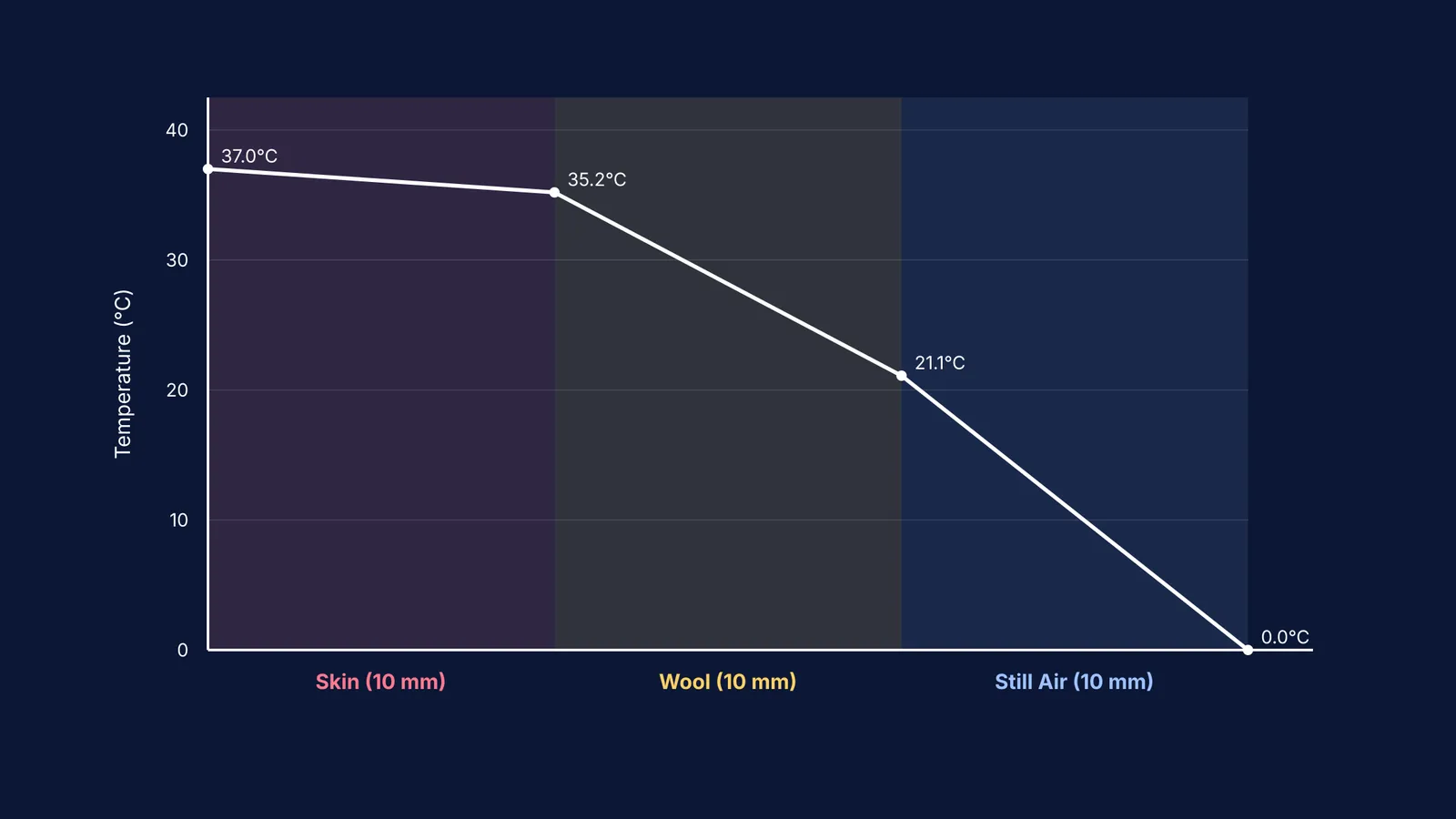
Air is one of the best natural insulators available. Because it is trapped in small pockets, it cannot move freely, which stops convective heat loss. Instead of losing heat to the freezing winter air, your body heat warms up these trapped pockets of "dead air", which then sit against your skin and provide a warm buffer.
What is thermal conductivity?
To understand why trapped air is so important, we can look at the thermal conductivity (k) of different materials. This value measures how easily heat passes through a substance.
According to data from the Engineering ToolBox, the thermal conductivity of still air at room temperature is roughly 0.026 W/(m·K). Sheep wool itself has a slightly higher conductivity of 0.039 W/(m·K). Because the conductivity of still air is lower than the solid wool fibres themselves, the air trapped inside the sweater is actually doing more of the insulating work than the yarn.
For comparison, a good conductor like solid metal has a much higher thermal conductivity. This is why a metal park bench feels freezing in winter—it rapidly conducts heat away from your body, while a woollen blanket actively resists that flow.
Why is air such a poor conductor of heat?
The reason still air insulates so well lies in its molecular structure. Conduction requires atoms and molecules to collide with their neighbours to pass along kinetic energy.
In a solid metal, atoms are packed tightly together and free electrons can carry heat energy swiftly across the material. In a gas like air, however, the molecules are spaced far apart. Because there is so much empty space between them, collisions are infrequent. This physical distance makes it incredibly difficult for heat energy to travel from one side of an air gap to the other purely through conduction.
If air is a poor conductor, why does a cold breeze chill us?
If air is a natural insulator, you might wonder why standing outside on a winter day feels so cold. The answer is convection.
When your body warms the layer of air immediately next to your skin, that warm air expands, becomes lighter, and rises. Cold air rushes in to replace it, continuously stripping heat away from you. If there is a wind, this process happens even faster.
This is where wool's structure becomes vital. By trapping air in millions of tiny compartments, wool prevents the air from moving. It stops convection completely, forcing heat to travel only by conduction—which, as we know, air is very bad at doing.
Why are two thin blankets warmer than one thick blanket?
This is a classic question that appears in science exams. The answer relies entirely on the principle of trapped air.
When you use two thin blankets, a layer of air is trapped between them. Since still air is a poor conductor of heat, this extra layer provides better insulation than a single thick blanket of the same total weight and material. The more layers of trapped air you can create between your body and the cold environment, the warmer you will stay.
Visualising heat transfer
When studying thermodynamics for exams, you will calculate the time for ice to form on a pond or measure heat in isobaric and isochoric processes. Students often memorise the phrase "wool is a poor conductor of heat" without picturing the mechanics of how molecules interact.
If you struggle to visualise how heat flow is blocked by microscopic air pockets, the Fermi Simulation Lab can help. By using interactive simulations for the ideas that are easier to see than to read, Fermi's AI tutor lets you explore the physics intuitively, noticing where you are stuck and explaining the reasoning step by step.


