

On this page
Chemical coordination looks like a list to memorise, but many lost marks here come from a fact stored the wrong way round. Each slip below is checked against NCERT's Class 11 Biology book, Chapter 19, Chemical Coordination and Integration (kebo119, Reprint 2026-27). The NMC's NEET (UG) 2026 syllabus covers this chapter as "Chemical coordination and regulation", one topic of Unit 5 (Human Physiology).
This is a study summary, not medical advice.
Which look-alike names get swapped?
"Glucagon turns glucose into glycogen; the two names nearly match."
Why it happens: glucagon and glycogen differ by a few letters, so the hormone inherits the storage job.
What NCERT says (19.2.8): glucagon comes from α-cells and works mainly on liver cells, where it drives glycogenolysis (breaking glycogen down) and gluconeogenesis. Blood sugar rises, so NCERT calls it hyperglycemic. Building glycogen from glucose, glycogenesis, is credited to insulin from β-cells.
Check: fill the gaps. Insulin drives glycogen-______; glucagon drives glycogen-______. (-esis; -olysis.)
Habit: on the glycogen stem, -genesis builds and -lysis breaks; glucagon goes with glycogenolysis, insulin with glycogenesis.
"LH is a female hormone, so it has no role in males."
Why it happens: "luteinizing" points to the corpus luteum, so LH gets filed under the ovary alone.
What NCERT says (19.2.2, 19.2.9): LH and FSH are both gonadotrophins. In males, LH stimulates the testis to make and secrete androgens, and FSH works with androgens to regulate spermatogenesis. In females, LH triggers ovulation of mature follicles and keeps the corpus luteum going. Inside the testis, the Leydig (interstitial) cells are the ones that produce androgens.
Check: if a man's pituitary stopped releasing LH, which hormone group from the testis would NCERT's account lead you to expect to fall, and which cells make it? (Androgens, mainly testosterone; Leydig cells.)
Habit: for every gonadotrophin, write one male line and one female line.
Where is the hormone actually made?
"Erythropoietin is made wherever red blood cells are made."
Why it happens: the hormone gets placed where its effect shows up, so source and target merge.
What NCERT says (19.3): the juxtaglomerular cells of the kidney produce erythropoietin, a peptide hormone that stimulates erythropoiesis. The chapter also ties other hormones to red cell formation: thyroid hormones support it (19.2.4), and cortisol stimulates RBC production (19.2.7).
Check: cortisol, thyroid hormones and erythropoietin all support RBC formation in this chapter. Pair each with the organ that makes it. (Adrenal cortex; thyroid; kidney, from its juxtaglomerular cells.)
Habit: write the source and the target as two separate words, every time.
"Everything the adrenal gland releases is a steroid."
Why it happens: cortisol is a steroid, and the label spreads to the whole gland.
What NCERT says (19.2.7, 19.4): the adrenal has two tissues. The outer cortex secretes corticoids, and NCERT calls the glucocorticoids steroid hormones (19.2.2); it also releases small amounts of androgenic steroids. The central medulla secretes adrenaline and noradrenaline, the catecholamines, and NCERT places epinephrine in a different chemical group: amino-acid derivatives. Our adrenal cortex vs medulla guide lays the two tissues side by side.
Check: a revision card reads "Adrenal hormones, all steroids: cortisol, androgenic steroids, epinephrine." Strike the entry that does not belong and name the adrenal tissue it comes from. (Epinephrine, an amino-acid derivative; the medulla.)
Habit: split the adrenal into cortex and medulla before you name any chemical class.
Which way does the hormone push?
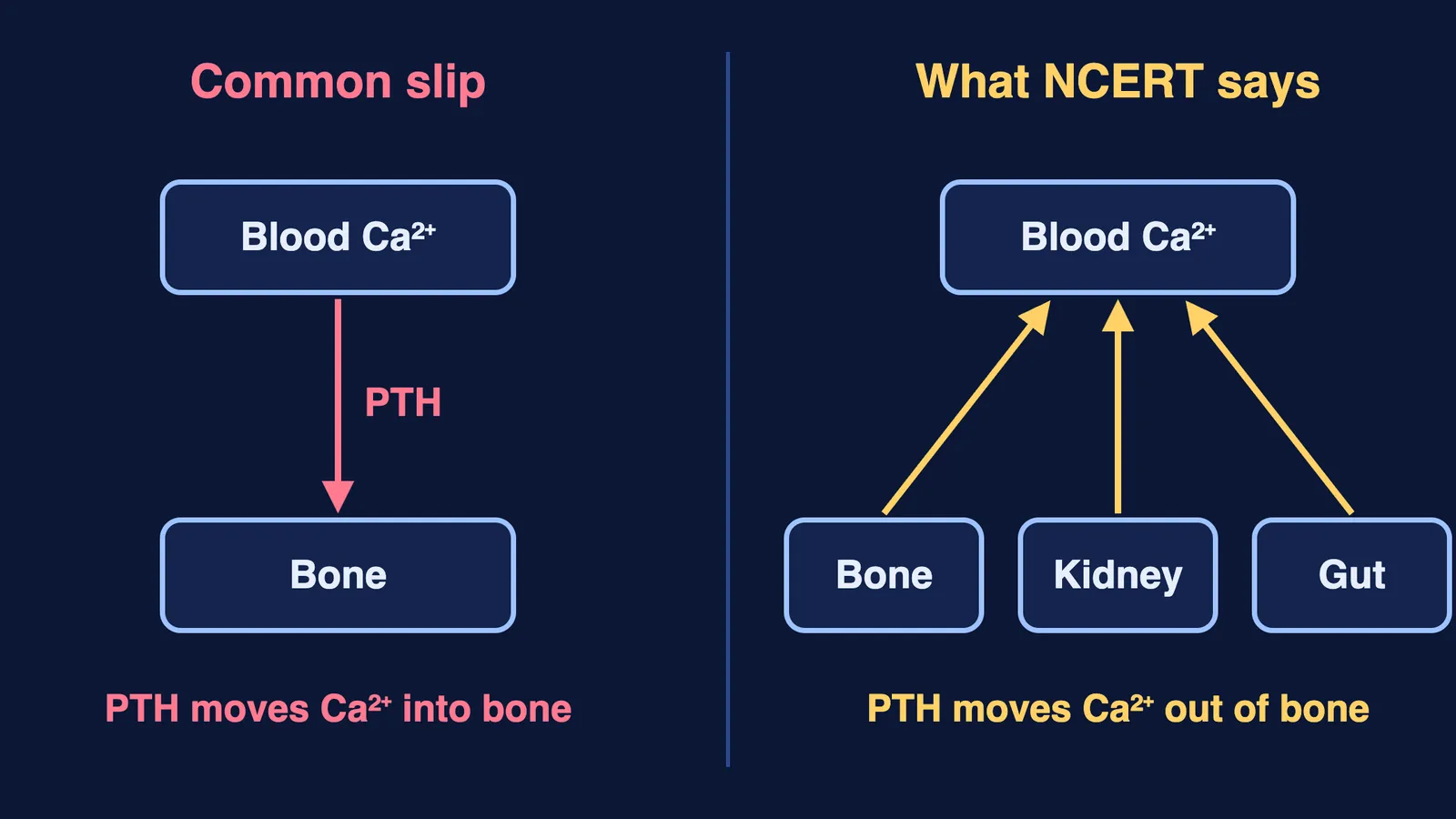
"PTH builds bone, because it is the calcium hormone."
Why it happens: calcium means strong bones, so a calcium hormone must lay calcium down.
What NCERT says (19.2.5): PTH increases blood Ca2+. It stimulates bone resorption, which NCERT glosses as dissolution or demineralisation, raises Ca2+ reabsorption by the renal tubules and raises Ca2+ absorption from digested food. That makes it hypercalcemic. Thyrocalcitonin from the thyroid is the one that lowers blood calcium (chapter summary).
Check: when PTH rises, does calcium move from bone into blood, or from blood into bone? (Bone into blood.)
Habit: follow the calcium, not the label; ask where the Ca2+ ends up.
"Aldosterone makes the kidney get rid of sodium."
Why it happens: students remember that aldosterone handles Na+ and K+, then flip which one is kept.
What NCERT says (19.2.7): aldosterone, the main mineralocorticoid, acts mainly on the renal tubules. It makes the tubules take back Na+ along with water while sending K+ and phosphate ions out, and through this it helps keep electrolytes, fluid volume, osmotic pressure and blood pressure in balance.
Check: under aldosterone, which two ions go out in the urine, and which ion is kept along with water? (K+ and phosphate go out; Na+ is kept.)
Habit: learn it as one line: sodium and water in, potassium and phosphate out.
"Cortisol strengthens the immune response."
Why it happens: cortisol keeps many body systems running, so students assume it supports defence too, and mix it up with thymosins.
What NCERT says (19.2.7, 19.2.6): glucocorticoids, particularly cortisol, produce anti-inflammatory reactions and suppress the immune response. The hormones NCERT ties to stronger immunity are the thymosins, which drive T-lymphocyte differentiation and promote antibody production.
Check: sort into "raises immunity" or "damps immunity": thymosins, cortisol. (Thymosins raise; cortisol damps.)
Habit: give each hormone an immunity arrow, up or down, on your gland card.
Does a hormone act on every cell it reaches?
"Once a hormone is in the blood, every cell responds to it."
Why it happens: blood reaches every tissue, so delivery gets confused with action.
What NCERT says (19.4): a hormone works by binding specific receptor proteins found only in its target tissues, and each receptor is specific to one hormone. Hormones on membrane-bound receptors usually stay outside and act through second messengers; those on intracellular receptors mostly act on gene expression.
Check: a hormone in the blood passes cells P and Q, but only P's metabolism changes. What does P carry that Q lacks? (A receptor specific to that hormone; NCERT places these in target tissues only.)
Habit: name the target tissue before you name the effect.
A 60-second self-check before you mark
To plan the rest of the unit, use our Human Physiology for NEET chapters, traps and study plan.
Not sure which of these slips is yours? Fermi's AI tutor works out what you already know and builds a plan for the session.


